Concrete Decor Archives

Formliners used in Four Gateway Plaza

Concrete Form Liners: Function & Beauty
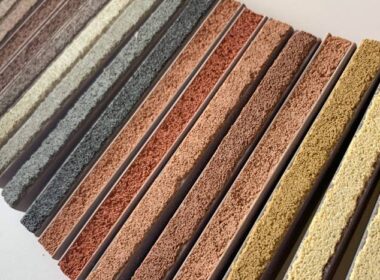
Form liners give texture and design to vertical concrete, just as stamping mats create patterns on flatwork. Custom-made form liners, usually made from urethane, can create patterns from leaves to fossils and more on concrete walls.
by Amy Johnson

One of the greatest advantages of working in concrete is its versatility. When viewed as an artistic medium rather than simply a construction component, the material offers infinite possibilities for creativity. Many tools for expressing this creativity have been around for a long time, but they are finding new uses. One proven system receiving renewed attention is form liners.

Form liners are essentially molds for giving texture and design to vertical concrete surfaces. Dana Scott, marketing director of Scott System, Denver, Colo., describes form liners as "a reverse stamp." Instead of pouring the concrete and applying a texturing tool, the tool (the form liner) is attached to the form and concrete poured onto it.

Form liners have been widely used for years to beautify otherwise ordinary structures such as highway walls, sound barriers, bridge supports and retaining walls. This market continues to grow as more and more communities demand beauty as well as functionality from their highway systems. In many cases, budgets for these projects include a required amount for art, a requirement that can be met with form liners.

Municipal structures like picnic pavilions, pumping stations and restrooms are often constructed with concrete because of its longevity and ease of maintenance. However, more communities are now demanding that these structures be aesthetically pleasing as well as functional. As Isaac Sparks of Hunt Valley Contractors Inc., in Owings Mills, Md., explains, "Nobody wants an eyesore in their backyard." Form liners offer a practical technique for beautifying even these mundane structures. Sparks estimates using architectural concrete adds just 2 percent to 5 percent to the cost of the finished project.

In addition to traditional uses in roadways and public buildings, contractors and designers are starting to see new opportunities for using form liners in commercial projects, residential construction and landscaping.

 
This Issue
Concrete Decor, Vol. 6, No. 2
April/May 2006
Concrete Decor, Vol 6, No 2
 

Stay informed!
Enter your e-mail address
and subscribe to the
Concrete Decor Newsletter.


Related Readings
Concrete Steps
Coloring Stamped Concrete
Hot Weather Stamping
Secrets of Better Concrete Stenciling
From Slump to Stamp
Stamping Decorative Concrete, Stamp Mats
Concrete Art and Decorative Forms
Stamping Concrete Overlays
Decorative Concrete Stamping Basics
Stamping Curves In Decorative Concrete

Other articles in this issue
Get Creative with Shotcrete
Concrete Overlays on Wood
Admixtures & Integral Colors
Form Liners
Decorative Concrete Steps
Technology: Ductal
Artisan: Masterpiece Concrete
Technique: Stamping Overlays
Project Profile: Pattern-Crete
Business Strategies: Warranties
Tooling: Portable Mixers
Product News
Letters to the Editor
Final Pour: Natural World
Concrete Industry News
Concrete Association News