
Polymers aren’t as colorful as pigments, acids and other raw materials used in decorative concrete. But because they help thin cemetitious toppings hold together, they are just as important.
Decorative concrete is both an art and a science, and nowhere is that more true than in the case of thin overlays and toppings. The art lies in the palette of finishes and designs that make old, worn concrete look bright and new and different. The science lies in the chemistry that makes these toppings possible.
“Thin toppings” in this case means cementitious overlays applied at a depth of 1 inch or less — sometimes as thin as 1/16 inch — over an existing slab. While they have the look of regular concrete, they are not formulated in the same way. “Standard concrete has no strength at that depth,” explains George Henderson, president of PermaCrete/Quality Systems Inc. “It depends on its mass for strength, so it must be 2 inches thick, at least.”
Steve Crast, technical director for Crossfield Products, adds: “Traditional cementitious materials depend on alkali silica reactions and hydration of cement. Minimal thickness is difficult to achieve without shrinkage or cracking. Bonding is also a problem.”
Enter polymers — chemical molecules linked in chains that change the strength, elasticity and adhesion of any formulation to which they are added. “ ‘Polymer-modified’ is a term used to describe cementitious products that have both an inorganic binder and a polymer modifier that work together to impart special properties that cannot be achieved by cementitious systems without polymer modifiers,” says Stan Stratton, director of technology development for L.M. Scofield Co. “The inorganic binder is most often portland cement, and the polymer modifier is either a dry, redispersible polymer or a polymer latex.”
When a traditional concrete mix is formulated with a polymer, the resulting material can be stronger or more flexible, depending on the polymers used and their ratio to cement in the mix. “Polymer modification of cementitious materials affords more control of final set-time properties, strengthening of the mix, enhancement of physical properties and longevity,” Crast says.
The advantages for concrete are clear. Now a formulator can manipulate the mix to deliver the most desirable attributes for a given application, delivered in a thin overlay that improves the look and performance of the underlying concrete without tear-out or significant buildup.
Polymers also improve the adhesion of a topping. “Polymer additives form a chemical bond with the underlying surface so the topping won’t delaminate,” Henderson explains. “Regular concrete offers only a mechanical bond.”
Latex polymers
Pioneering efforts to modify concrete were made with natural rubber latex as early as the 19th century. Today, the most familiar toppings for decorative applications are modified with synthetic latex polymers: styrene butadiene rubber, polyvinyl acetate or acrylic. SBR has long been used as a general-purpose cement modifier. Noted for water resistance, it is often used in countertop formulations. However, a tendency to discolor under UV exposure makes SBR-modified concrete toppings less attractive for exterior applications.
Acrylic has good weathering characteristics and provides increased work time compared with other polymers. Acrylic also imparts the highest physical strength of the three polymers. “Acrylic is a very hard resin,” says Brian Farnsworth, assistant director of technical services for Bomanite Corp. “Acrylic-modified toppings improve wear resistance in high traffic areas. They are less likely to show dents or damage from wear from, for example, a rolling chair.”
The downside of this hardness is rigidity. Toppings modified with acrylic polymers perform best in interiors or mild climates where they are not subjected to temperature extremes.
Mike Ferraro, owner of Decorative Coatings and Concrete Co., based in Aurora, Colo., says another advantage of acrylic-modified toppings is water-vapor permeability. “Acrylic cement is breathable. Moisture comes through the concrete below and breathes out so the topping won’t delaminate.”
Vinyl acetate is the most flexible of the polymers used to modify concrete for cementitious toppings. This, along with inherent water resistance, makes it a good choice for exteriors in climates that see extreme freeze-thaw cycles. Toppings modified with vinyl acetate can flex without cracking during thermal expansion and contraction.
Daniel Owen, vice president of Arizona Polymer Flooring, believes the choice of materials often comes down to personal preference. “Acrylics set faster and get harder, which makes them more difficult to stamp,” he says. “Vinyl acetate has a longer pot life, and we can make a 1/4-inch stampable overlay with it.”
A technical bulletin published in 2001 by Arizona Polymer Flooring states: “Our research and development efforts showed that a blend of acrylic and vinyl acetate ethylene produced a modifier that maximized the properties we sought — strength, flexibility, adhesion and weatherability.”
Epoxy- and urethane-modified concrete
Decorative concrete toppings are modified with latex polymers, but there are large industrial and commercial markets for polymer-modified cementitious toppings based on epoxy and urethane resins. While they can accept integral colors, the chemistry of these materials is too complex to formulate them for staining or other decorative techniques. Aesthetics can be improved by techniques such as broadcasting quartz chips, but generally these epoxy- and urethane-modified cementitious toppings are designed and used for their physical attributes, not their appearance.
“Urethane cements are among the most popular in the market and have excellent performance properties for high impact, thermal shock and chemical resistance,” says Robert Cain, president of Key Resin Co. “They are used prominently in food plants, dairies, kitchens and so forth.”
“Epoxy-modified concrete is a little easier to install and handle because it is more trowelable than urethane-modified concrete,” observes Ron Borum, executive vice president of Crossfield Products. “This is a newer technology just starting to get traction in the market.”
The choice between epoxy and urethane-modified cements is dictated by experience and personal preference, supplier recommendation, and cost and criteria for the project. Cain says that polymer-modified toppings are generally less expensive then such competing materials as epoxy mortars or 100-percent-solids resinous materials.
When only a topping will do
Modifying cementitious mixes with polymers makes it possible to apply the material in a thin topping and still get long-term performance. This makes them attractive for several applications. Toppings and overlays fill the bill when renovation or repair is required but concrete cannot be removed. This happens, for example, when concrete is cut out for a new plumbing run. Even though the concrete is repaired and integrity restored, the only way to restore the appearance is with a topping.
Sometimes a topping is applied just to get a new look. And thin toppings are attractive for interior renovation because they don’t interfere with existing features like doorjambs. In new construction, toppings are used where a 2-inch concrete slab would not be workable. They can also be used as part of a moisture suppression system.
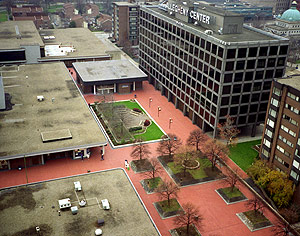
Polymer-modified cementitious toppings have another advantage over traditional concrete. George Henderson explains that because polymer chains tend to fill in material voids, toppings are less much porous than concrete. This means that dirt and other contaminants sit on top instead of penetrating, making polymer-modified topping surfaces easier to clean effectively with mild detergents and pressure-washing. Henderson even recommends cleaning driveways with a simple household cleaner and a hose. He cites as an example an 111,000-square-foot outdoor pedestrian plaza in Pittsburgh with a polymer-modified topping installed in 1990. “It looks like new,” he says. “We just pressure-wash the chewing gum off and put on a light coat of colored sealer every few years. A topping like this with high cement and high polymer content can go on indefinitely.”
Polymer-modified cementitious toppings are supplied in self-leveling or trowelable formulations. “Self-leveling toppings are slurries the consistency of pancake batter,” says Cain. “They are spread with a gauge rake or notched trowel and allowed to self-level.”
Self-leveling polymer-modified products help with fast-track construction, Farnsworth says. “These products are generally used to level a surface and finish all in one application.”
“The advantage of self-leveling over troweled toppings is speed and efficiency of application,” Ron Borum says. “However, most are limited to interior use and cannot be used over wood or other deflecting substrates, nor can they be used vertically. They are not suitable for texturing. Most need to be sanded, which makes them less efficient for stained decorative finishes.” Borum also recommends use of a primer with self-leveling toppings.
Stratton points out that self-leveling toppings are helpful on interior floors that need to be level so that cabinets and shelves stand straight. “Normally, exterior concrete is sloped slightly to facilitate water drainage in the right directions,” he says. “The slope requirement precludes the use of toppings that are self-leveling for exterior applications. Most of the self-leveling products in the marketplace also do not have enough durability to perform satisfactorily in weather-exposed areas.”
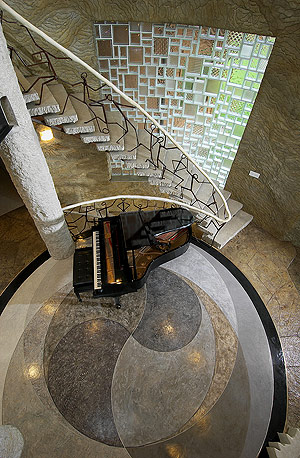
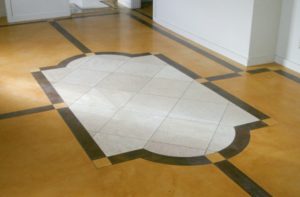
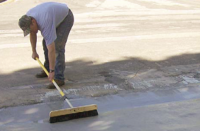
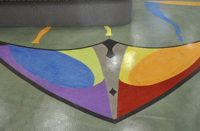
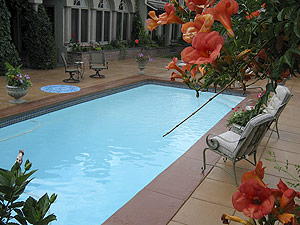
Troweled toppings are generally thicker and may be used on horizontal or vertical surfaces. While they require more labor, they open up more decorative possibilities. Besides stains or dry-shake powders, various texturing finishes may be used. Many trowelable toppings can be stamped or stenciled. Trevor Foster, Miracote sales manager and head trainer for Crossfield Products, offers a list of finishing materials that can be appropriate: pool and finish trowels, texture mats, rollers, brooms, squeegees, notched trowels, sponges, foam rollers, plastic, carving tools and chisels, antique rakes, cheesecloth, spiked rollers and even the human hand. Mike Ferraro once used a paint roller to roll a cementitious topping onto a pool deck to change the color. “It looks and feels more like concrete than paint, because of the cement.”
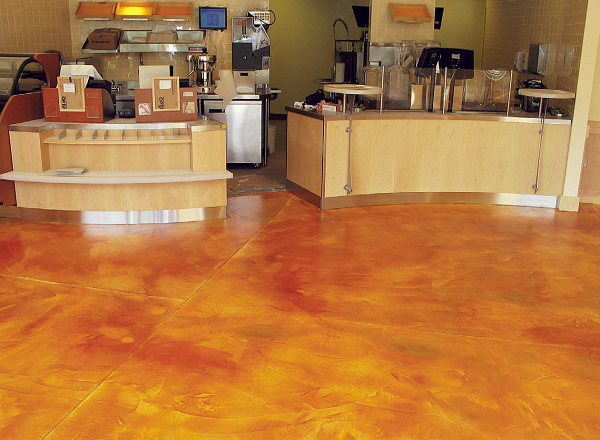
It was this opportunity for artistic expression that lured Mac Gordon, owner and general manager of Concrete Solutions Plus, in Louisville, Colo., out of the floor maintenance business and into decorative concrete. After 22 years of cleaning and detailing old floors, he converted his janitorial service into a decorative concrete business focused on decorative overlays, staining and industrial coatings, including epoxies, polyurethanes and polyaspartics. He says whether concrete has been discolored, vandalized or repaired, polymer-modified cementitious toppings do the job. “You can take the oldest, nastiest concrete and put a microtopping on it to get a nice fresh surface to work on. You get a fresh start and everybody’s happy. You can integrally color it, stain it, dye it, or leave it natural. There are a hundred things you can do with it.”