



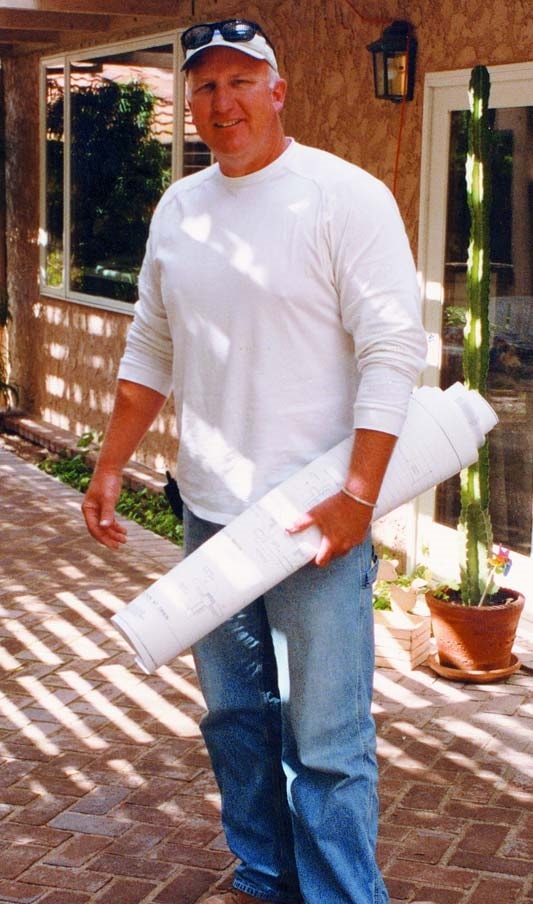
Rick Smith, owner and president of Richard Smith Custom Concrete of West Hills, California, subscribes to a business maxim. He believes it is crucial to the success of any contractor business, or, in fact, any business. “Do more listening and less talking.”
“It all boils down to honest and open communication,” he says. “People would just try to keep their mouths closed and their ears and eyes open more often. There’s virtually nothing that can’t be done. We all need to do a better job of listening to our clients.” (That advice would probably save many marriages as well!)
Not that you should stop talking entirely, however. The ability to clearly communicate your ideas, your strengths as well as your weaknesses, and your concerns about a given project are also very important, Smith adds.
“Anything can be achieved as long as everybody’s honest at the table — honest about what they want, what they know what they don’t understand. Instead of the proverbial poker game that takes place at the beginning of too many projects, wouldn’t it be more beneficial to all parties involved if the ‘game’ were to be played ‘open-handed’? Lay your cards on the table and dispense with the posturing.”
His Success
In his 20 years in the concrete installation business, Smith has been involved in more than his share of successful projects, from 20-square-foot residential patios to 200,000-square-foot malls. He’s also seen a few projects that were less than successful, and in nearly every case, he believes this was due to communications failure. “There are many ways for communications to break down,” he points out. “The client may be unclear in conveying what he wants. The designer and architect may not fully appreciate each other’s area of concern. The contractor may fail to admit his lack of experience with the type of application the project requires. The budget and its flexibility, may not have been discussed sufficiently. Any of these will decrease the likelihood of having a satisfied customer at the project’s end.”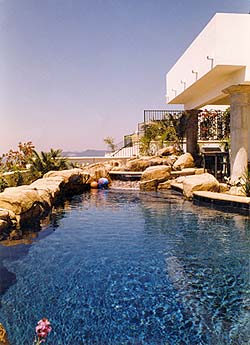
Nurturing the relationships between the key players on any concrete job — the owner, the architect, the designer and the contractor — is crucial to achieving successful results, says Smith. “Every project has its key players, and those players, as controlling as they might be, are constrained by the progress of the project itself. Each has his or her own agenda and level of understanding within their area of expertise. For example, many clients are very precise about what they envision the project should look like upon its completion, but too many are rather vague about what they want. In those cases, it’s up to the contractor to probe for more information, or show samples of products and applications, that might help the client identify and communicate their wishes.”
A Balance Between Structure and Aesthetics
Meanwhile, the architect, who has a tremendous liability on a given project, is keenly interested in the nuts and bolts: load-bearing values, thickness, weights, UV exposure concerns and ADA issues. The designer, on the other hand, has an interest in creating an atmosphere through design elements such as color, texture, size and placement. “All projects need the architect as well as the designer,” notes Smith. “It’s our duty, when working with a designer, to compassionately convey the structural requirements during the design process, while at the same time taking intro consideration the design aspects when speaking to the architect. After all, the architect and designer share the common goal of creating a finished product based on the client’s vision. It takes a tremendous amount of courage and patience — and communication — to design toward the client’s dream, and to feel confident that the other key players have the knowledge to achieve that dream.”
The concrete application specialist’s responsibility is to assess the variables, learn the client’s desired concept, and communicate them to the architect and designer, Smith says. “It takes a lot of patience and a lot of time to really listen to people and try to understand exactly the language they’re speaking. The successful contractor is, in effect, a translator who is fluent in the multiple languages spoken by the project’s key players.
One of the certainties I’ve discovered about concrete is this: Everything you construct takes a significant amount of orchestrating and networking, with the involvement of talented people, in order to get great results. No way is this a one-man job. Those who say they’re in business by themselves are immediately labeling themselves as not as good as they claim to be.”
Preparation is Critical
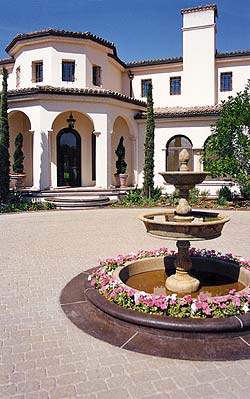
Another rule of a successful business, Smith maintains, is the same as the Boy Scouts’ motto: “Be prepared.” “Concrete is one of a very few things on this planet that is unstable and has a life of its own. Concrete is a volatile material. It tells us what it’s going to do; we do not dictate what we want it to do. We can add all the chemicals, reinforcing agents, retardants and accelerants, but sooner or later, it’s going to blow up on you. It’s going to fail. So, you have to prepare yourself, not only with what you’re specifically trying to do, but for any eventuality because concrete has so many variables. Do you have enough iced water on hand? Do you have extra manpower? Are all the necessary tools on site? What if the weather changes for the worse? Preparation is the key.”
Smith, whose father was in construction, worked in concrete after high school, but he found it to be very difficult work. So, instead he chose to pursue his dream to become a fireman or paramedic. “I had a calling to help people. I really wanted to do my part in helping our society. Having the honor of working as a volunteer with several local fire departments in California was wonderful. Things so awful you can’t describe them, and I was quick to learn I wasn’t cut out for that. I don’t have thick enough skin to see the things these firemen see nearly every day.”
New Attitude
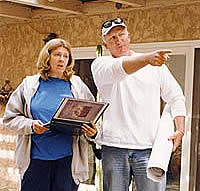
He decided to get back into concrete, but adopted a new attitude. “I decided I wanted to do it better and be more inspiring and more passionate, than anyone else out there. One way to do that was to not lock myself in a bubble. I didn’t do just stamped concrete. We would try new applications, experiment with them in research and development, and broaden our palette. We started doing small patios, and then got into foundations, then walls and hardscapes, and eventually the decorative, artistic side of the business, including concrete sculptures and countertops. Our way is to try to take it to the next level, to see if we can improve on it.”
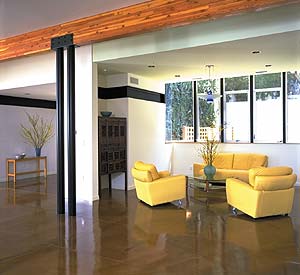
Smith employs 18 people and, he says, “We’ve never been without work. We’ve never really had a recession because we diversify. There seems to always be concrete work around, and the recent popularity of the decorative stuff is great. I think it’s because the new-age designers coming out of school. They have now opened their eyes to applications that old-school thinking wouldn’t permit. For interior projects, for instance, instead of always using hardwood or carpet or tiles, they have seen how concrete can have a warm element. A sense of elegance as well as a sense of old-world renaissance.”
Be passionate about your work
One more key characteristic of a successful concrete contractor, Smith believes: passion. “We try to turn up the enthusiasm, especially when a project appears simple or mundane. We do our best work when the client is passionate about the project, and we share or mirror that passion. Whether it’s a government library building or a homeowner’s back pool deck, we live for the passion. If it’s a residential customer, chances are it was a flip of the coin. Are they going to do this extensive project or go to Jamaica for a vacation? We won out, so we strive to make their choice equally enjoyable.”
Smith thinks the future looks bright for his company as well as his industry. “If the industry holds integrity and people do high-quality work, there’s no end in sight. As for our business, we intend to maintain the nice conservative growth that we’ve been experiencing. Instead of that explosive growth others shoot for. We want small growth so we can maintain communication and passion. When a prospect or client calls, answer the phone. Return the message. Listen. Be enthusiastic. Treat everyone equally no matter the size of the project. Those are the kinds of things I want to maintain.”
He concludes, “You have to like what you do. I think have the greatest job in the world. Basically, we take unskilled labor, a material that can blow off on us at any time. Plus clients that really don’t know what they want, and then use the information to achieve a dream. It’s a wonderful challenge, and it inspires hope to give the chance to reach out and do something right.”