Welcome to Concrete Decor Magazine Online,
The Journal for Professional Concrete Contractors
   
 
ADVERTISEMENTS
 
Concrete Decor Archive — Artisan in Concrete
pg 2 of 2
Lokahi Stone


...continued from previous page

Lokahi Stone, Honolulu, Hawaii
Inspired by Fu-Tung Cheng’s landmark book, “Concrete Countertops,” Andrew Simon and Jamie McGuire quit their corporate jobs and went into business for themselves in Honolulu in 2003.

Do you prefer cast-in-place applications or casting off site?
I don’t really have a preference, but most of our work is cast off site in our studio. This method allows for greater quality control, versatility and expression. Forms can be made in the studio that are impossible to make on site, where most pieces are finished with a trowel. Three-dimensional works — inlays, drain-boards, bowls, et cetera — are more easily achieved and more beautifully executed in our studio.

Lokahi StoneThat said, you can’t beat the massiveness of a large, poured-in-place, monolithic piece. However, that look does not come without a cost. Poured-in-place work requires a client who is willing to have forms, workers and a mess in their home for a while. If at all possible, large monolithic pours should take place when construction is in its early stages.

Often, our poured-in-place walls and surrounds are topped with off-site cast counters — the best of both worlds.

Do you literally break the mold after every piece is done?
We actually do break the molds each time. No two pieces are exactly alike, and no two molds are alike. Our clients like knowing that their pieces are one of a kind, and we like providing a product that is as much art as it is functional —functional art, in other words.

We know you do a lot of acid staining and integral coloring. Do you ever use dyes or acrylic stains?

We haven’t done a lot of experimenting with dyes and acrylic stains. I think that’s because, in our minds, the colors and effects do not mimic nature. They’re too flashy. I guess this is an area we need to explore some more.

How do you create those petroglyph inlays?
The petroglyphs we use are bronze replicas of actual Hawaiian petroglyphs found around the islands. A local artist forms the images and has them cast on the mainland. We create imagery in brass, stainless steel and bronze, using high-pressure water-cutting and CAD. With this method, any image can be recreated and used as an inlay.

How has Fu-Tung Cheng influenced your work?
Jamie and I have always admired Fu-Tung Cheng’s work, and it was his book “Concrete Countertops” that started this whole venture. Years before starting Lokahi Stone, Jamie purchased a condo and began remodeling. It took the patience of a cabinet maker who let us use his shop (in return for a cabinet contract), and several weeks of “vacation” to produce our first concrete countertop. That countertop is still a beautiful — albeit crude, compared to our more recent works — testimonial of what can be achieved with the right willpower and desire.

Since Lokahi Stone was formed, we’ve had the pleasure of working with Fu-Tung Cheng on jobs here in Hawaii, and sharing the spirit of Aloha with Cheng Design. Likewise, Jamie and I have both advanced our expertise by attending Cheng Design’s seminars and being members of the Cheng Concrete Exchange from its inception.

You guys won the Best Decorative Finishes category in the Cheng Concrete Exchange’s design competition. What’s the story behind your winning counter?

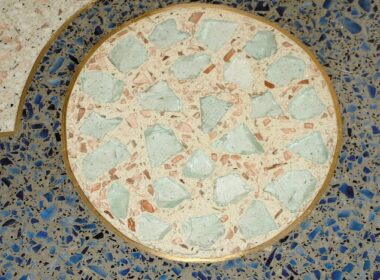
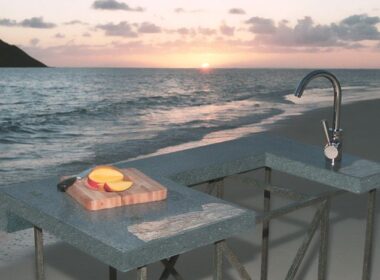
That project was created in association with Building Industry Association of Hawaii’s 2004 home show. The theme of this display was “build green,” and it highlighted many “green” products and energy-efficient appliances. Our counter was made with recycled glass aggregates, discarded marble tailings, and found objects. In our business, you’d be surprised what treasures can be found in the local junkyards! It takes a creative eye to pick out objects that will ultimately make beautiful inlays. Wherever I travel, I keep a keen eye out for interesting objects, from automobile parts to fossils and polished minerals. The sky is the limit.

Here too is an area where the client can play a part in the design process. We’ve had many clients bring their own keepsakes, beach glass, found objects and heirlooms to our shop. Many even want to place them themselves. It really makes a client feel a part of the process, and lets them say, “I helped make it!”

What are your long-range plans?
Our plans include expansion to the islands of Hawaii and Maui, and possibly the West Coast.

What drives you guys to do such beautiful work, and do you consider decorative concrete an art form?

Decorative concrete is definitely an art form. Our clients seek our work because each piece is a unique expression. Artisans, not machines, craft each piece. It is apparent in each work, not unlike the finger marks in handmade pottery or the brush strokes of Van Gogh. Around here, each day holds new surprises. Having spent so many years in the corporate conundrum, where creativity is as desolate as individuality, we needed a change. I’ve always had an unsatiated creative side that decorative concrete fulfills.

 
This Issue
Concrete Decor, Vol. 5, No. 3
June/July 2005
Concrete Decor Vol 5 No 2


Stay informed!
Enter your e-mail address
and subscribe to the
Concrete Decor Newsletter.


Other articles in this issue:
Achieving Success with Integral Color
Rock Features
Applying Sealers
Mixtures & Additives: Using Glass
Polished Perspectives
Artisan in Concrete: Lokahi Stone
Specialty Concrete Products
Tooling: New Stamps on the Market
Final Pour: There’s somethin’ fishy
Decorative Concrete Tips
Industry News
Concrete Association News
Product News
Product Profile


© 2007 Professional Trade Publications, Inc. Unauthorized reproduction of any
information on this site is a violation of existing copyright laws. All rights reserved.