

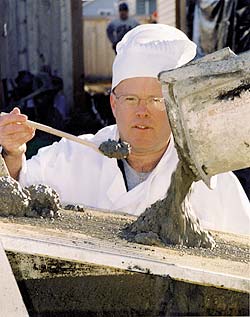
 Determining the best mix design for decorative concrete is like creating a recipe for a gourmet treat. It should take advantage of the best qualities of the various ingredients in it to produce the specific product for your needs. When it comes right down to it, according to Kelly Idiart, vice president of customer service, Central Concrete, San Jose, California, good quality concrete is the same for both decorative and nondecorative applications. Much depends on job site conditions, with their specific moisture levels, subgrades, finishes and cure practices.
More specifically, mix design for decor will vary depending on the region of the country, the site and the type of finish the project will receive, says Ward Malisch, senior managing director of technical operations, the American Concrete Institute (ACI), Farmington Hills, Michigan. On general principles, he says, no one-size-fits-all mix design exists. He suggests that a good mix take into account three elements:
- The properties of the concrete in its plastic state as it comes out of the truck,
- The finished concrete’s strength to withstand loads and its durability to withstand freeze. Also economics — how much it costs.
- If possible, he says, reduce the amount of raw materials used as much as possible while retaining strength and durability.
It all begins with proportion, says Malisch, getting the right ratios of each ingredient. You make concrete with cement and water to form a binding agent. Then add sand and aggregate to provide its substance. Admixtures will provide special qualities. These can include either water reducers of varying capabilities or set modifiers. Finally, air entrainment products and fibers add strength and durability, while color gives a special aesthetic. Each one plays a role in making the concrete both beautiful and long-lasting.
Here’s how:
Cement
The first ingredient in concrete is portland cement, which is typically 10% to 15% of the mix by volume. ASTM C150 lists eight types of cement that offer a variety of performance benefits to concrete. Three of the most common types are Type I, for normal concrete, Type II, offering moderate sulfate resistance, and Type III, for fast-setting and high early-strength applications. Portland cements now come in blends that can meet more than one ASTM specification.
Fly ash, one of the mineral admixtures, can replace from 18% to 20% of the cement in the mix This results in a slower set. Fly ash also tends to decrease early-age compressive strength, but it typically increases late-age strength.
One main advantage of fly ash is that it lowers concrete cost because it is cheaper than cement. According to Don Skundrick, Liniger’s Tru Mix, head of operations, Medford, Oregon, fly ash in decorative mixes reacts with lime to hold down leaching. This can result in unsightly deposits. It is important to note that not all fly ash is suitable for concrete. Improper usage can even cause surface flaking on color-hardened concrete applications.
Water
Water is the catalyst that hydrates the cement and makes the mixture workable. For complete cement hydration, you need a water-to-cement ratio of 0.19 to 0.22. However, to make the concrete workable, the w/c ratio ranges from 0.40 to 0.60.
Slump determines concrete consistency, as it relates to its fluidity or mobility. It does not measure the workability of concrete. Rather, the higher the slump value, the more mobile the mixture. ASTM C143 describes the method to determine the concrete’s slump. Slump should be maintained throughout the pour, and admixtures can be used to do this.
When determining the mix proportions for a cubic yard of concrete, you should first determine the w/c ratio (which relates to the durability compressive strength) and the maximum size of the aggregate. In the absence of historical performance with a given set of materials, ACI 211 provides relational tables and additional information for proportioning a concrete mixture.
“Keeping the water-to-cement ratio right is the No. 1 rule for mix design,” says Skundrick. “Use as little water as possible, as this affects the quality of the concrete.”
The excess of water will cause excessive bleed water as the concrete begins to cure, he says. Thus, the substance will shrink. Using too much water also risks the surface color. You can use superplasticizers and other admixtures in place of water to reduce the amount used.
Aggregates
In decorative uses, the size and shape of aggregates in the mix design are important, says Malisch. Each contractor has an opinion about particle size. Many say it depends on what kind of finish you use.
Here is the conundrum. In decorative, texture and pattern are vital and are affected by the size aggregate used. The deeper the stamped impression, the smaller the stone needed. But the smaller the stone, the more cement needed. Thus, the mixture requires more water.
According to Tom Ralston, president of Ralston Concrete, Santa Cruz, California, using a smaller pea gravel means making up for the reduced solid mass with sand This increases the need for water, thus reducing structural integrity.
While the 3⁄8-inch aggregate promotes clean edges when stamping with rubber or aluminum stamps, he says, using larger angular rock improves strength. The rocks have a better tendency to interlock, reducing cracking. He says the only time a larger aggregate is difficult for stamping is when the aluminum or rubber stamps are used. He suggests using 3⁄4-inch angular aggregate with all polyurethane texture mat stamps to help overcome some of the shrinkage problems.
Skundrick believes that with stamped applications, you should use a smaller 3⁄8-inch rock. You should then compensate with a higher cement content and a 45% aggregate to 55% sand ratio. This is just the opposite from a normal mix. He advises using plenty of matrix to get the detail needed on stamped applications.
Idiart also suggests using a smaller-sized aggregate to help enhance the stamping impression. However, he advises mixing it with a larger size to enhance durability and quality.
Round or water-tumbled rock is seen only in some areas of the country. Many consider it best in exposed designs.
Admixtures
Admixtures can customize just the right mix for a specific job, climate, and site, to control the set and to add durability. ASTM C494 classifies common admixture types. These include water reducers, accelerators and retarders.
Water reducers act as the name suggests. They either lower water demand while maintaining slump or they can increase the slump without additional water. Some provide set control in addition to water reduction and act as either accelerators or retarders.
Different types of water reducers impart different amounts of water reduction. The amount typically ranges from about 3% to 10%. High-range water-reducing admixtures or superplasticizers offer the highest level of water-reducing capability. This typically ranges from 12% to about 25%. Ralston notes that superplasticizers increase slump without adding water.
ASTM C494 defines accelerators as “an admixture that accelerates the setting and early strength development of concrete.” They may or may not provide water reduction as well. They primarily allow concrete to maintain an even set when the temperature differs.
One must take care when using these admixtures in combination. These admixtures, even from the same manufacturer, can offset each other, so get solid advice before beginning. Says Ralston, “If you use admixtures indiscriminately, using too much retardant for example, it can wreak havoc. They can delay your setup and create a spongy effect.”
Retarders give the mix the opposite effect. These admixtures slow the rate of setting and can offset the accelerating effect of hot weather. They can also delay the set, allowing for special finishing processes, which often increase strength. Admixtures are usually dosed in fluid ounces for every 100 pounds of cement per cubic yard of concrete.
Air Entrainment
The design must result in a durable concrete that can stand up to freeze-thaw cycles in wintry climates. You can accomplish this through air entrainment. This can come from either air-entraining cement or from air-entraining admixtures, described in ASTM C260.
The microscopic voids provided by air entrainment allow space for frozen water to expand so it won’t fracture the concrete. The need for air entrainment, says Malisch, varies from region to region. It runs from 3% to 7% of the volume of the concrete.
Skundrick notes that air entrainment additives can make a finish sticky. However, the solutions to this lie with the finishing process, not with a change in mix design.
Ralston suggests that contractors look into the use of such materials as acrylic polymer., These help increase a mix’s adherence to old concrete and improve concrete’s flexibility. Such polymers, says Ralston, mean a lower water-to-cement ratio and help reduce shrinkage as the plastic fills these interstitial voids.
“As the industry develops,” he says, “modified acrylics and latex additives will become more important in mix designs as we strive for sophisticated applications. Tinkering with these admixtures will mean we will begin to see some awesome things.”
Fiber
For inhibiting plastic shrinkage and plastic settlement cracking, there are two common types of synthetic fiber, a monofilament nylon fiber and a monofilament fiber or fibrillated tape polypropylene. You can use them to provide a three-dimensional secondary reinforcement to decorative concrete. You can add these products , available in pre-weighed degradable bags, into the ready mix at the rate of from 1.0 to 1.5 pounds per cubic yard.
The advantages of using synthetic fibers are directly related to concrete durability, according to Bob Zellers, PE, vice president of technology and engineering at NyCon, Westerly, Rhode Island. Synthetic fibers control plastic shrinkage cracking, and increase toughness and impact resistance. They also reduce water migration. You couldn’t have gotten these benefits from the older approach with wire mesh, a secondary reinforcement.
Zellers says that synthetic fibers keep shrinkage at bay and improve durability. They help the finish stand up to surface abrasion. “Every contractor has a preference for nylon or polypropylene,” he says. “It’s like Fords versus Chevys.”
However, one thing is certain. The shorter micron-fiber best suits decorative concrete. Longer fibers will generally stick up on the surface of the finished concrete. But you can easily burn them off with a torch to maintain the aesthetic appearance with colorful textured or stamped concrete finishes.
Color
In addition to texture, color sets the hallmark for decorative applications. “With color, concrete becomes a piece of art,” says Ralston. “But it is the trickiest, most difficult part of the mix.” Clients, he says, expect the finish to look like painted substrate. Subsequently, you must teach them that it’ll have a natural, variegated effect caused by the many elements in the mix.
There are two methods for adding color to concrete. One method of coloration involves adding integral color or iron oxide pigments, never more than 10% by weight. The second method uses color only on the top layer. This adds some labor cost but generally decreases the cost of color throughout.
Frank Piccolo, of the Decorative Concrete Council and Natchitoches, Louisiana ’s Artcrete Inc., says that different concrete contractors prefer different kinds of coloration. “Opinions are like belly buttons,” he says. “Everybody has one.” Some contractors use only integral color, and others prefer a dry shake, thinking it gives a richer color without fading out. Still others will use a combination of both integral and topical coloring applications.
Malisch says that integral color is expensive and liable to vary from pour to pour. But Skundrick suggests the cost is higher only for reds, greens, blues and darker colors. He notes integral earth tones are generally a better value.
“Integral colors were the hardest to use,” says Ralston. However, many companies now use liquid systems over the dry powders. A computer, rather than an individual driver, adds the liquid. This greatly enhances the consistency.
Adds Idiart, the new liquid systems are “the wave of the future.” They offer ease of application as well as consistency.
Strength
The industry standard for comprehensive strength of concrete is measurement performed at 28 days. Some consider 3,500-4,000 psi acceptable for decorative uses.
According to Piccolo, top-applied color hardeners, which include wetting agents, were developed to allow a higher specification for PSI in industrial uses. This created abrasion resistance at a lower cost as they can strengthen concrete surfaces two to three times higher than the standard compressive strength. However, he says, nowadays people use color hardeners in decorative concrete to enhance aesthetics.
“PSI is not as important in decor,” adds Skundrick. “You strive to get a high quality surface. And color hardeners simply give concrete that unique natural stone appearance. Because of color hardeners strengthening qualities, however, it does make the top of the concrete very resilient to foot or wheel traffic. Repairing damage to color hardened concrete is quicker and easier to blend with the existing surface.”
Decor
What it all comes down to is that each contractor must construct his own basic recipe for a mix design to meet his climate, site and aesthetic needs. Frank Rusk, a Las Vegas-based contractor turned consultant, says that he came up with his own mix design, adapting it with the help of a ready-mix supplier. He starts with a Type V cement as it’s resistant to the attack from minerals in soil and water. He also doesn’t use fly ash, as it causes splotching.
For stamping applications, he advises a 5.5 to 6.5 bag per cubic yard ratio, with a 50/50 sand and aggregate ratio, and a 3⁄4-inch aggregate. In exposed aggregate applications, he advises a 70/30 or 60/40 sand-to-aggregate ratio, with a 3⁄8-inch rounded aggregate. He uses integral color, sprayed with a nationally recognized surface etching product.
And because sun and shade will cause the concrete to cure irregularly, colors can also develop differently. Therefore, he suggests covering the surface with a 6-mil black plastic overnight then returning the next morning and pressure washing the surface several times. For stamping applications that require a more production-oriented environment, he suggests running lights and adding color hardeners at night to achieve a more consistent color.
Working with ready-mix producers
Decorative concrete contractors can work with ready-mix producers by describing what they want to happen with the mix and then working together to find the best way to achieve it. Ultimately, Malisch advises doing a preliminary mix and then tweaking it to come up with the right proportions for that site application.
Piccolo adds that help is available on-line. The American Society of Concrete Contractors, he says, which the Decorative Concrete Council is part of, has a hotline for members that will answer technical questions about mix design. Contractors can also get help from such resources as at the Scofield Institute, ACI, Portland Cement Association and the National Ready Mix Concrete Association.
In short, mix design, though based on scientific properties, is as much a matter of art as of science. Like a great chef, each contractor will bring his own expertise and insight into the recipe.
Questions from Readers
Question
What are good formulas or mix designs for producing a good dry shake color hardener?
Answer from Concrete Decor
A good starting point for choosing a good mix design for your stamped concrete projects would be to talk to your local ready-mix supplier.
Some will say that a pea gravel aggregate is best. However, I disagree unless your concrete is only going to see foot traffic and there are multiple joints built into the project’s design. Make sure to consider the distance the ready-mix truck must travel to get to your project along with admixtures available through your ready mix supplier. There are times when it’s important to have bag ad-mixes on hand from someone like Fritz-Pak so that you can maintain the upper hand on set-time.