



Creating Beautiful Effects Takes Knowledge and Practice
One of the least expensive and most practical ways to add decorative effects to a concrete project is to add a color to the finishing sealer. While many contemporary projects are using integral coloring or color hardeners, tinting sealers offer an alternative that can create unique surface treatments and enhance color finishes. This approach is desirable for many projects, since the customer is already paying for a clear sealer. Adding a minimal premium for a tint is a simple way to add value to the project.
In general, there are three ways to think about adding color to a concrete installation. The first, as noted above, is to add a color pigment to the original mix. This can be very effective, but finish and color consistency can vary. The second is a stain that uses a chemical reaction, and the resulting color is what remains. A protective sealer finishes the project. The third approach is to use a sealer that has tint color in it. It is dispersed, translucent to opaque, and goes down very thin. A tinted sealer is not penetrative, it is topical.
Colored sealers or stains are available, premixed with a specific coloration. This is fine for applying an exact color to a small or large area, but is more difficult if you are trying to match an existing condition. Many contractors prefer this approach because a color or acid stain has a more penetrative quality. Overall, stains tend to be about 50% more expensive than tinted sealers for the same coverage application.
Adding a tint color to the finish sealer provides more flexibility in creating the desired effect. It is also a good way to match or enhance an existing colored surface. However, depending on the use the tinted area will experience, a topical application like a tinted sealer can be prone to more wear if not properly maintained. On the positive side, the application can be completed in about half the time of a stained finish.
Getting it Right
 Before attempting the application of a tinted sealer, you need a very basic knowledge of color theory and the chemical properties of the sealers you will be using. The experts agree that one of the biggest problems in our industry is there is a very serious lack of knowledge from the manufacturers, the supply houses and the contractors themselves. Taking time to do the research will result in a better installation and a happier customer.
Having a working knowledge of color theory can give you an advantage over a competitor. If the color or finish is not already specified, understanding the color wheel, and the use of contrasting and complementary colors, can be an important differentiator to the customer. As in most creative efforts, try to keep it simple. A few choices, carefully selected to work with the color schemes already present in the project, gives real value.
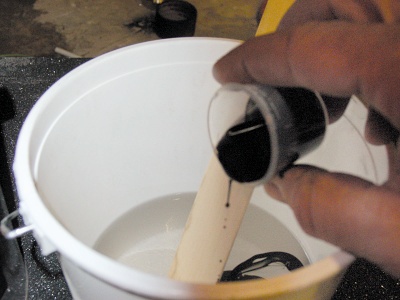
It is very critical that you use pigments that are compatible with the sealer you are using. There are several choices ranging from translucent acrylic pigments, solvent-based pigments and specially formulated pigments for use with solvent-based and water-based epoxies, and those developed for urethane applications.
Anytime you start tinting clear sealers to do topical color, you need to use a compatible pigment. When using solvent-based epoxies, you need to be using either epoxy dispersions, or solvent-based surfactant dispersions. Liquid pigments do not work in 100% urethane formulations. It is very critical that you use compatible pigment solutions with the appropriate sealer.
As with any additive, you have to worry about harming the integrity of the sealer. For example, if you take a universal color, and try to stick it into a solvent-based acrylic, it will not mix. It is like oil and water. This is where a little homework will help a lot. Make sure you have selected a pigment that works with the sealer you are using.
Go to the manufacturer of the sealer and ask them to recommend a pigment, or buy it through that manufacturer and you should not have a problem. Recommended formulations are designed to be compatible. Therefore, be sure that what you are buying is appropriate for that application, both from its chemical formulation and for its intended use.
Application Techniques
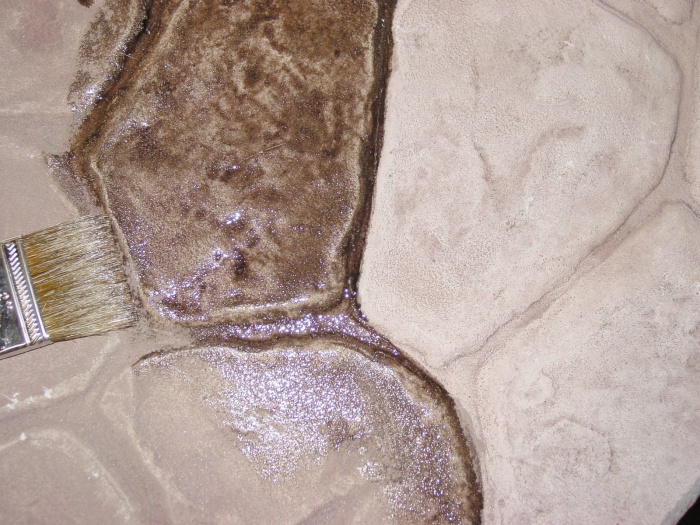
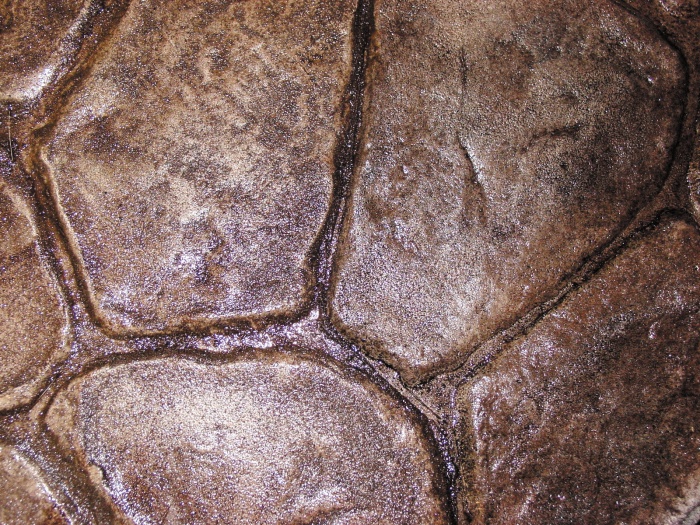
Application technique is crucial to a successful project. The final finish will be very dependent on when you apply a tinted sealer, how you apply it, its thickness, and other characteristics. It takes a somewhat artistic touch, and some real practice, in order to get the final finish to meet the desired aesthetic. Depending on the method used, finishes can range from marbleized like an acid stain, to colorful blends like terra cotta. Think “faux” finish.
For the fewest problems, the easiest tintable product is a solvent-based acrylic. It does the best job of dispersing the color as well. Next, would be a water-based acrylic, and most of the manufacturers of stains right now are water-based acrylics, or hybrids with urethane or epoxy. Typically, these are a single chemical component.
Solvent-based sealers generally give a better consistency than water-based sealers. It gives more depth, and much better durability. However, if you add too much color, it can start to break down the sealer and make it weaker. The molecular structure gets changed. Similarly, if the pigment is not compatible with the sealer it can settle in the lower areas of the pour, causing a undesirable mottled finish.
Using a colored sealer is an excellent choice to help touch up areas. Where acid staining can be temperamental, and can react differently with different mixes of concrete, sealers generally make the final project look newer and cleaner.
In or Out
Colored sealers can be used interior or exterior. The application method is different, depending on the look you want to achieve. Interior applications require an acrylic hardener over the top, or a floor polish. For exterior applications, to protect a stain or pigmented sealer, you put a clear sealer over top as your protective film.
Exterior projects are not often maintained as well, and the finish is subject to UV-degradation, pollutants and other environmental factors. This is why epoxies are not used for exterior projects. If you are using a tinted sealer for an exterior application, organic oxide pigments will be more UV-stable than non-oxide based pigments. Typically, exterior application are renovations or repairs. You can use pigmented solvent-based acrylics to retrofit a stained job that is worn out. For a successful exterior application, you have to maintain the topcoat of protective sealers in order to maintain the integrity of the color.
For interior projects, it is critical that when you select a sealer, you take moisture vapor emissions into consideration. Traffic levels are also a consideration. Water-based acrylic sealers have the least amount of abrasion resistance, adding to maintenance costs. When the surface to be treated is going to have heavy pedestrian traffic, a colored sealer is probably not a good idea. Lots of foot traffic will wear it down quickly if a good maintenance program is not in place.
Moisture in the concrete substrate can be a problem in a colored sealing application. Running the calcium chloride test is important and inexpensive insurance. As with any concrete application, the simple, common-sense approach is usually best.
When Not to Tint
The biggest caveat colored sealers have is their tendency to be film-forming. Because they sit on the surface, they do not penetrate like an acid stain. Most applications are surface film-forming acrylics in water-based form and also do not penetrate deeply.
If the project calls for a very hard smooth-trowel finish, getting the tinted sealer to bond can be difficult. In certain situations, they tend to peel or not bond adequately. If the preparation includes proper profiling of the surface, this should not be an issue. However, if it is not a good substrate (e.g., one that is old, degraded or damaged), the sealer is simply going to peel taking the coloring along with it. If the preparation is right, and the test sample has been done, you will get good adherence and no problems.
If you know that the project is going to have poor maintenance, topical anything is not a good idea. Any form of topical treatments will wear through. For high-traffic, low-maintenance applications, sticking with integral coloring would be best.
If the project calls for a more solid, opaque look, with less mottling and less accent coloring, a colored sealer does not make a lot of sense. Colored sealers add variety and more color density variation to a surface. If you do not want any accent colors, then you should not use colored sealer because even when it is the same color, it would give it density variation that is not natural.
Think Faux
The options for colored sealers are many. The variety of cost-effective and aesthetic opportunities can provide a real value add to many projects. Make sure you have selected a tinting agent that is compatible with the sealer you are using. Practice the application to ensure the finishing technique to give the desired results. Inform the customer on the maintenance needed to ensure the finish lasts. Avoid situations like high-traffic, low-maintenance situations where stains or integral finishes would be a better choice.
While integral pigments give a concrete mix a solid color, and acid staining creates a finish by its reaction to the concrete, using topical tinted sealer techniques can expand the horizons of finishes for architectural flooring, allowing a wide variety of looks to meet almost any desired finish. From translucent and brighteners, variegated colors to solids of white to black, tinted sealers can add beauty to almost any architectural concrete project.
Questions from Readers
Question
Can you seal acid stain with an oil-based sealer?
Answer from Concrete Decor
You can seal acid stained concrete with virtually any type of concrete sealer. However, you need to make sure the areas you’ve acid stained are pH neutral before you apply any type of sealer. If you haven’t neutralized the stained concrete areas, you can accomplish that with a solution of baking soda and water.
We recommend testing a small area with your sealer to make sure it’s achieving the effect you want. Some sealers can have virtually no effect on your color while others can excessively change the intended color.


