
Contractors choose acrylic stains over chemical stains for a variety of reasons. Acrylic stains offer an array of colors that chemical stains cannot. Designers and applicators are no longer limited to the eight colors commonly available with acid-based stains. And when combined with a chemical-based system, the design possibilities are limitless. It is even possible to achieve the unique variegated look of an acid-etch stain. Add to that ease of use and you’ve got an unbeatable system.
Concrete Decor magazine recently asked contractors and manufacturers what they like — and dislike — about acrylic stains.
“Not all acrylic stains are created equal,” says Chris Sullivan, regional sales manager and liquids product manager for QC Construction Products in Madera, Calif. He notes there are different types of acrylic stains, from pigmented acrylic sealers to penetrating water-based acrylic stains. Unlike acid stains, which all basically work the same, acrylic stains can be membrane forming and opaque or penetrating and translucent. “It is important to understand the difference and what the limitations are with each product,” says Sullivan
Wear and fade resistance
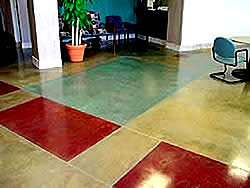
One advantage acid-based stains have over acrylics is that they can achieve a deeper wear surface. But when correctly sealed, acrylics can wear well. Resistance to wear and fade varies from one kind of acrylic stain to another and among manufacturers. “Typically we see acrylic stains holding up to UV exposure quite well,” says Sullivan. “It depends on the type of pigments used in the particular stain.” Applicators should ask their manufacturer about UV and long-term exposure results if using products in an exterior application.
Tina Anderson and husband Gary own Tri-Co Floors in La Mesa, Calif. “Most of our experience in using acrylic stains is on interior projects with no UV problems,” says Anderson. But she, too, recommends using caution on exterior applications.
Diana Strongosky is a product manager for H&C/Sherwin Williams in Cleveland, Ohio. She urges applicators to look for 100 percent acrylic resins, but adds that not all such resins are created equal. “Some are better than others,” she says. To achieve a durable uniform finish, she recommends putting down two coats of stain. “Two coats are going to give you the durability you need for abrasion resistance and wear resistance,” she says.
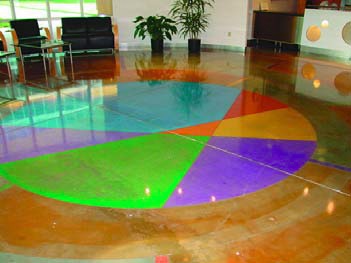
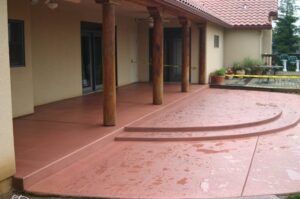
Texas. Applicator is Tolman Floors in Dallas. Six Pantone Colors of QC Cemtint lithium quartz penetrating acrylic stain.
Application methods
Application methods for acrylic stains vary considerably, depending on what the manufacturer recommends and what effect the applicator wants to achieve.
Mark Donaldson owns Skookum Floors Ltd., in Seattle. Donaldson applies his acrylic stains by sponging, spraying, ragging, bagging and mopping. He does not recommend rolling, however, because roller lines can appear and give an unnatural look.
Sullivan recommends spraying acrylic stains with either an HPLV sprayer (his first choice) or a pump-up sprayer (his second choice). “A roller or brush can be used with no application problems, but this tends not to provide as variegated a look,” he says.
These stains can provide the unique variegated look of acid-etch stains, but applicator technique is critical, says Donaldson. “Numerous light coats are required; slight color shifts during subsequent coats will give depth of color, and different application methods will create natural mottling.”
Sullivan adds that penetrating acrylic stains will produce much more variegation then membrane-forming acrylic stains. “The variegation achieved with acrylic stains depends more on the variegation and porosity of the concrete being stained,” says Sullivan. “A hard-troweled slab with burn marks and color variations will allow for a more marbled look then a broom-finished slab with little color variation.”
A non-chemical alternative
A near endless color selection is one of the major advantages of acrylic stains. “With some acrylic stains the entire pantone color wheel is available,” says Sullivan.
Your concrete profile can dictate the type of stain you use. While acid-etch stains must be applied to bare concrete, so that the acid can react with the concrete, acrylics can be applied to previously painted concrete as well as asphalt.
“We see best results when acrylic stains are applied to smooth-finished concrete that has some highlights and color variation,” says Sullivan. Over-troweled or very hard concrete can sometimes retard the penetration, color development or adhesion of these types of stains. “The surface smoothness and porosity will have a major impact on color, penetration and adhesion,” he adds.
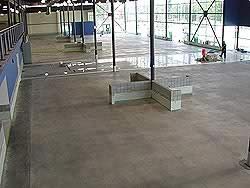 “Surface prep is critical when using acrylic stains,” says Donaldson. “Many dense or tight concretes will require a sand blasting or acid etching to meet coating specifications and guidelines.” Donaldson recommends against shot blasting, however, because it can leave track lines in the surface.
Combining systems
Acrylic stains can be used on top of acid-etch stains to create a stronger and more authentic look. Anderson, Donaldson and Sullivan agree that when combined correctly and applied artistically, the results can be fantastic. “A wider range of color and effect can be achieved with the combination of systems,” says Anderson. “It is absolutely necessary to use them [together] to achieve exact color matches and unique finishes,” adds Donaldson. “We have seen our top-end applicators create stunning color combinations by blending our Patina acid stains and Cemtint acrylic water-based penetrating stains,” says Sullivan.
 Choosing a sealer
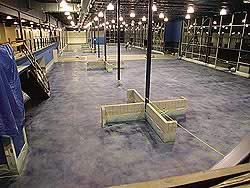
All acrylic stains are not the same, and neither are their sealers. Some stains are surface treatments, while others act as a penetrating stain. “A surface stain will wear faster then a penetrating stain in side-by-side wear comparison tests,” says Sullivan. “That said, the sealer system used is intended to take all the wear. Properly maintained, the stain — no matter what type — should never be affected.”
Acrylic stains demand a durable topcoat, and our sources recommended a variety of sealers, depending on the job and desired effect. When UV and wear is an issue, Donaldson uses commercial-grade UV-resistant sealant and coating systems. Anderson recommends matching bases; that is, if your stain is water-based, choose a water-based sealer. “The wear resistance depends on the type and quality of sealer you use, as well as the maintenance program given to the client,” she says.
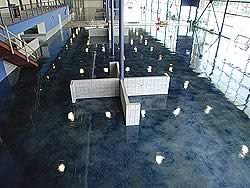
“Sealer selection is one of the most important factors in stain application, and can also be one of the most confusing,” says Sullivan. “Cutting corners with cheap sealers is the fastest way to fail,” he says. He recommends spending a little more for a high-end sealer designed for high-end stain applications. “High-build sealers such as polyurethanes and epoxies provide the best wear, stain resistance and life span,” says Sullivan. Because most epoxies will yellow over time, he recommends non-yellowing polyurethane sealers, followed by acrylic systems.
Sullivan recommends applying a base coat of medium solids (18 to 27 percent) water- or solvent-based acrylic sealer, followed by two to three coats of a high solids top coat sealer. These top coat sealers — or sacrificial sealers — are growing in popularity and have become a staple for high-end stain applicators. “Top coat sealers provide a durable wear surface that can be easily and inexpensively reapplied without stripping previous coats,” he says. “They also adhere to almost any type of base sealer, from polyurethane to acrylics.”
As with any coloring system, moisture problems in the concrete can negatively affect acrylic stains. Moisture, if it gets trapped under the sealer, can change the appearance of the stain or bring a migration of salts (efflorescence) to the surface. Pressure from underneath can make the stain pop and peel off.
Make maintenance a priority
Maintenance is critical with acrylic-based stains. And the level and type of maintenance required depends on the sealer, coating and finishes used — not the stain underneath. Because the level of penetration is slight to none compared with acid stains, maintaining the sealer system is crucial. Sullivan urges applicators to produce samples and get them approved prior to application. “Applicators also need to sell prospective clients on the fact that stains are not coatings and will produce random affects. That is the nature and beauty of all concrete stains,” he says.
The pros and cons of acrylics
Acrylics offer many advantages over chemical stains: With acrylics, applicators can create colors not obtainable by acid-based stains. When sealed correctly, acrylics can resist wear and exposure well. They typically need less time to react or cure than chemical stains. Because they are water-based, they emit few volatile organic compounds and clean up is easier. In most cases a simple damp mop application is all that is needed before sealing. And depending on the quality of the application technique and the materials used, acrylic stains can be used on almost any surface, including previously painted surfaces and asphalt.
But there are disadvantages to acrylics worth noting. They often require initial surface preparation and acid washing. They aren’t naturally UV stable. And they lack the permanence that acid stains provide. While they offer more color choices than can be obtained with chemical stains, they offer less variation in color. “Nothing can produce the natural variegation effects of acid-based stains,” says Sullivan.
Their ease of use may explain their growing popularity, especially with do-it-yourselfers.
“A lot more things can go wrong in the application process with acid stains if you are not familiar with the product,” Strongosky says. “An acrylic stain is easy for anyone to use.”