Cutting Pictures in Concrete:
Jeffrey Donius
Premier Veneers, Frankfort, Illinois
is the second floor of a brand-new, upscale restaurant, Cowley's Irish Pub, in downtown Farmington, Michigan. The concrete floor of this building was poured with a slate gray integral color. This coloring was to serve as the background for a significant amount of design work. Initially, two design options, acid etch stenciling and engraving, were considered by the owners. Because of the potential mess entailed with acid etch stenciling over the course of extensive design work, and because engraving, accompanied by a dust control system, is virtually dust-free, the engraving option was decided upon.
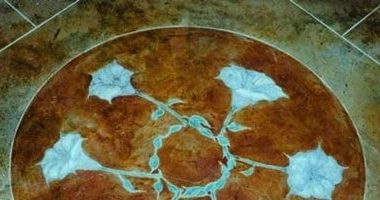
My company, a trained user of the Engrave-A-Crete tool systems, was hired to perform the design work. The design layout was developed by Pam Cowley, one of the owners, and consisted of two patterns: first, for the main seating area, a design from the front of a jewelry case in Pam's family, reproduced three times and enclosed by a one-foot wide circular border; and second, for the main walkway in front of the bar, two side-by-side, 60'-long, repetitive borders.
To reproduce the image on the jewelry case, I took a picture of it with a digital camera and e-mailed it to Brandon Adamson of Engrave-A-Crete, who was going to create the templates for the project. I included the appropriate dimensions for the image to ensure that the design would cover the entire seating area. Brandon and I then worked together until we had a proof that was okayed by Pam. Using the template created from this proof, I drew the image with soapstone onto the floor three times, spaced equidistantly, and used trammel points with a center pivot to draw two large circles around the images to serve as the border. Pam also asked for several smaller, inner circles to be added.
Once we achieved the appropriate size and spacing for the overall design, I sprayed over it with black lacquer (from an auto body shop). This prevented bleeding when the image was stained and ensured that the layout would not be erased during the cutting process.
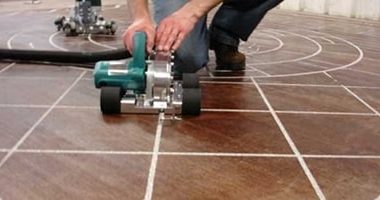
After coloring the design with chemical stains, we cut the image, with a 1" wide outline, into the concrete floor using the Engrave-A-Crete "Shark" and "Barracuda" in tandem, followed closely behind by the "Wasp" to removes remaining traces of the black lacquer and make the borders more distinct. Finally, we used the Engrave-A-Crete "Mongoose" with trammel points and center pivot, to cut the circular borders.
For the main walkway, Pam selected a border design from the Engrave-A-Crete catalog. She wanted this border duplicated, side-by-side, and to extend from an elevator and stairwell in the rear of the building, along the main bar (a 40'-long, handcrafted antique imported from Ireland), and conclude at the main front stairwell with the corner piece of the border pattern. Because the border was so large and long, however, the templates could be based on only one segment of the pattern. That segment then had to be repeatedly traced (sprayed with black lacquer) and cut over the entire length of the border. Using a laser square and tape measure we made sure that each succeeding segment was cut in line with, and equidistant from, the previous one.
After the main outline was cut with the Shark, we again followed with the Wasp to clean up the edges. Because in this instance the engraved -- and not the raised -- portions of the design were to be colored, we stained the borders after the engraving.
For the landings of the two stairwells leading to the second floor, Pam chose a Celtic corner pattern from the Engrave-A-Crete catalog. She wanted the pattern engraved in each corner of both landings against a black background. As with the previous patterns, we placed the templates first and sprayed the pattern on to the concrete with black lacquer. We then stained the landings (and the steps) with black acid stain. Once we rinsed the stain residue, we replaced the templates and cut the patterns with the Shark and Barracuda, followed by the Wasp for detail.
Because black acid stain is a tone lighter than true black we were still able to see the painted pattern after staining. However, since this pattern was much more intricate than the previous ones, we had to take special care not to let the template move during the cutting process. Even the smallest shift could result in an asymmetrical design, which would not become apparent until we removed the template.
Once the design work was complete, we sealed the 1,200 square-foot floor with two coats of a waterborne polyamide epoxy and one coat of waterborne aliphatic polyurethane. The first coat of epoxy served as primer and established excellent adhesion. The second coat of epoxy created film build and durability for the floor; and the polyurethane topcoat provided abrasion and UV resistance so that the floor wouldn't easily scratch from furniture and foot traffic or yellow from sunlight. However, because catalyzed polyurethanes are especially prone to slipperiness we took the precaution of adding 80-mesh glass bead, at 4 ounces per gallon, when we coated the steps and landings.
To protect the overall system and provide for easy maintenance, we then applied a high-solids acrylic floor finish.

|