 Builders have been using fibers to reinforce clay, plaster, mortar, and concrete since ancient times. According to the fifth chapter of Exodus, Pharaoh knew the value of fiber reinforcement when he commanded the Jews to find their own straw for making bricks. Later, the Romans used animal hair to strengthen cementitious mortars that are still supporting the Coliseum and other ancient structures.
Now that hair and straw have given way to steel and polymers, fiber reinforcement can benefit concrete projects under many conditions. If you want to color or texture fiber-reinforced concrete, you’ll need to know a few tips for keeping your surface looking good.
 Steel or synthetic?
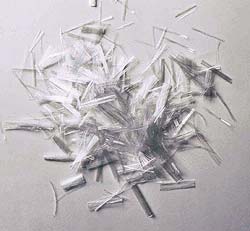
Steel and synthetic fibers impart different properties to concrete. Steel fibers impart resistance to bending under load and damage from impacts. They look like straight or crinkly wires a couple of inches long, made of carbon steel or, for corrosive environments, stainless steel. A steel fiber-reinforced slab can be thinner than an unreinforced slab. Architects specify steel fiber reinforcement for projects such as factory floors that must withstand heavy traffic and impacts. Steel fibers are added to a truckload of concrete during mixing at 0.25% to 1.5% by volume (between 33 and 100 pounds per cubic yard). They are rarely used in decorative concrete.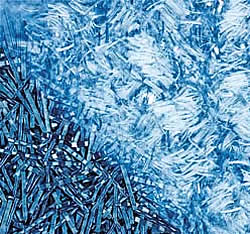
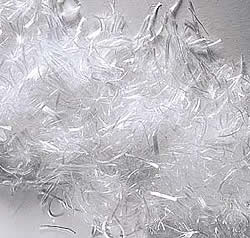
Synthetic fibers, which look like hairs or bundles of hairs an inch or two long, help protect fresh concrete from shrinkage cracking (caused by too-rapid drying of the surface) and thermal cracking (caused by stresses as the concrete heats up during curing and then cools off). Once the concrete has hardened, they help cracked sections hang together, but they don’t increase the strength of the concrete once it has hardened. Synthetic fibers also help keep the mix homogeneous by keeping the aggregate from settling out.
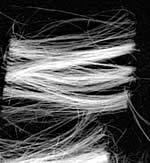 Synthetic fibers may be nylon, polypropylene, or glass; exotics such as carbon fiber are sometimes used as a substitute for steel. Like steel fibers, synthetics are added to the truckload during mixing, but in lower quantities — about 0.1% by volume, or 1.5 pounds per cubic yard. Synthetic fibers are also available as mats, which can be helpful when pouring overlays.
What fibers don’t do. Although steel fibers give some impact resistance and stiffness to a slab, synthetic fibers don’t. Don’t expect fibers of either type to increase the space between control joints or to reduce freeze-thaw cracking. For the latter purpose, use air-entraining agents, which make little bubbles in the concrete into which freezing water can harmlessly expand instead of cracking the concrete.
Steel fibers and decorative techniques
Unless the project’s engineering requirements call for steel fiber reinforcement, as in a parking structure or industrial floor, you will not often encounter steel fibers on a decorative concrete job. The manufacturers of steel fibers, such as Nycon and SI Concrete Systems, don’t officially recommend stamping concrete that contains their fibers, nor do they recommend exposed-aggregate or burlap-dragged finishes.
Nevertheless, according to Vance Pool, marketing director for SI Concrete Systems, which manufactures both steel and synthetic fibers, a contractor experienced with both stamping and steel fibers can have good results. But if you’re new to either stamping or steel fibers, don’t try using them both on the same job.
“Steel fibers aren’t for heavy relief,” Pool explains. A deep stamped impression will expose the fibers. But a shallow stencil impression should be fine. If you’re going to use acid stain, make sure that the steel fibers are completely buried; Pool recommends using a laser screed for the purpose. Control joints can be cut with a saw in the normal way.
Bob Zellers, vice president of technology and engineering for Nycon Inc., says he wouldn’t use steel fibers in decorative concrete. “If you do hand finishing, the fibers will be exposed to the atmosphere, and they will rust,” he says. The fibers can be buried with the use of a laser screed, he says, but that’s not often used with decorative concrete.
Synthetic fibers and decorative techniques
Not only will you find yourself decorating jobs where synthetic fiber reinforcement has been specified, but you also may want to specify this type of reinforcement yourself to reduce shrinkage cracking and plastic cracking. “I use it in just about every job I do that’s stamped,” says Harlan Baldridge, a decorative concrete contractor in Roseburg, Oregon. He uses it in slabs and also in thin overlays to minimize cracking. “If the customer is paying for decorative concrete, all the reinforcement is warranted. It makes sense for the contractor to protect his interest and do the best quality job.” Adding only $8-$9 per cubic yard to the cost of the job, synthetic fiber is a cheap insurance policy against cracks.
Nylon vs. polypropylene. Both nylon and polypropylene fibers are compatible with stamping and stenciling, and with integral colors, acid and acrylic stains, and shake-on color hardeners. Nylon is a little more expensive, but the fibers are less likely to emerge from the surface during finishing because they absorb water and have a higher specific gravity (in other words, they don’t float as much).
Adding to the choices to ponder, long and short fibers are available, and single-strand and multistrand (“fibrillated”) versions are available. Longer fibers afford more crack protection, but shorter ones are less likely to find their way to the surface during finishing.
 Zeller doesn’t recommend using fibrillated polypropylene in decorative concrete. “You can get a hairy surface,” he says. Monofilament nylon fibers are his first choice.
Placement and finishing tips. Tell the ready-mix supplier what you’re doing, and he or she will add fibers to the truckload. No adjustment to the water content is necessary. A quirk of synthetic fibers is that they will cause the concrete to have less slump as measured by a slump test, but the concrete won’t actually be stiffer to pour. “There is a loss in slump, but it will take hardly any more energy to move the concrete,” Pool says. He emphasizes that no additional water will be necessary; if you do find it necessary to correct the slump, do it with superplasticizers.
Good finishing is essential to keep from dragging the fibers to the surface. As with any concrete, don’t get on the surface too early. Pool says that fiber-reinforced concrete bleeds more uniformly than other concrete, so just because you don’t see puddles on the surface doesn’t mean that the concrete is ready to finish. Use magnesium tools, and don’t overtrowel.
Baldridge finds that using color hardener gives extra insurance against the appearance of stray hairs. Any hairs that do pop up will wear away quickly with traffic, or they can be burned off with a propane weed burner.
Control joints can be cut with a saw. If raveled fibers appear at the edges of the cut, stop cutting and come back in half an hour.
If you plan to texture the surface with a broom, make sure you use a stiff-bristled broom, Zeller says. “Pull in one direction and one direction only over a given area,” Zellers says. “That way you are aligning the fibers.”
A useful addition
Synthetic fibers are a good addition to almost any decorative job, whether it’s a new slab, a formed wall, or an overlay. Baldridge says he has benefited from taking vendors’ classes to become familiar with fibers’ effect on slump and to develop the right touch for finishing concrete that contains fibers. Once you become confident about using them, they’ll add a margin of security against cracks, which will help keep your work beautiful and your customers happy.