
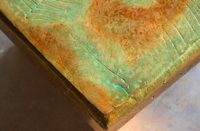
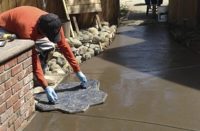
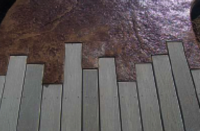
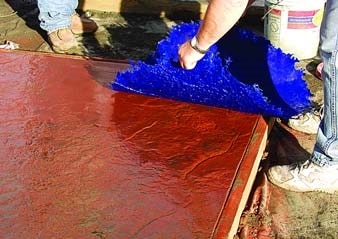
 Imprinting into corners or up against walls or other obstructions takes additional time, so plan your pours accordingly.
Special mats and tools can be used to imprint the pattern or texture in these tight areas. Flexible (or floppy) mats typically have about half the weight of a regular mat and thus can be bent to get closer to the wall or corner. To get even closer, some contractors use a texture roller that matches their mat design. Or, you can sacrifice one of your regular mats and cut it up into smaller pieces so that you can work right up to the edges.
Most experienced contractors develop their own unique techniques for working in tight spaces, but they generally fall into two different methods:
- Work a little ahead of where you are stamping the main floor and use a touchup (or cut-up) texture skin or texture roller to imprint a couple inches back from the wall or obstruction. Then use a flexible mat to bridge the distance from the normally stamped area to the textured edge. Use detail tools to handtool detail where the pattern is not complete.
- Use a normal stamp to get about one mat’s distance from the wall, corner or obstruction. Then use a flexible mat to cover the remaining distance, getting as close as you can. Along the edge, use a touch-up skin and continue the grout lines up to the wall using a joint tool.


