



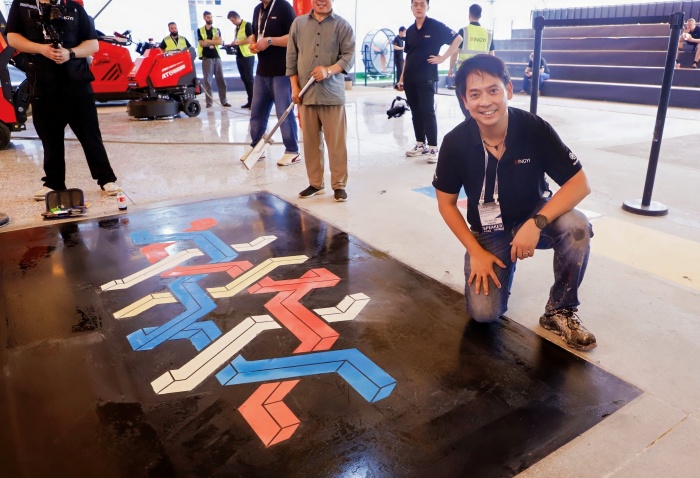
When I attended the 3rd Global Flooring Summit and the 17th International Flooring Seminar in Jinjiang, China, I saw firsthand how the flooring industry is evolving—not just in technology, but in mindset.
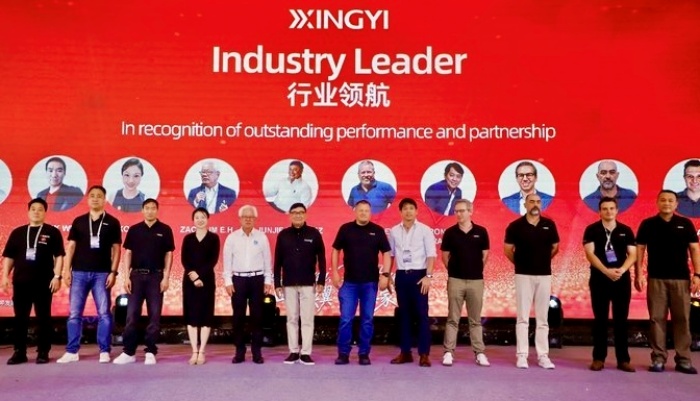
Hosted by Fujian Xingyi Intelligent Equipment Co., the event brought together more than 200 professionals from 35 countries under the theme “Smart Construction, Winning the Future.” It was a powerful statement of where the industry is heading: toward data-driven execution, intelligent machinery, and global collaboration.
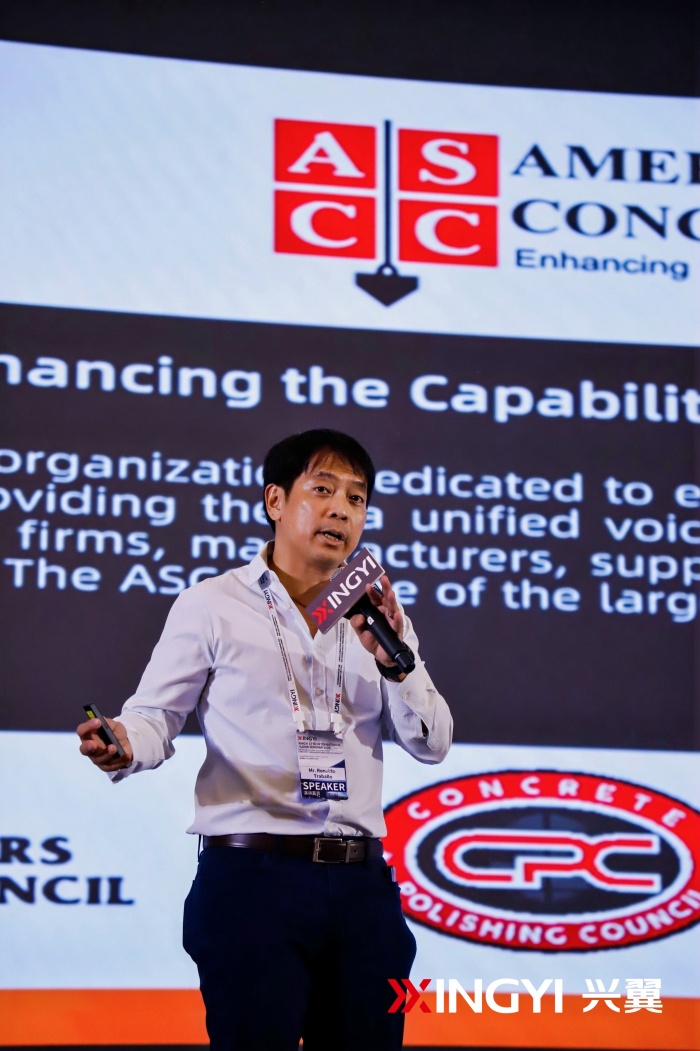
But beyond the technology and demonstrations, what struck me most was the convergence of perspectives—from East and West, from emerging markets and mature industries. One of the most valuable voices in that conversation came from Eric Traffie, a long-time Bomanite licensee and a seasoned American expert who has worked and traveled at least five times in China for the last 15 years.
A 15-Year Perspective: How China Has Evolved
Eric’s perspective provides a rare longitudinal view of how decorative concrete has developed in China.
He shared that over the years, he has been “extremely impressed” by the progress of companies like Orangestone, a decorative concrete Beijing-based contractor that he has consulted with for most of his China visits. According to him, the transformation has been driven by a strong commitment to:
- Better workmanship
- Higher quality products
- Continuous education
- Investment in equipment and R&D
This aligns closely with what I observed during the summit. The level of discipline, curiosity, and willingness to adopt global best practices is accelerating China’s position in the decorative concrete space.
From a global standpoint, this is significant. It signals that emerging markets are no longer just adopters—they are becoming innovators and standard-setters.
Microtop and the Global Opportunity for Decorative Overlays
One of the highlights of the summit was Eric’s live demonstration of Microtop, a polymer-modified micro-topping system widely used in the United States.
While Microtop has been around for years in the U.S., Eric made an important point:
Many markets around the world are only now discovering its full potential.
He described Microtop as a highly versatile system that can be used across a wide range of applications. In many cases, it can even be a better alternative to epoxies or dyes—especially when aesthetics, flexibility, and surface customization are required.
What stood out to me was the reaction of the audience. Contractors, engineers, and developers were not just watching—they were analyzing, asking detailed questions, and immediately thinking about how to apply the system in their own markets.
Eric noted that:
“Microcement is gaining popularity globally… and I believe it has strong growth potential because of its many use cases.”
From my perspective, this reinforces a key trend: decorative concrete is no longer niche—it is becoming mainstream. But for it to scale globally, it must be supported by proper training, system discipline, and quality control.

Education as the Foundation of Industry Growth
Eric also shared a powerful insight about the role of education:
“The more installers become educated and committed to high quality, the more the entire industry will grow.”
This point cannot be overstated.
One of the risks in any growing industry is the proliferation of low-quality installations. These can damage client confidence and slow down adoption. As Eric rightly pointed out, uneducated and poorly executed work can bring the entire industry down.
This is why events like the Xingyi Conference are so important.
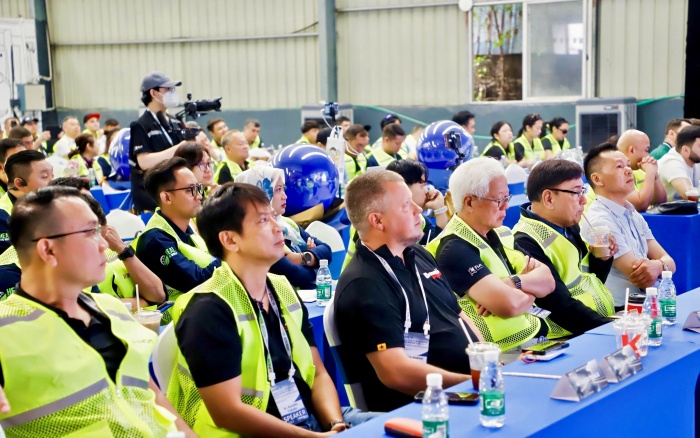
Unlike traditional conferences, this event emphasized a “theory + hands-on” approach:
- Live grinding demonstrations
- Real-time CSP (Concrete Surface Profile) comparisons
- F-Number (FF/FL, Fmin) measurements
- Micro-topping application from start to finish
- Direct interaction with global experts
Participants didn’t just learn—they experienced.
And that experience builds confidence.
From Straightedges to Data: The Industry Inflection Point
One of the central themes of the summit was the shift from experience-based construction to data-driven delivery.
For decades, contractors relied on the following:
- Visual inspection
- Straightedge measurements
- Personal judgment
Today, the conversation is changing.
Clients are asking:
- How do you guarantee flatness?
- Can you quantify surface roughness?
- How consistent is your finish?
The answer increasingly lies in the following:
- F-Number systems (FF, FL, Fmin)
- CSP quantification
- Digital monitoring
- AI-assisted equipment
As discussed during the summit, we are approaching a point where these tools will no longer be optional—they will be baseline requirements for major projects.
Intelligent Equipment: From Tools to “Smart Workers”
Another major highlight was Xingyi’s development of intelligent grinding systems.
Their machines now integrate:
- SLAM-based navigation (LiDAR + vision)
- AI ground recognition
- Real-time process monitoring
- Dynamic pressure control
- Autonomous path planning
In simple terms, these machines can:
- Understand the environment
- Adjust to surface conditions
- Optimize performance
- Operate with minimal human input
This is a major shift.
We are no longer just talking about tools—we are talking about autonomous partners on the jobsite.
Building a Global Ecosystem
Xingyi is also expanding beyond equipment through its FLM (Floormart) Flooring Supermarket concept—a one-stop platform for materials, tools, and solutions already operating in multiple countries.
This reflects a broader strategy:
From equipment manufacturer → ecosystem enabler
The future is not just about selling machines. It is about delivering:
- Systems
- Standards
- Training
- Certification
- End-to-end solutions
This is something we in the decorative concrete industry must take seriously if we want to scale globally.
The Bigger Picture: Where the Industry is Headed
Bringing together my observations and Eric’s insights, a clear picture emerges:
- Global awareness is rising rapidly
- Education is becoming the differentiator
- Technology is accelerating adoption
- Standards and measurement will define quality
- Collaboration across countries is essential
And perhaps most importantly:
The industry is moving toward “measurable certainty.”
No more guesswork.
No more purely subjective evaluation.
Every floor will increasingly be defined by data.
Final Reflection
As someone deeply involved in decorative concrete across Asia and beyond, I see this as a defining moment for our industry.
The question is no longer:
“Can you do the job?”
The question now is:
“Can you prove your results—consistently, globally, and with data?”
With leaders like Eric Traffie bringing decades of expertise, and companies like Fujian Xingyi Intelligent Equipment Co. pushing the boundaries of innovation, the path forward is clear.
The future of flooring—and decorative concrete—is not just about creating beautiful surfaces.
It is about delivering world-class, measurable, and repeatable results—anywhere in the world.


