
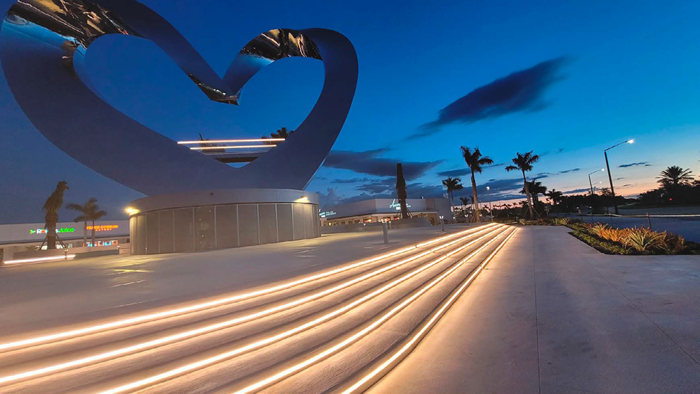
When you think of what the concrete work surrounding the world’s largest heart sculpture might look like, you may envision red. However, in reality, it’s white in color—but the mix design is as green as could be.
Back in spring 2024, Rich Rhoades, vice president of Adena Corp. in Florida, teamed up with Cemex to develop a green cementitious mix for his work in the thematic entertainment industry.
“We wanted to use a mix design that had reduced global warming potential and to incorporate a fiber that would reduce the global warming potential on the footprint itself. We also wanted something that wouldn’t be susceptible to corrosion,” says Jae Jaegar, technical manager at Cemex Orlando.
After months of brainstorming and testing, the final mix design had replaced 50% of the cement with slag and added basalt fibers to reduce the need for rebar. In the end, it reduced global warming potential by nearly 40% over a traditional mix with rebar.
After achieving success with the design and installation at several themed resorts, Rhoades wanted to expand its presence outside of the industry. So, when project developer Mattamy Homes contracted with
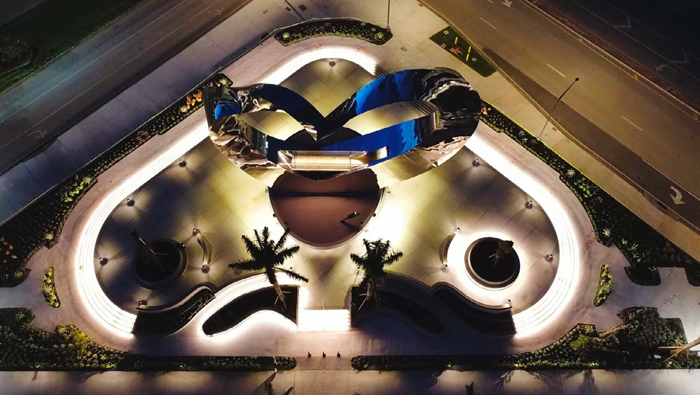
Adena to install the concrete work around a 73-foot-tall stainless-steel heart in Port St. Lucie, Florida, Rhoades and his team proposed to use the new green mix at the project site. The idea was a hit with the developers of Heart in the Park.
Slag and fiber mix successful
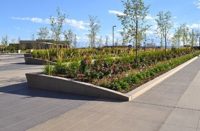
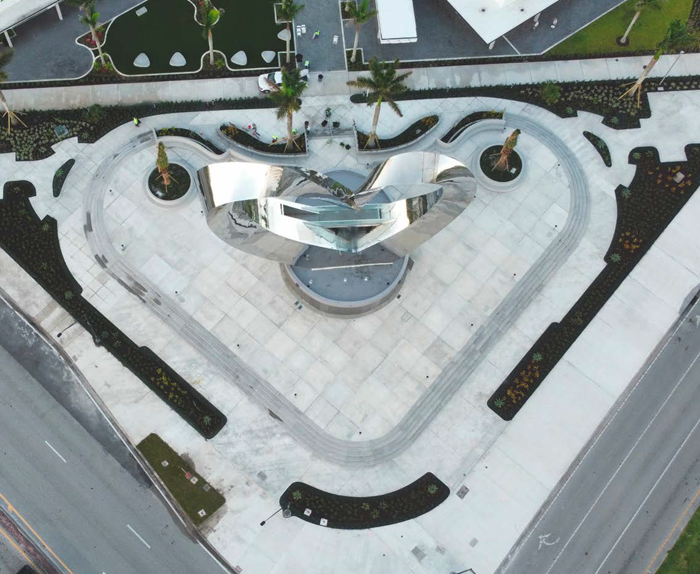
Adena’s work for Heart in the Park began in spring 2025. The company was hired to provide 22,000 square feet of concrete work, including a decorative slab, walking path, stairs, and the actual platform where the four-story sculpture would eventually be placed. All of it consists of the green slag mix, although the stairs contain some steel as the slag mix was still being tested for its use at a commercial level.
According to Javier Ruiz, a finisher for Adena, the work took several months to complete. On average the crew poured roughly a dozen 8-foot squares each day. Most of the squares were poured in an alternating pattern, although a few areas required a larger pour. For the larger sections, the crew created joints with a 4-inch edger with a 1/8-inch radius.
The project’s upper level incorporated alternating broom finishes with a 3-inch picture frame. The lower level features a standard broom finish with saw cuts to create 4-by-4 sections.
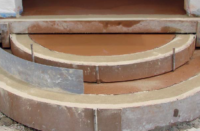
The stairways and sidewalks incorporate what Rhoades calls a “modified rock finish.” The crew accomplished this by broadcasting wood barbecue pellets, tamping them in and spraying them with a deactivator.
“The moisture of the concrete dissolves them and there is no residue left,” Rhoades says. “We pressure washed the next day with a surface etch. It created a rock salt-like finish.”
The entire project was then sealed with a low-solid, solvent-based sealer.
Worth the work
“It was an extensive and demanding job,” says Ruiz. “The process involved much more than pouring. We had to fill the space with dirt, compact it and complete all forming work before each pour. It resulted in long days.”
While Ruiz noted this mix is more complex than a standard mix with rebar, he’s comfortable with the technique differences needed in the finishing process.
“It’s pretty straightforward,” Rhoades explains. “With this mix you jitterbug so the aggregate and fibers push down below the surface to allow more cream to come to the top to eliminate fiber exposure.”
Incorporating CFRTC dowels
In addition to the green slag mix, the team also incorporated PolyDowel by ReForm Composites Engineering to create an even more environmentally friendly design. The company produces dowels from continuous fiber-reinforced thermoplastic composites, a lightweight, noncorrosive, high-performance
material that doesn’t compromise structural reliability.
The CFRTC dowels were initially developed for demanding applications such as aerospace but have subsequently been adopted for durable, cost-effective concrete construction. They are up to 80% lighter than steel-plated dowels, which are prone to corrosion and contribute to maintenance costs over time.
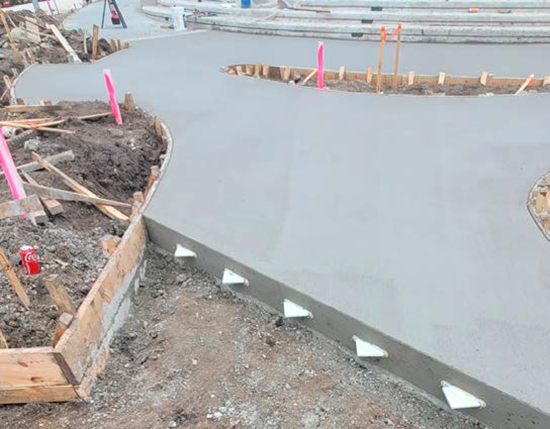
The crew placed the CFRTC dowels every 18 inches in the joints of each square Ruiz and his installers poured. He noted he had used them before, so installation went smoothly.
While the primary benefit of the design reduces the global warming potential, it offers a few other benefits as well. “By eliminating the steel and going with this mix, it allowed Adena to pour larger, minimize the schedule, minimize inspections, and decrease costs,” says Rhoades.
Going for the green
Although the focal point in Port St. Lucie may be the giant shimmering stainless-steel heart, the concrete has been a real showstopper for those familiar with green initiatives. Soon, Rhoades and Cemex are hoping to make the slag mix a popular option outside the thematic entertainment industry around the country.
“We tested with as much as 70% slag replacement. It worked for me, but the goal was to decrease carbon impact with a product that a contractor could use tomorrow,” Rhoades says.
“We’ve got this design teed up on a couple of different projects,” says Jaeger. “We’re waiting for it to take off.”


