

Over the years, I’ve had the privilege of assisting contractors with thousands of issues—sometimes simple, sometimes baffling, and occasionally the kind that leaves many scratching their heads. What I’ve learned is that every problem tells a story—a story involving timing, chemistry, environment, craftsmanship, or sometimes pure luck.
And while troubleshooting can be frustrating, it’s also one of the most rewarding parts of this industry. Each mystery solved becomes another piece of shared knowledge that helps the next contractor, the next project, and the next generation of decorative concrete professionals.
Sealer bubbles and baffles
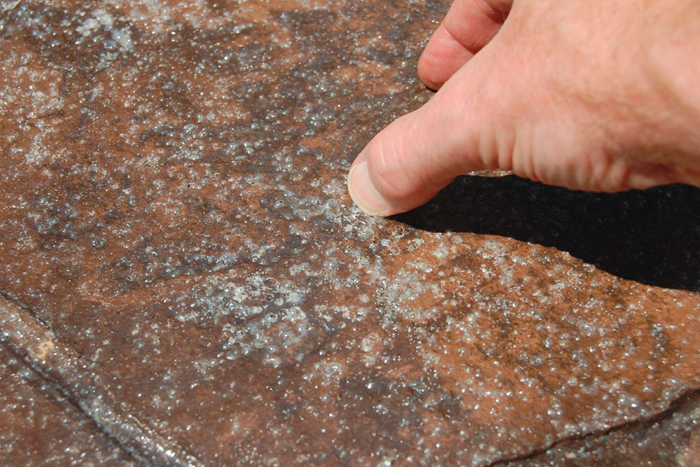
Sealer issues were—and still are—the most common troubleshooting topic in decorative concrete, and one stamped patio, in particular, stands out as a perfect example. The contractor called several days after sealing, confused because the weather had been ideal, the concrete was more than three weeks old, and the sealer looked great when they left the job. But by the weekend, bubbles and blisters had popped up across the entire surface, almost as if the patio had broken out in a rash.
At first glance, the symptoms didn’t match the conditions. There was no moisture from below, no rain, no early morning dew, and no contamination. The contractor tried a quick solvent bath to reflow the sealer, and, temporarily, it worked. The blisters disappeared, and the surface looked smooth again. But a few days later, after a stretch of sunny weather, the bubbles returned. Then they returned again. And again.
That’s when the real culprit became clear: the solvent-based sealer had been applied far too thick. While it looked great on day one, the heavy application trapped solvent in the film. As the sun heated the surface, that trapped solvent began to expand and push upward, almost like water starting to boil under a lid.
The pressure created blisters that rise, fall, and reappear with every warm cycle. This left the contractor chasing a problem that would never fully resolve on its own.
The fix wasn’t glamorous, but it was effective. The contractor back-rolled the surface with solvent to reopen the film and redistribute the material. This thinned the sealer layer so it could finally breathe and cure properly. Once the excess sealer was broken down and the film relaxed, the blisters stopped appearing for good.
It was a textbook reminder that with sealers, more is rarely better. Proper coverage rates exist for a reason. Even perfect weather can’t compensate for a too-heavy application. In decorative concrete, the sun has a way of revealing every shortcut and every oversight, often one blister at a time.
Coping with unwanted stain reactions
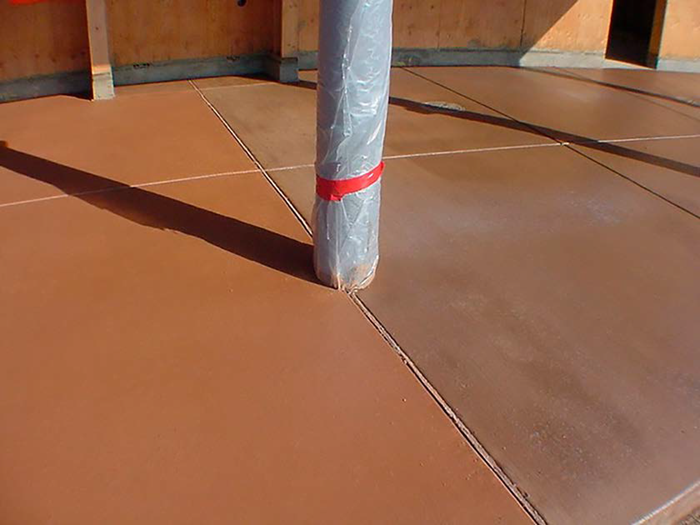
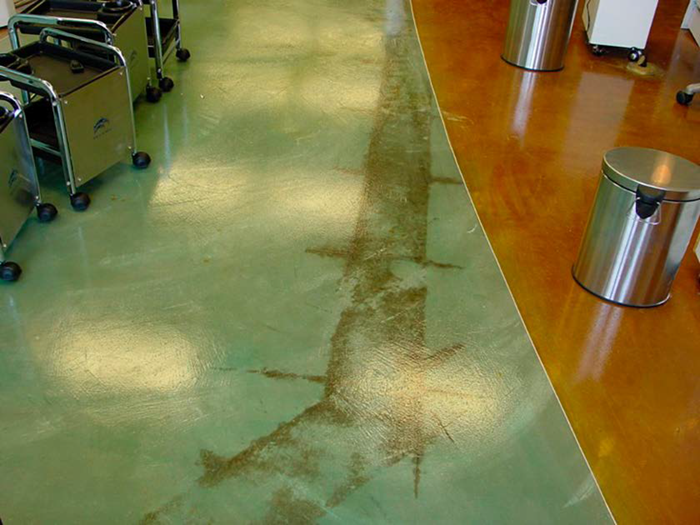
A trench cut into the floor of a hair salon remodel in Florida created one of the most surprising stain reactions I’ve ever seen. The contractor called me in a panic after applying an acid stain. The entire floor had turned a beautiful, rich brown—except for the strip of new concrete poured back into the trench. That section had developed a bright, unmistakable green-and-black tone, almost like a decorative accent they definitely hadn’t planned on.
After walking through the sequence of events, the mystery became clearer. The original salon floor had a fully intact vapor barrier beneath it, which kept moisture from migrating upward. But when the crew cut the trench to install new plumbing, they unknowingly breached that barrier. Florida’s famously high water table did the rest, pushing moisture up through the new pour long after it was placed.
The excess moisture interacted with the copper compounds in the acid stain. This essentially created a natural patina effect—beautiful if you want it, horrifying if you don’t. The result was a perfectly brown floor … with a green and black racing stripe right through the middle of the salon.
Once the crew understood the “why,” the solution was straightforward but expensive.
The options were to replace the trench and add a vapor barrier, or seal off the floor and apply an opaque coating or microtopping.
It remains one of the best examples of decorative concrete chemistry, reminding us that the ground beneath the slab has just as big an impact as what we put on top of it.
Integral color: The whole package
The last project that stands out involves integral color—a category that has provided more troubleshooting lessons than almost any other. A contractor reached out after completing a large residential driveway placed in multiple sections over several days. The finish was a straightforward light broom texture, and the first half of the project had gone smoothly. The integrally colored concrete came out exactly as specified: a warm, consistent tan.
But midway through the job, things took an unexpected turn. The contractor got into a disagreement with the readymix supplier—the kind of heated exchange that usually starts with slump and ends with someone saying, “Fine, I’ll call someone else who wants my business.”
True to his word, the contractor switched to a different ready-mix company for the remaining pours. Wanting to stay ahead of potential issues, he even confirmed that the new supplier used the same brand of integral color and the same color code. In his mind, that meant problem solved.
Except it wasn’t.
When the final sections were placed, finished, and cured, the “same color” from the new supplier was anything but. The original pours remained the intended tan, but the new sections came out a dramatically darker brown. The sections looked like two entirely different driveways stitched together.
That’s when the real lesson came into focus. Pigment is only one piece of the color equation. Cement type, cement brand, aggregate source, fines content, batch water, mix temperature, and even regional mineral variations all affect how an integral color develops. Two ready-mix suppliers can use the exact same pigment but produce completely different outcomes because their base materials aren’t identical.
The contractor had assumed that color was the only variable he needed to control. However, with integral color, the entire mix design is the variable.
Tough lessons to learn
Unfortunately, once the concrete hardens, options for correcting integral color mismatches are limited and rarely ideal. You can rip out and replace—what I call the “nuclear option”—or you can cover the slab with a topical coating or overlay. But that second choice turns what should have been a low-maintenance driveway into a long-term maintenance commitment. It would require resealing, recoloring, or recoating for years to come.
It was a tough lesson for the contractor, but a valuable reminder to the entire industry. With integral color, consistency in the mix design matters just as much as consistency in pigment. A change in supplier isn’t just a business decision. It’s a color decision, whether you realize it or not.
Countless calls that start with “Chris, I swear I did everything right…” or “I have been doing this for a long time…” are usually true. But the variables in decorative concrete are endless, and that’s what makes troubleshooting both challenging and rewarding.
Final thoughts
After 25 years of helping solve problems big and small, one thing remains clear. Decorative concrete is as much about curiosity as it is about craftsmanship. The willingness to ask questions, learn from mistakes, and share knowledge is what drives this industry forward. I’ve been fortunate to play a small part in that journey through the pages of Concrete Decor.
As we look ahead to the next 25 years, I’m confident the industry will continue to grow, innovate, and evolve—and yes, probably create a few brand-new problems for us to troubleshoot along the way. But with a strong community, a commitment to education, and publications like Concrete Decor leading the conversation, I know we’re in good hands.