


 |
 |
 |
 |
 |
 |
Architectural micro-toppings are as versatile as they are beautiful.
Defined by their thickness — or lack of it — they are generally between 1/32-inch and 1/8-inch thick. They are typically applied with a trowel or squeegee but can also be broom finished.
By contrast, self-levelers generally require at least 1/4-inch material and are poured into place. Micro-toppings do not have the flow characteristics or sufficient mass of material to flow and so are not considered self-leveling.
This paper-thin concrete mixture is easy to install and bonds to almost any properly prepared existing surface, including concrete, other overlays, wood, metal, plastic, terrazzo, ceramic tile, marble and asphalt. They should not be used over gypcrete, vinyl or rubber.
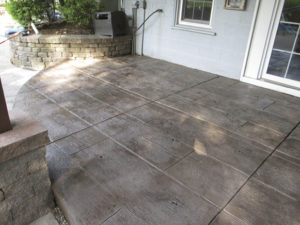
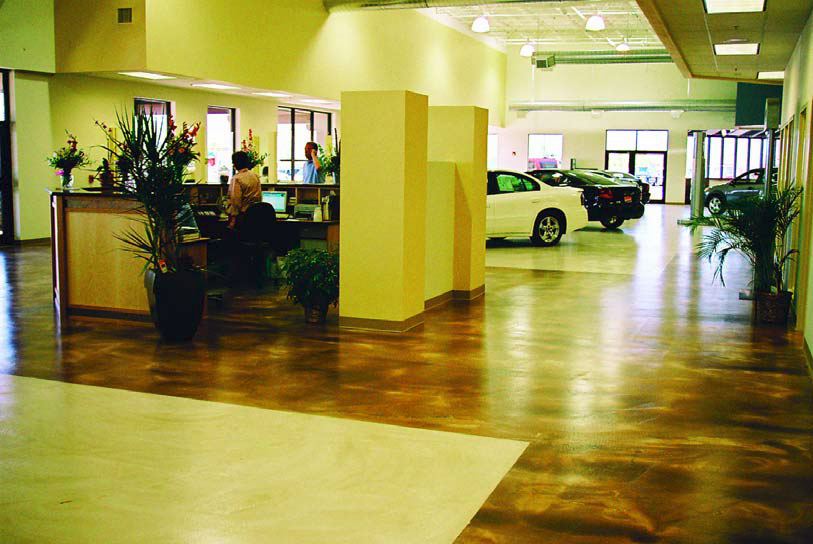
Micro-toppings can be used on interior and exterior surfaces, residential and office walls and floors, lobbies, retail walls and floors, decks, patios, ceilings, countertops, showers, masonry, bleachers, food concession areas, waterparks, sidewalks and driveways. “The more flexible the micro-topping is, the more versatile it is with regards to what substrates it can be used on top of,” says Lee Tizard of Floric Polytech in Rancho Cucamonga, Calif.
Ron Borum of Miracote in Rancho Dominguez, Calif., stresses that these various substrates do need to be in good condition before a micro-topping is applied. “Micro-toppings are not necessarily a solution to resurface distressed concrete,” says Borum.
Gary Anderson of Tri-Co Floors in San Diego, Calif., agrees. “Micro-toppings can do some flexing, but over time they will crack,” says Anderson. “So you need to start with a stable floor.”
Cost-savings
Anderson estimates that micro-toppings can save up to 25 percent compared with using other types of overlayments. Tizard agrees. “Without sealers, micro-toppings can start as low as 45 cents per square foot of material,” he says. “Self-levelers start at $1.50 and go to $3.00 per square foot.” Borum adds that wax and maintenance should be figured into the final cost of the system.
Micro-toppings can be more cost-effective from a materials standpoint, but they’re not always more cost-effective from a labor standpoint, says Tizard. “That really depends on what the profile of the job is and how good the contractor is,” he says.
Design versatility
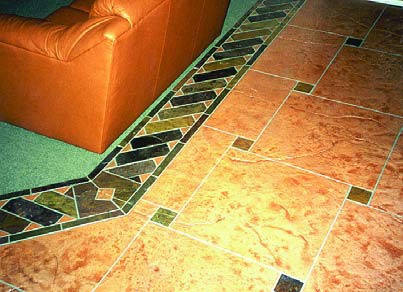
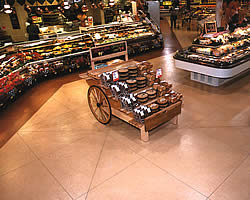
As with other architectural concrete products, you’re limited only by your imagination. “We do a lot of things with micro-toppings that other people don’t do,” says Anderson, who recently installed 23,000 square feet of micro-topping on the concession area floors at the Las Vegas Convention Center.
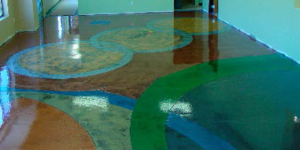
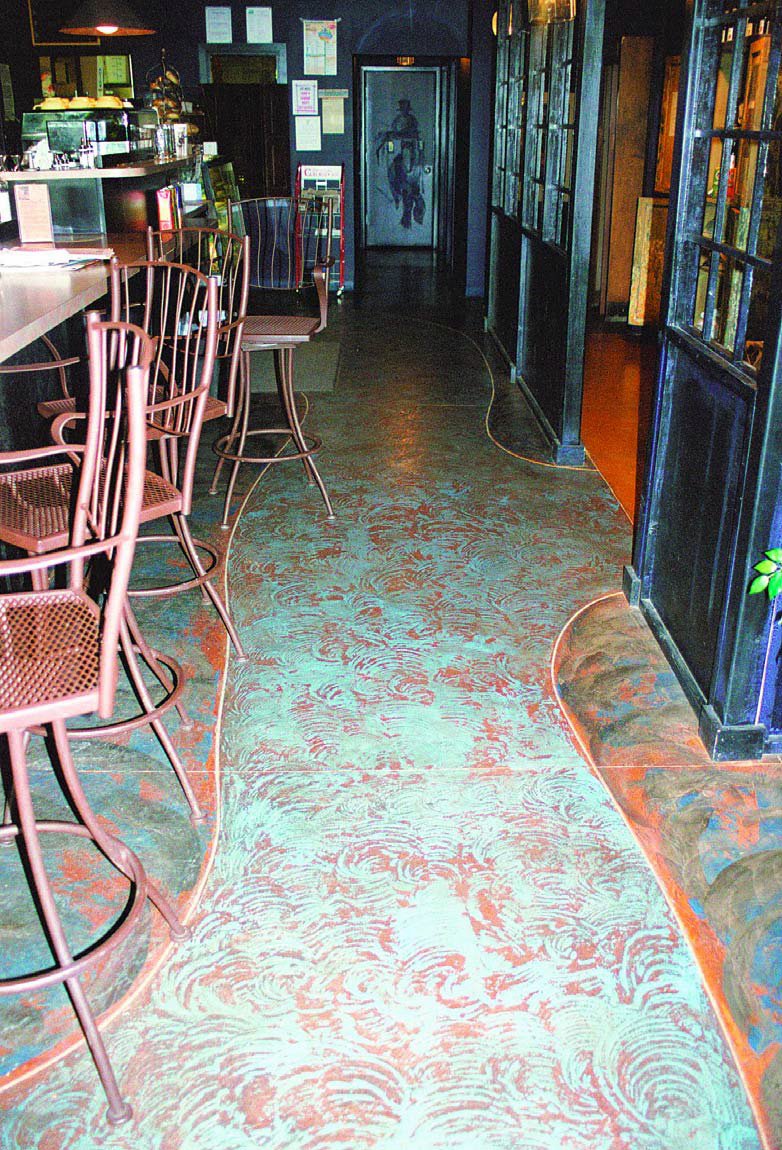
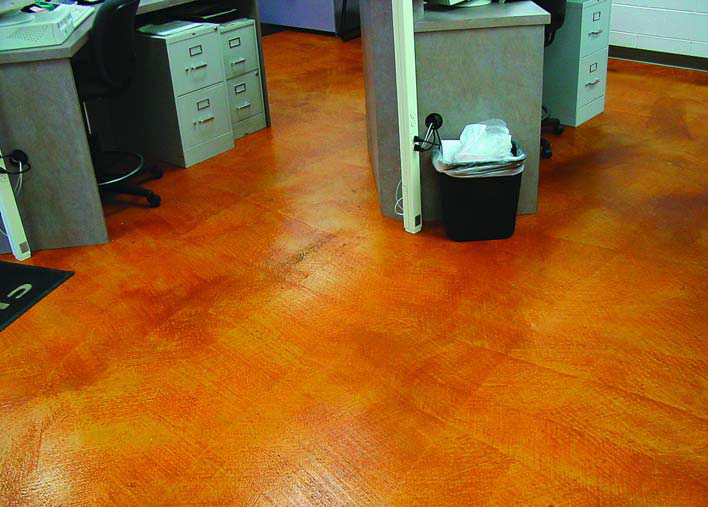
“Micro-toppings offer infinite design, texture and color possibilities,” says Borum. And sealer selection affords multipurpose uses, slip resistance, chemical resistance, easy maintenance and cleaning, a variety of gloss levels, and protection.
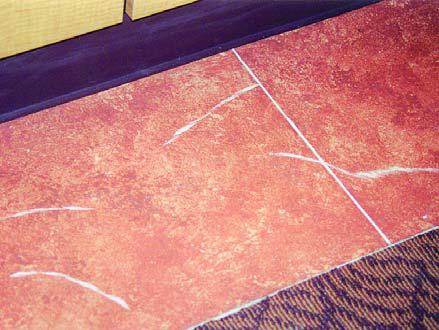
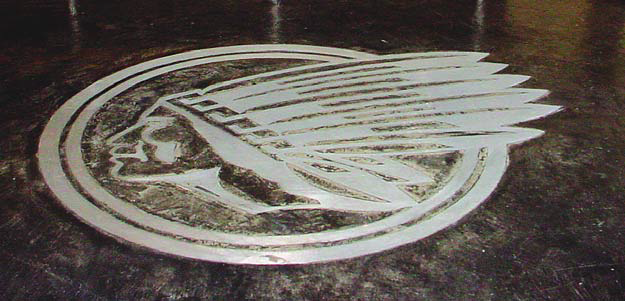
“When used in combination with repair mortars, you can take any existing space and resurface it to make it look like a brand new canvas,” says Tizard. “You can incorporate thin-gauge stainless steel inlays into the micro-topping using Mylar stencils to create patterns. You can overlay the micro-topping with metal and seal it with epoxy to give the effect of terrazzo strips. Sandblasting is often used to achieve the look of a stencil. Micro-toppings can be used on top of self-levelers to enhance features and details of self-levelers. You can achieve a more random look with a slop trowel application method.”
Flexible properties
One of the advantages of micro-toppings over self-levelers has to do with water. “Because micro-toppings don’t require the amount of water that self-levelers do, there are fewer inherent shrinkage issues and subsequently fewer problems with shrinkage cracks,” explains Tizard.
Most micro-toppings also have a higher percentage of polymer solids than self-levelers, which adds flexibility to the product. “If you have a really cracked up slab, you can incorporate micro-toppings with fracture-resistant membranes to create a monolithic slab without the effects of cracking,” says Tizard.
Our experts generally agree that curling is not an issue with this product. As long as the products are well formulated, curling is not a problem, says Borum, who adds that “some micro-toppings are more ridged than others and can be problematic if the substrate moves, expands, contracts or otherwise deforms beyond the micro-topping’s ability to withstand the stress.”
 Surface prep
Proper surface preparation is critical when working with any micro-topping. “Achieving a smooth surface necessitates a mechanic with very good skills,” says Bruce Newbrough, technical services manager at Ardex. Newbrough recommends cleaning the surface with mechanical methods only. “Never use acid etching, solvents or adhesive removers,” he says.
“These systems are coatings and rely on the formation of an integral bond to the substrate,” says Borum. “Surface prep must be directed to achieve this. However, the substrate’s hidden problems can be the most troublesome — weak strength, presence of an unknown bond-inhibiting chemical, poor structural design, lack of or misplaced joints an so on.”
Anderson stresses the importance of properly preparing your substrate. “Proper prep work is everything. We always shotblast the slab to remove all possible contaminants,” says Anderson. “It just gives you a better bite. Sometimes if you’ve got a contaminant on the floor, you may not even see it. But if you don’t properly prepare the floor, those can be your problem areas.”
Tizard cautions that if the slab is severely damaged, the repair can become cost-prohibitive. “Then you’re better off pouring a self-leveler,” he says. Know the extent of the repairs needed before bidding, advises Borum.
 |
 |
“If blemishes and surface irregularities aren’t prefilled and prepatched, then they can telegraph through,” says Tizard, who recommends letting any patch dry thoroughly before applying the micro-topping. Tizard warns against deep-filling a crack with micro-topping material because it prevents uniform hydration, needed to achieve uniform color. “Hydration has to take place slowly up through the surface,” explains Tizard. “If the micro-topping is integrally pigmented, as it hydrates through the surface you will get a much more intense color in that area where the micro-topping is thicker because as the hydration is drawn to the surface it draws the pigment with it.”
“It also draws the polymer with it,” Tizard adds. “So when you acid stain that area with the deep-fill micro-topping, that area with a higher concentration of polymer will stain less because there’s less free alkali. The area adjacent to the deep-fill will stain darker.”
Tizard recommends letting your patch and repair dry thoroughly dry before applying the micro-topping. Use nongypsum-based repair materials whenever possible. Tizard recommends applying one coat of micro-topping, letting it dry thoroughly, and then applying a second coat of micro-topping. The first coat ensures uniform hydration of the second coat. “By applying two coats of micro-topping you can achieve more uniform hydration, more uniform color and more uniform staining,” says Tizard.
Tizard warns against sanding a micro-topping too aggressively. “It is very easy to sand right through it,” he says. “So it’s important to build your micro-topping with a couple coats so you don’t sand through it in one pass.”
Installation and set-up
Micro-toppings can take anywhere from one to 12 hours to set up. Many are walkable within a few hours. Sun and shade variations, ambient temperature, surface and substrate temperatures, humidity, airflow and wind all affect application and performance.
 Set-up also depends on the porosity of your concrete. Porous slabs can draw the moisture out of the micro-topping. “That can make your material set really fast,” says Anderson. “If you’re going over the top of a sealed floor you’ve got a lot more open time because there’s not moisture being drawn out of the micro-topping.”
“Micro-toppings are fairly user-friendly products,” says Anderson, “but every job is different. You can’t always follow the manufacturer’s instructions. Those are written for ideal conditions and you never get ideal conditions on a job. So there are different things that you have to tweak, but always within a safe tolerance.”
 Borum offers these tips for a successful installation: Understand the material’s limits and have a clear understanding of what the end result needs to be. Use a proven product. Require and receive training. Specialize in several applications. Know your labor and experience limits. Know the conditions of your site. And most important, know the science of the substrate.
Maintenance
With proper surface preparation and maintenance, our experts agree that micro-toppings can last a lifetime. “Maintenance is everything,” say Anderson. “Without proper maintenance, your finishes break down and then you’re walking on the product.”
She recommends a good quality, easy-to-maintain wax. “If you use good quality products to maintain micro-toppings, they’ll hold up extremely well and be a fairly low-maintenance floor.”
“Higher mil, high-solid sealers require less maintenance and give more l ongevity than do thin-mil sulfinated or water-based sealers,” adds Tizard.
“Several coats of a sacrificial wax that can be easily buffed out and then stripped and reapplied as necessary will help to protect the appearance of the topping over time,” says Newbrough.
In addition to performing regular cleaning and applying protective sealers and waxes, Borum emphasizes the importance of repairing damaged areas as quickly as possible.