
The rapid expansion of cloud computing, AI and high-performance data processing is reshaping the physical infrastructure that supports the digital economy. Across North America and around the world, new hyperscale data centers are being constructed at an unprecedented pace. These innovative facilities house thousands of servers, cooling systems and electrical components that must operate continuously with minimal interruption. Beneath all this sophisticated technology lies an element that is often overlooked but critically important: the concrete slab-on-ground.
For contractors who typically work in decorative and architectural concrete applications, the design of data center slabs may seem far removed from stamped patios, polished retail floors or colored overlays. Yet many of the same principles governing surface durability, crack control and finishing quality apply – often at a much larger and more demanding scale. One emerging technology that is remodeling how these slabs are designed and constructed is synthetic macrofiber reinforcement.
Originally developed to improve the performance of industrial floors and pavement systems, synthetic macrofibers are now gaining traction in data center construction because they provide enhanced crack control, improved durability and simplified installation compared to conventional steel reinforcement.
As demand for resilient infrastructure continues to rise, understanding how fiber reinforcement works – as well as how it influences placement and finishing – can help decorative concrete contractors broaden their expertise and adapt to new construction opportunities.
The Structural Demands of Data Center Floors
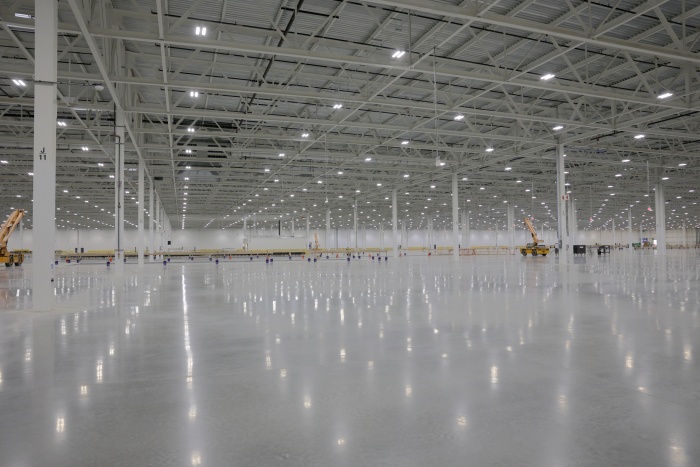
Data centers represent one of the most technically demanding environments for concrete slabs-on-ground. These facilities must support dense arrays of server racks, cooling equipment and power distribution systems while maintaining extremely tight tolerances for flatness and levelness. Even minor floor irregularities can affect the alignment and stability of sensitive equipment.
Unlike many commercial floors that can be modified or resurfaced over time, the slab-on-ground in a data center is essentially permanent once the facility is operational. Repairs are expensive and disruptive because they may require shutting down equipment or relocating servers. As a result, designers prioritize long-term durability and crack control during initial construction.
In addition to static loads, these floors must withstand dynamic stresses from rolling server racks, maintenance equipment and vibrations generated by mechanical systems. Temperature fluctuations and moisture gradients within the slab can also create shrinkage stresses that lead to cracking.
Historically, welded wire mesh or steel reinforcing bars were used to manage these stresses. While effective, steel reinforcement introduces its own challenges. Placement and tying of reinforcement adds labor and scheduling complexity, and improper positioning of welded wire fabric is a common field issue. Steel is also susceptible to corrosion when exposed to moisture or aggressive chemicals.
In response to these limitations, engineers increasingly specify synthetic macrofibers as either a replacement for or supplement to traditional reinforcement in concrete applications.
Understanding Synthetic Macrofibers
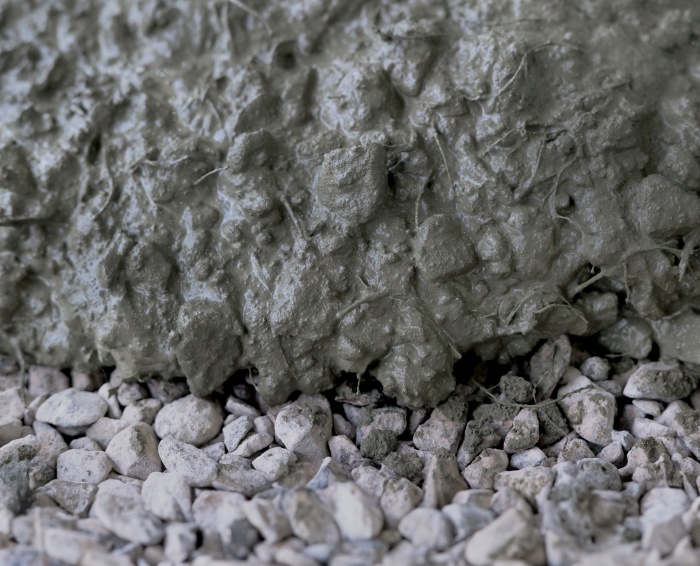
Synthetic macrofibers are engineered polymer fibers, typically manufactured from polypropylene or polyethylene, that are designed to enhance the mechanical behavior of concrete after cracking. Unlike traditional reinforcement that is placed in discrete layers, macrofibers are dispersed throughout the concrete mixture during batching, creating a three-dimensional reinforcing network.
These fibers are significantly larger than conventional microfibers used for plastic shrinkage crack control. Macrofibers are generally between three-quarters of an inch and two inches long and feature textured or embossed surfaces that improve bonding with the cement matrix.
Although concrete is inherently strong in compression, it is relatively weak in tension. Once cracks develop, reinforcement is needed to carry tensile loads and maintain structural integrity. Synthetic macrofibers directly address this issue by bridging cracks as they form, transferring stress across the crack plane and providing post-crack load-bearing capacity.
Practically, this means that a slab reinforced with macrofibers can continue to support loads even after cracking occurs. The fibers distribute stresses throughout the slab thickness, reducing crack widths and improving toughness compared with plain concrete or improperly placed steel reinforcement.
Another big advantage is durability. Because macrofibers are non-corrosive and chemically inert, they do not rust or deteriorate when exposed to moisture, salts or aggressive chemicals, which is an important consideration for long-term performance in large industrial facilities.
Why Macrofibers Make Sense for Data Center Construction
The scale and complexity of modern data center projects make constructability a major factor in material selection. Concrete slabs in these facilities can cover hundreds of thousands of square feet, and construction schedules are often extremely compressed.
By incorporating synthetic macrofibers directly into the concrete mix, contractors can reduce or eliminate the need to place welded wire mesh or rebar across large areas of floor. This simplifies logistics, reduces labor requirements and accelerates placement operations. For large placements, this translate into significant cost savings and schedule reductions. Eliminating steel placement also reduces jobsite hazards associated with lifting, cutting and tying reinforcement.
From an engineering standpoint, synthetic macrofibers are supported by standardized performance testing. Flexural toughness and post-crack capacity are typically evaluated using ASTM C1609 testing, which measures the residual strength of fiber-reinforced concrete after cracking. The results can then be incorporated into concrete slab design methodologies such as ACI 360 (Guide to Design of Slabs-on-Ground) or the widely used TR34 industrial floor design guidance.
These standards allow engineers to quantify the structural contribution of fiber-reinforced slabs that meet load and performance requirements without relying solely on traditional reinforcement.
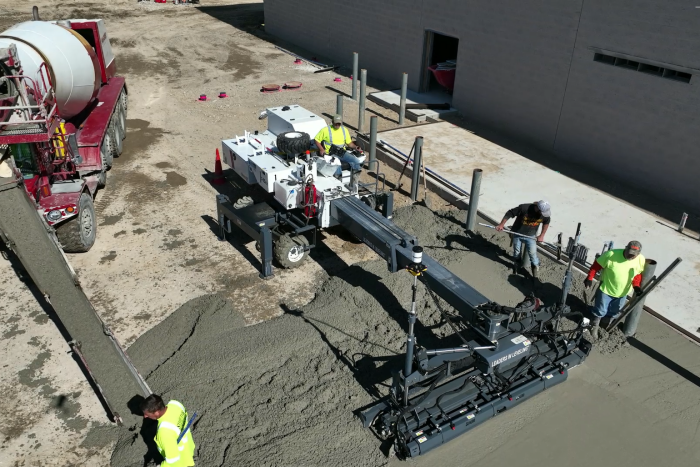
In many data center applications, synthetic macrofibers are used in combination with complementary technologies such as shrinkage-compensating or reducing admixtures to enhance slab performance. While macrofibers control crack widths and provide post-crack load capacity, these admixtures reduce drying shrinkage and curling, lowering the overall cracking potential.
Together, they allow designers to increase joint spacing and, in some cases, reduce the number of contraction joints across large slab areas. This is an important advantage in data centers, where joints can interfere with rack alignment, require additional maintenance and become weak points under repeated loading. Fewer joints generally mean a more continuous and durable floor that performs better over time.
Surface durability and dusting resistance are also critical, as airborne particles can impact sensitive equipment and cooling systems. Dusting typically results from a weak or poorly cured surface, often caused by excessive bleed water, over-finishing or inadequate curing. While synthetic macrofibers are not specifically intended to prevent dusting, they can indirectly improve surface integrity by reducing bleeding and segregation, contributing to a more cohesive matrix.
However, dust resistance ultimately depends on proper mix design, controlled finishing and effective curing. Low water-cement ratios, appropriate curing compounds and surface hardeners or densifiers remain essential to ensure long-term abrasion resistance and minimize particulate generation.
Sustainability Benefits for High-Tech Infrastructure
Sustainability has also become a major consideration in the development of high-performance data centers. While these facilities require enormous amounts of energy to operate, designers are increasingly seeking ways to reduce the environmental impact of their construction.
Concrete reinforcement presents a meaningful opportunity to lower embodied carbon during the construction process. Steel production is energy-intensive and contributes significantly to greenhouse gas emissions. By replacing some or all of the steel reinforcement with synthetic macrofibers, project teams can reduce the overall carbon footprint of the concrete slab system.
In addition, synthetic macrofibers are lightweight and easier to transport than steel reinforcement, further lowering transportation-related emissions. Because fiber-reinforced slabs often exhibit improved durability and reduced cracking, they also require fewer repairs over their lifecycle, which helps to conserve materials and minimize future construction impacts.
What Decorative Concrete Contractors Should Know
Although macrofibers are often associated with heavy-duty industrial floors, their influence extends to finishing practices—an area where decorative concrete contractors already have valuable expertise.
When synthetic macrofibers are added to a concrete mix, the material behaves slightly differently during placement and finishing. The fibers increase cohesion and may cause the concrete to appear stiffer during initial placement. Timing of finishing operations becomes especially important to achieve a smooth surface and prevent fibers from being pulled to the top.
Using a vibratory screed during strike-off can help to consolidate the concrete and distribute fibers evenly throughout the slab. Proper vibration ensures that the macrofibers remain embedded directly within the concrete matrix rather than collecting at the surface.
It is also important that finishing tools be used carefully during place. Steel troweling should be performed only after the concrete has reached sufficient set to avoid dragging fibers upward. In many cases, modern fiber designs—such as twisted or fibrillated geometries—are engineered specifically to minimize surface visibility and improve finishing characteristics.
For contractors who are accustomed to producing decorative finishes such as polished or dyed concrete, fiber reinforcement may initially raise concerns about aesthetics. However, with proper mix design and finishing techniques, fiber-reinforced slabs will achieve excellent surface quality while maintaining the structural benefits of the reinforcement.
Mix Design & Quality Control Considerations
It’s important to understand that the successful use of synthetic macrofibers depends heavily on mix design and quality control during batching and placement. First, the dosage rate must be carefully determined by the project engineer based on anticipated loads and slab thickness. Typical dosages for structural macrofibers range from three to eight pounds per cubic yard of concrete, although higher rates may be specified for more demanding applications.
Uniform fiber dispersion is equally critical. Fibers are typically added during batching at the ready-mix plant, where they are mixed thoroughly to prevent clumping or “fiber balling.” Adequate mixing time ensures the fibers distribute evenly throughout the concrete matrix.
Workability adjustments may also be required. Because synthetic macrofibers increase the effective surface area in the concrete, water-reducing admixtures are often used to maintain pumpability, when necessary, and finishing characteristics without increasing the water-cement ratio.
Contractors must also coordinate closely with material suppliers and engineers to verify that the fiber-reinforced mix meets performance specifications through laboratory testing and field quality control.
The Role of Fibers in Future Concrete Construction
As digital infrastructure continues to expand, the demand for durable and resilient data center floors will only grow. Synthetic macrofibers offer a compelling solution that aligns with the industry’s goals of improved performance, faster construction and reduced environmental impact.
For decorative concrete contractors, understanding this technology provides an opportunity to expand into new types of work while applying familiar finishing and quality control skills. The principles of surface integrity, crack control and durability are universal, whether the project is a decorative plaza, a polished retail floor or the structural slab supporting thousands of servers in a hyperscale data center.
Beyond being a new reinforcement option, synthetic macrofibers are part of a broader shift toward smarter concrete design that integrates advanced materials, engineering science and construction efficiency to create infrastructure capable of supporting the digital world for decades to come.


