

 Veteran concrete contractorsare generally well aware of the potential health hazards of working with dry portland cement and wet concrete, and the necessary precautions that should be taken to avoid illness or injury. But it’s wise to review those hazards and precautions every now and then to ensure against harmful exposure.
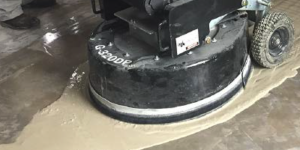
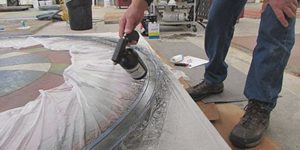
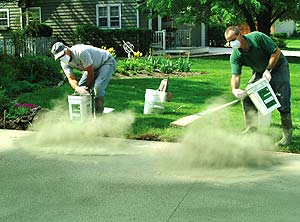
Cement and aggregate both contain trace amounts of crystalline silica, alkaline compounds such as calcium oxide, and hexavalent chromium, all of which can result in serious short-term or long-term health problems. For example, when concrete workers are using sanding equipment, dumping out bags of cement, or making dry sawcuts for decorative concrete applications, they create substantial volumes of airborne dust. This dust, if inhaled repeatedly over prolonged periods, can cause silicosis, a lung disease that can be disabling or even fatal. Exposure to cement dust containing crystalline silica can also cause serious eye irritation, chemical burns, or, in extreme cases, blindness. Some workers may find that airborne dust can cause mild skin reactions as well.
A small percentage of cement workers is likely to develop a hypersensitivity to the hexavalent chromium found in cement. This typically manifests itself in any number of allergies, most notably skin reactions or respiratory problems such as wheezing or asthma-like symptoms.
In addition to these maladies associated with cement dust, working with wet concrete can also pose serious health hazards. Because of its abrasive, caustic and drying properties, wet concrete that comes in contact with the skin for even short periods of time can actually penetrate and burn the skin if not promptly detected and washed off. Wet cement that makes continuous contact directly with skin or through soaked clothing can cause first-, second- or third-degree burns that may require skin grafts and months of convalescence.
With all these potential health concerns, one might come to regard concrete as a hazardous substance. However, thousands of concrete contractors work with cement all day every day without incident, notes Andrew O’Hare, Vice President of Governmental Affairs for the Portland Cement Association. “Although workers can theoretically have the potential for getting silicosis over a lifetime of exposure to silica, the incident rate is not even measurable. There is no significant documentation of cases in our industry as there is in, for instance, the sandblasting environment, or in the aggregate industry, where you’re crushing stone day in and day out and the risk is significantly greater. The good news for concrete workers is, these potential health problems are easily remedied through the use of proper personal protection equipment. If you follow simple, common-sense precautions, injury and illness can be totally avoided.”
Simple precautions guard health
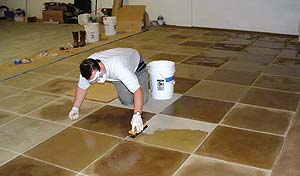
First and foremost is the use of adequate eye protection and dust masks or respirators for workers who are repeatedly exposed to cement dust. Safety glasses with sideshields, or goggles, are the best choice. “It’s always a good idea to protect your eyes because they’re so vulnerable to dust,” says O’Hare. “You should also wear a mask, particularly if your work site is not sufficiently ventilated. The type of mask you choose depends on the duration of your exposure to dust. If you’re around it all day, you should probably have a high-quality mask or respirator, but if it’s just an occasional part of your job, then the temporary masks so many workers wear should be fine. Generally, cement dust particles are in the 10-micron range, which are captured by the inexpensive masks.”
Limiting exposure of wet cement to the skin is easily achieved through the use of waterproof or rubber gloves, rubber boots, and long sleeves and long pants. If skin comes in contact with wet cement, it should be immediately washed with cool clean water. “Below the knee and below the elbow are the areas of primary concern,” O’Hare notes. “Pick gloves sturdy enough not to rip but flexible enough to allow for dexterity. For those who must sometimes stand in wet concrete while it is being placed or finished, the boots you select should be high enough to prevent concrete from getting into them. Don’t forget to wash thoroughly with pH-neutral soap and clean water at the end of each shift.”
The Portland Cement Association, the American Society of Concrete Contractors, and the Occupational Safety and Health Administration offer printed materials, videos and other information about on-the-job safety training and procedures.