 Integral color and color hardener are still the most common ways to tint concrete. But these days, the buzz is all about acid stain.
“It’s one of the most popular things that’s going, period,” says Sherry White, director of corporate communications for L.M. Scofield Co. “As far as people calling us with inquiries, it’s the hottest thing we have going.”
Barbara Sargent, owner of Kemiko Concrete Products Inc., agrees. Acid stain gives even the blandest concrete slab a blast of unique character, she says. “Every floor comes up different. I’m not slamming integral color, but that’s more monochromatic and uniform than acid stain.”
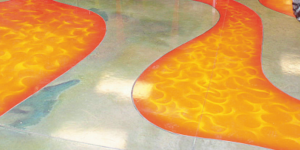
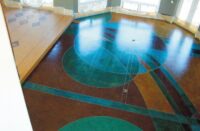
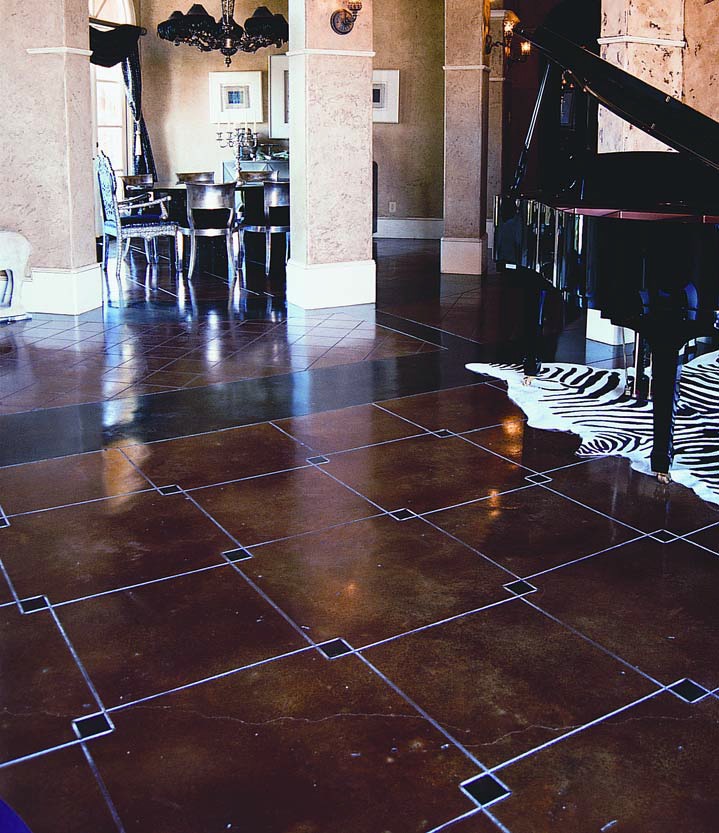
Stain bonds chemically with concrete, creating crystal formations that lend color to the slab. Because the stain is the result of many individual chemical reactions, the tint is uneven — gloriously so. It can contain marbling, mottling and all kinds of variations in the base hue. It can be manipulated to duplicate the shadings of natural stone or the effects of age. What’s more, it’s translucent, allowing variations in the substrate to show through. Each stained floor has a look that can’t be duplicated, even with another batch of the same stain.
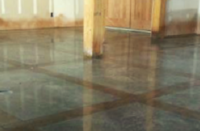
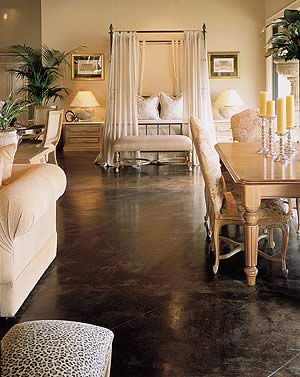
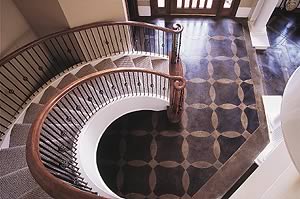 Sargent stained the floors in her home with her company’s tan stain, and she sees all kinds of delicious shades in the result: caramel, creamed coffee, buckskin suede. Her company’s most popular color, cola, turns out a floor that looks like old distressed leather, she says.
“Landscape architects love staining concrete because concrete is boring and bland to them,” she says. “Concrete is plain by nature. If an owner has gone to all the trouble to landscape it, it just finishes off the home.”
A homeowner who stains a kitchen floor doesn’t have to buy tile or carpet. Stained floors are easy to clean, making them ideal for pet owners and working parents. Acid stain resists snow, mud and sand, and doesn’t attract allergens. And it wears only as the concrete wears.
Acid stains can color interior and exterior surfaces, from garden statuary and urns to settees and fireplace mantles to countertops and sinks. Stained driveways are increasingly popular, Sargent says.
Age is not a factor. Decades-old concrete will stain as easily as fresh. Concrete that is tinted with integral color or dry-shake hardener will take stain just fine.
How it works
These are the basics about acid stain: The acid, often a mild hydrochloric acid, is mixed with metal oxides or trace minerals, the particles small enough to penetrate the capillaries of concrete.
“Acid stains aren’t as acidic as most people think they are,” says Lee Tizard, vice president of Floric Polytech Inc. “The solution of acid isn’t that high. It’s not profiling the surface.”
The concrete must be properly hydrated for the process to work. It must be properly cured, at least a couple of weeks old. And it must contain lime.
When the solution is applied, the topical colorants react with the lime to create insoluble crystalline compounds. In general, the higher the cement content, the more intense the color, because there is more available free alkali in the concrete.
The crystalline forms penetrate usually between one-sixteenth and one-eighth of an inch. The deeper the stain, the longer it will stand up to wear.
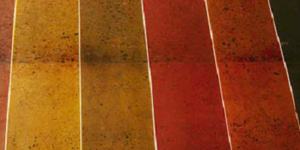
Acid stains come in blacks, blue-greens, and earth tones ranging from reds to tans. But the same color of stain will oxidize differently when subjected to the smallest variation — when puddled, for example, green stain may turn the concrete brown instead.
“Acid staining is an unpredictable animal,” says Tizard. “The oxidization of the crystallization as it’s forming gives different intensities of color and stain.”
What’s more, lime varies from quarry to quarry, which also affects color. A tan stain that looks the color of buckskin in Texas, for example, may turn out more russet in Colorado, Sargent says.
All stains are not the same, says Shellie Rigsby, a Dallas, Texas, contractor who specializes in acid stains. Some products marketed as “concrete stains” are, in fact, paint or pigmented sealer, she says. Paint starts out the same color it dries into, but acid stain doesn’t. “Black stain usually starts out bright yellow,” she says. “Red stain usually starts out a green.”
Green and blue acid stains are risky outdoors, because when they are exposed to water, they may change into black or brown, she says. On the other hand, paints tend to be sensitive to ultraviolet rays, while acid stain is not.
Also, each manufacturer has a different recipe for acid stain, she says. Some come ready to use, while others are concentrated, less expensive but with more potential for contractor error. They also vary in terms of strength of acid and particle size. “Acid stain in some ways is like a bottle of wine,” she says. “A merlot is a merlot is a merlot, but they’re all a little bit different.”

Prep work
By far the best way to ensure the results you want is to obtain a sample of the acid from the manufacturer and test it on one or two square feet of concrete. “I don’t think you can say, on an individual basis, what will or won’t work,” says Tizard. “That’s why you do mockups.”
It’s also important to evaluate the manufacturer, Rigsby says. “If a company has good customer service, that is a good indicator of a good product.”
L.M. Scofield’s Web site, which describes prep work and spray techniques, stresses that different substrates require different types of preparation. “If the surface is too porous, too dense, or covered with any contaminants, the stain may not penetrate the surface.”
If the floor is coated with paint, sealer or any other topping that is not cementitious, it needs to be stripped before acid stain is applied. Even a streak of clear sealer, invisible before the stain, will show up vividly on a slab after a stain.
A floor that is tightly troweled will accept stain differently than a floor that was broom-finished. “The tighter the concrete, the less porous it is, and the less penetration you get,” Rigsby says. “The depth of penetration has a lot to do with the life of a decorative floor.”
Shot-blasting, sanding, and brush or pad work are all acceptable choices for prepping a floor. Do not, however, use acid wash. It will neutralize the lime in the concrete, and the acid stain won’t take.
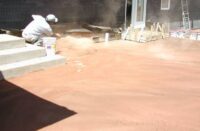
The stain can be applied with an inexpensive garden sprayer, but use one that is plastic; acid will ruin metal. In smaller areas, use a sponge brush.
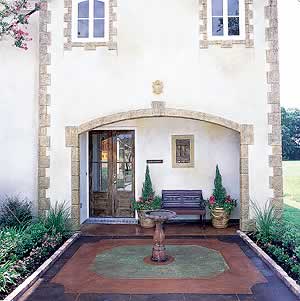
Perhaps the most critical part of the job comes after the stain has dried: cleaning residue off the surface of the slab. Scofield’s Web site explains: “When Chemstain is applied to concrete it reacts with the calcium hydroxide. Once that reaction is complete, there’s a residue on the surface that must be removed before sealing. (Mopping the surface is not an effective way to remove the residue because you spread contaminated water each time you return the mop to the surface.)” Instead, the site advised, buff the dry residue using a white pad, then sweep up or vacuum.
The surface should be neutralized with a cleaner such as baking soda or ammonia. “I’m a stickler for ammonia,” Tizard says. It’s caustic, strongly alkaline, and doesn’t leave residue like powders, he says.
The crystallizing color can take a while to form. Sargent says her company’s black stain will show results within the hour, but their tan will not impress until the following day. “I’ve seen them take a couple of days to generate color, although not ours,” Tizard says. “Everybody is going to have different variables with acid stain.”
Because acid stain is translucent, it will not mask any spots or marks. But Sargent offers a solution that will work on, say, an oil-stained garage floor. Lay down two coats of her company’s “cola,” then follow with a light, random scattering of black stain. The eye will have a hard time finding the stain spots, she says.
Finish the job with a sealer. If it’s an interior job, there are also waxes designed for the occasion.

Special effects
Because wet acid stain responds so dramatically to disturbances, contractors like to get creative with their floor patterns.
Ragging, splattering and sponging are common. An air compressor can be used to smear secondary stain colors to simulate marble. Sealer sponged onto an area will resist acid stain applied afterward.
Contractors are known to throw everything short of the family cat onto a floor of wet stain, anticipating the wrinkles and distortions that result from the variations in oxidation. Possibilities include rock salt, fronds, leaves, sand, straw, sawdust, Visqueen membrane, fertilizer, crumpled newspaper, cereal and spaghetti noodles. “The only problem with these techniques is that they are generally a little bit messy,” Tizard says. “They are hard to clean up.”
Tizard’s company also makes a thickening powder that turns acid stain into “profiling jelly.” Jellied stain will cling to walls without dripping and help create formations with crisp, bleed-free edges.
“There are really no rules in acid staining,” Tizard says. “Acid staining is a technology, not necessarily a product. Whether you dilute it, whether you apply by brush or not — these all are different aspects of technique.”