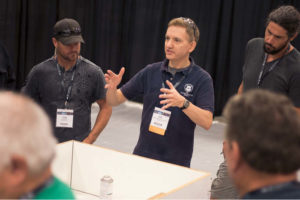



 As most concrete contractors are aware, the market for decorative concrete has grown exponentially over the past 25 years, and especially during the past 8-10 years. What was once a highly specialized application limited to theme parks, resorts and casinos has become an established niche market with thousands of installations in a broad range of commercial, residential, corporate and hospitality environments.
Not surprisingly, the money-making opportunities inherent in decorative concrete installation have not gone unnoticed. Experienced concrete contractors are taking advantage of this “sexy” niche in order to improve their bottom line. In addition, artistically inclined newcomers with limited background in concrete are also trying their hand at designing and installing decorative concrete.
Therein lies a big problem, both real and potential, according to knowledgeable industry insiders. While there are without question some very highly skilled practitioners out there doing outstanding work with decorative concrete, there are, regrettably, too many people with little or no training or education in proper installation techniques. Their efforts are often unsuccessful or inferior, resulting in unhappy customers and a black eye on the industry’s overall public image.
“One bad job by an inexperienced contractor can poison the well for the people who do a good job,” asserts Ward Malisch, senior managing director of the American Concrete Institute (ACI). “There are people who say, ‘Wow, this is great, it’s a booming market, I want to jump right in and get some of that business.’ But it’s more difficult than it looks. Concrete is a unique material with many variables involved, and you have to know how to deal with them. Proper training from someone with significant field experience is crucial.”
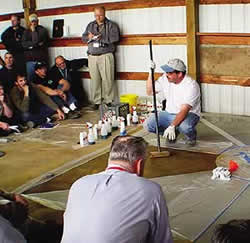
 Bev Garnett of the American Society of Concrete Construction (ASCC) agrees. “Our mission is to promote quality installation, whether it’s basic gray concrete driveways or fancy decorative work. You absolutely have to know the basics of working with concrete before you can do decorative concrete. If all you do is attend a one-day seminar and watch someone stamp and stain a 3′ x 3′ concrete sample, and then think you can do it yourself, you’re in for some trouble.”
There are many professional opportunities for the concrete contractor who wants to further his or her education and training in installing decorative concrete. Both ACI and ASCC periodically offer various seminars and courses in different regional locations across the country. A number of manufacturers also offer instructional sessions that explain how and where their products are best used in decorative concrete applications.
Everyone in the industry seems to agree that training is a wise investment. “It’s probably the best investment a contractor can make,” says Bob Harris, president of the Decorative Concrete Institute in Atlanta and a recognized leader in training and education in the industry. “Not only will students learn the necessary skills and techniques needed to install a particular manufacturer’s product, they can interface with other contractor students and learn from each other during the classes.”
As with any situation where one is faced with numerous choices of varying quality, it’s vital that the contractor do his homework. He needs to decide what he wants to learn, and he needs to investigate the various offerings and find out about the teacher’s background and how the course is structured.
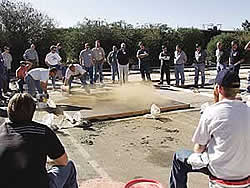
The first step is to determine goals, says Steve Jarred, a field representative with Mason’s Supply in Eugene, Ore. “They need to start by asking themselves what they’re looking to do. Are they interested in learning about all kinds of decorative concrete? Maybe they want to focus on just one part of the market, like stamping. They need to get more involved and in touch with what’s happening. They need to ask questions, read the trade magazines, come to the supply houses, and visit jobsites to see what the various applications look like and how to install them.”
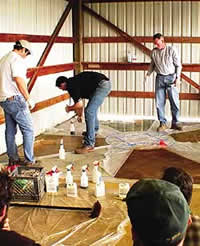
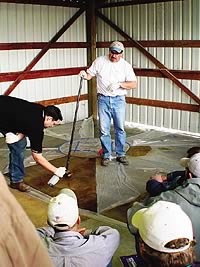
Once the contractor has determined his areas of interest, he needs to ask pointed questions about the seminars he is considering. “”Probably the most important thing is to find out about the teacher,” states Wes Vollmer, a San Antonio-based contractor and independent consultant who has helped teach seminars. “The teacher should be much more than just a salesman or distributor. The teacher should be someone who has a lot of experience actually installing decorative concrete. If the teacher hasn’t ‘been there, done that,’ then they’re just showing you pictures of how the product looks, and you’re not learning much in the way of technique. The seminar should give plenty of time for each person to get some hands-on experience working with the products and trying the techniques.”
 Harris concurs. “There are plenty of good schools out there, but unfortunately, there are bad ones as well. For instance, be wary of one-day classes that try to cover too many topics. If your desire is to learn staining techniques, choose a course with the emphasis on staining. Some schools give just enough information for newcomers to end up doing harm, which does nothing but hurt the industry overall.”
Word of mouth is an effective way to learn of a specific program’s worth, notes Malisch. “Talk to people who have attended the course. Did they teach useful skills or were they just trying to sell product? If you visit websites like www.decorativeconcrete.net, you can get feedback from others who have posted their thoughts and comments. At major events like World of Concrete, there are many opportunities to compare notes with others in the industry.”
 Training seminars should include a mix of classroom instruction and hands-on demonstration, believes Clark Branum of Rafco Products. “Both offer distinct advantages and the best programs combine the two. Both are necessary for a successful education. Also, contractors should ensure that the program can offer technical support after the class is completed.”
There has been some talk about establishing certification programs for those who have successfully completed training seminars, but there are difficulties in doing so. Says Branum, “A certification’s value depends on the value or expertise of the organization that issues it. Certificates show only that you attended the class. They don’t confirm if you’re competent.”
If structured properly, a certification program can be a good idea, says Harris, “but in order to certify, prefer, or approve a potential installer to use a certain product requires extensive training that cannot be taught in one day or on an 8′ x 8′ panel.”
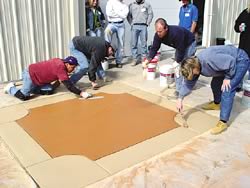 Relatively speaking, the decorative concrete industry is in its infancy. “If a guy with insufficient knowledge lands a job, then finds he’s unable to do it and walks away, that hurts the industry overall,” says Vollmer. “At ASCC, we’ve organized the Decorative Concrete Council, and we’re always looking for ways to better the whole industry. We need to help these guys be better businessmen and be more successful. Proper training plays a large part in that.”
Branum says, “Contractor training increases the overall level of expertise in the field, and improves the presence of quality work over poorly done projects. Happy customers mean happy contractors, and happy contractors mean happy distributors and manufacturers.”
Concrete Decor offers a comprehensive listing of learning opportunities on our website, concretedecor.net. Our training directory and calendar of seminars and events provides the latest on dates, locations and subject matter with links to providers for more information.