
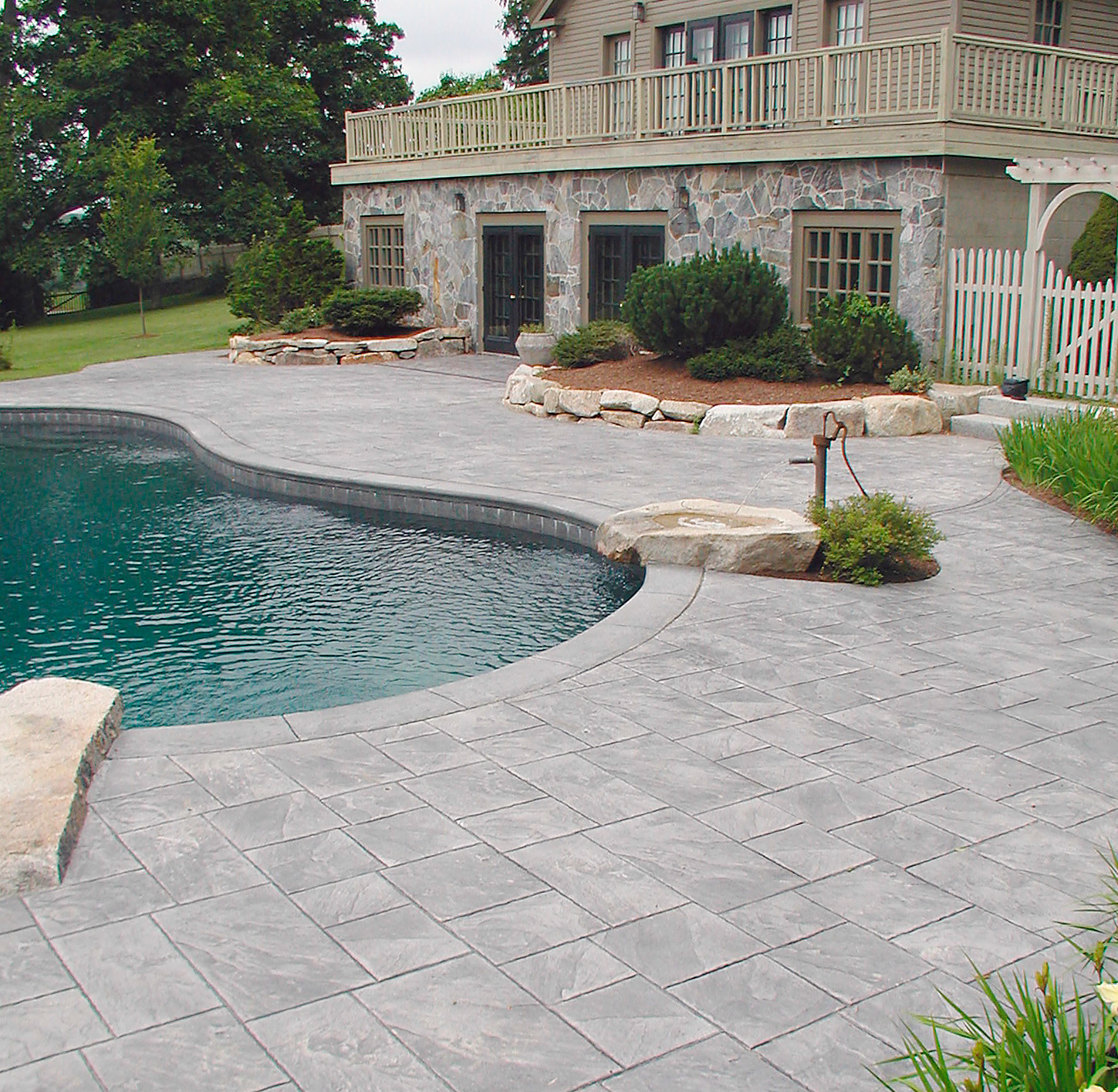
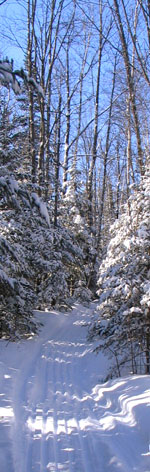
Talk about extremes. Minnesota’s record low in January and February is minus 60 degrees F, while in July, temperatures can climb to a searing 105. Many areas of the United States and Canada experience similar temperature fluctuations.
Despite customer concerns, decorative concrete contractors in the northern U.S. and in Canada are proving time and time again that decorative concrete can weather these extremes very nicely. But, just as contractors in southern climes know the tricks of concreting in hot weather, contractors in the north need to understand the special challenges of cold weather concreting.
“Cold weather concreting is a well-choreographed event requiring warm water, heated substrate, admixtures, adjusted cold weather mix design, heated materials and even the use of heating blankets,” observes Sean Fallon, admixture product manager for the Euclid Chemical Co.
Ambient temperature is an important factor. Brad Berg, vice president of Architectural Enhancements in Montgomery, Minn., says his rule of thumb is a minimum of 40 degrees for overlays. For concrete pours, the temperature can be pushed a little bit lower.
Most experts are of like mind
Robert Meltzer of MRT Construction Products in Entwistle, Alberta, recommends the temperature be 40 degrees or warmer, with a minimum curing temperature of 50 degrees for a minimum of three to seven days until the concrete reaches 70 percent of its design strength. “If the concrete freezes before it achieves 500 psi compressive strength,” Fallon adds, “the final hardened properties may be compromised and result in durability issues.”
|
|
|
|
|
|
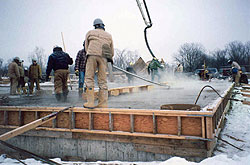
Many potential problems can be eliminated with the right mix design. However, as Fallon aptly points out, “adjustments to the mix design will vary depending on how severe the cold weather is. Cold weather in Tennessee is defined differently than cold weather in Minneapolis.” It is critical to make sure the concrete producer you use has historical information on hardened properties of cold weather concrete mix in your area.
Berg says ready-mix suppliers should adjust for cold weather conditions, but often it is overlooked or put on the contractor’s shoulders, so it is important that the contractor be knowledgeable, too.
As Meltzer says, “The need for proper air entraining, adequate cement content, low W/CM ratio, proper curing and proper maturing can not be emphasized enough for decorative concrete, to preserve the investment.”
Getting it right
Air entrainment is very important for freeze-thaw durability. Michael Littlefield, principal of Custom Concrete Design Inc. in Kennebunkport, Maine, says his crew is very attentive to this issue. “We always use an exterior mix with adequate air entrainment, and we’re sure not to overwork the surface. Overworking the surface (excessive troweling) will remove all the air bubbles from the surface. Those air bubbles prevent spalling (surface delamination) by allowing moisture to expand and contract when frozen.”
Fallon says higher cement content can help, too, by creating heat within the concrete mix as it starts to hydrate. But, if the temperature is expected to hover between 20 and 30 degrees, an accelerator might provide the needed solution.
Meltzer points out that, as a rule of thumb, a 10 degree drop in temperature will double the set time of concrete. Adding 1 percent accelerator will counteract this, he says.
“Despite the wind-chill factor, accelerators allow the concrete to set up like it’s an 80 degree summer day,” Littlefield explains. But he recommends using a non-chloride based accelerator because calcium chloride-based accelerators will weaken the structural integrity of the concrete.
| Contractor tip: Michael Littlefield, principal of Custom Concrete Design Inc. in Kennebunkport, Maine, says that year-round, one of his best tools is the canopy. “We use canopies in the spring so we can continue to work when we have weeks of rain. In the summer we use canopies to cover areas to allow for more working time and to help minimize variations in color between sections. Typically, a morning section sets slower and has less sun exposure. The canopy is our means of recreating these conditions for the afternoon section, which has direct sun exposure and at times excessive wind, causing both a rapid set and potential surface cracking from the surface drying out too quickly. In the fall we use canopies to eliminate shade lines, which cause uneven setting of the concrete, making it difficult to achieve a consistent impression. And when it gets cold, the canopy allows us to enclose the area and heat if necessary. I don’t think I would have made it in this business if it weren’t for the use of the canopy. It has allowed us to create a controlled environment in an ever-changing climate. |
Also, don’t use the wrong aggregate, such as lime or shale, Berg cautions. “Typically, in the freeze/thaw cycle the soft rock will shrink and expand and water and ice will sit in the open pockets, further deteriorating the slab. This can be prevented by using quartz and granite mixes. While there is an up-charge, it will save you in the long run.”
A variety of other tools are available for cold weather concreting: ground heaters, heating blankets and insulated blankets, to name a few.
John Buteyn, senior technical manager for Colorado Hardscapes in Denver, reports ground heaters are good for thawing frozen sub-grade, but not for curing the concrete.
Most contractors use poly or insulated blankets to prevent the concrete from freezing before it cures. But Littlefield says it’s important when covering concrete that each section receives the same treatment as the others. “If one section is covered due to extreme weather conditions, all other sections must be covered as well, even if it was not necessary to cover a section that was poured when it was warm. This will ensure the least amount of color variation between sections. We also use border patterns to minimize the appearance of color variations between sections.”
Buteyn has comparable issues. “Avoiding the staining of concrete from the use of insulated concrete blankets is one of our bigger concerns. We cover for the least amount of time necessary and try to create a breathable barrier between the concrete and our blankets.”
There is healthy debate among contractors about the use of overlays and color hardeners in cold weather concreting.
Berg likes overlays, saying they provide a variety of options for his decorative concrete customers, but he recommends working only with products from manufacturers who understand cold weather climates. He prefers to steer clear of color hardeners.
Littlefield, on the other hand, never uses overlays on his Maine jobs. “It’s not that overlay products are not effective, but once moisture finds its way between the two products and freezes, that overlay is going to pop right off during the thaw.” He prefers color hardeners, which he says increase surface strength, creating a more durable and impenetrable wear surface.
But Meltzer doesn’t recommend the use of color hardeners on air-entrained concrete with high cement content. He says that in these applications there is not enough bleed water available for the hardener to be properly worked in and, at the same time, properly hydrate the cementitious material in the hardener. Plus, he adds, working the hardener into the surface deteriorates the air void matrix in the surface of the concrete.
Except for the higher cost and the need for proper air entrainment, use of integral color is fine for cold weather concreting.
 Winter de-icing and snow-removal tips for decorative concrete
|
Sealing
Most experts agree that proper sealing of concrete installed during cold weather is important, but it generally can’t be rushed. Typically, one should wait 28 days so the free water has had an opportunity to evaporate. Surface temperature should be at least 50 degrees. But some contractors have come up with temporary solutions if the weather doesn’t cooperate. For example, Littlefield waits three days and applies a fine coat of sealer to hold the project over until spring, when he returns to apply the final sealer.
In any event, when it eventually gets so cold that the ground freezes, the outdoor concrete season comes to an end, until the frost leaves the ground in spring.
For new and experienced contractors alike, it comes down to knowing what you’re doing before you tackle cold weather concreting. The ACI specifications in the U.S. and CSA specs in Canada should be your guide.
As Meltzer points out, decorative concrete, properly installed, will hold up to harsh environments — such as freeze-thaw, saturation, de-icing salts and salt water — as well as regular concrete does.
Maybe even better, according to Buteyn, who says, “Due to high cement content, use of color hardeners and regular use of sealers, our decorative concrete may even be more durable in our cold climate.”