
“Rebuilt To Last.” That is the title of an article in the September 25, 2006, issue of BusinessWeek on remanufacturing. And what are you doing to an existing concrete floor when you restore it? You are remanufacturing, and the term fits polished concrete “to a T.”
Last year at this time I was writing my column that led up to the U.S. Green Building Council’s (USGBC) Greenbuild show in Atlanta in November. I titled it “Common Sense plus Dollars and Cents equals Green Sense, or so you would think.” The tone and direction of the column led the editor of Concrete Decor at that time, to call it “my rant.” Whether in jest or not, she wasn’t far off. Well, this year Greenbuild was held in Denver from November 14-16, and I went back a little mellower and hopefully a little bit wiser.
I again want to focus on how polished concrete is the ideal sustainable floor, but from the viewpoint of reusing or remanufacturing existing material. Polished concrete in conjunction with densification, such as the RetroPlate System, is the hands-down winner in life-cycle evaluation. It is less expensive over a 10-year life cycle than any other floor coating or covering. Period. It’s a given that a new polished concrete floor meets these criteria, but this year I will focus on a truly renewable floor — the existing concrete floor.
Polished concrete as the poster child of renewable flooring
Not only should an existing concrete floor be the poster child of renewable flooring, it is the only renewable flooring that can be renewed on-site. How many miles does a “renewable” carpet travel to be “renewed,” and what about the costs of removing it?
In an article I ran across recently, one of the main carpet tile manufacturers talked about how “it would reclaim its own products and use them as raw material for new textiles.” If that carpet tile were installed on the West Coast, and then shipped to the East Coast for recycling, that carpet tile must go thousands of miles just to become “renewable.” The existing concrete floor would not have had to move one inch! Tell me, when a building requires renovation, which flooring option is truly sustainable — carpet tile or polished and densified concrete? Don’t get me wrong: I am thrilled when any industry or individual commits to recycling and minimizing their impact on the environment. But the “rant” part of me wants to open the eyes of the designer, the specifier, the owner and end user to the viability of the truly renewable floor — existing concrete!
I will focus on three situations where existing concrete floors can be rejuvenated through the polished concrete process at a dollar cost, and cost to the environment, that is far less expensive than other coatings or coverings.
 |
 |
Replacement of an existing covering
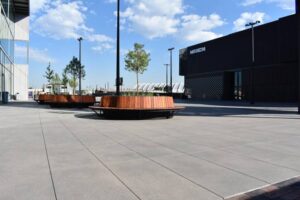
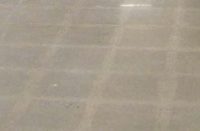
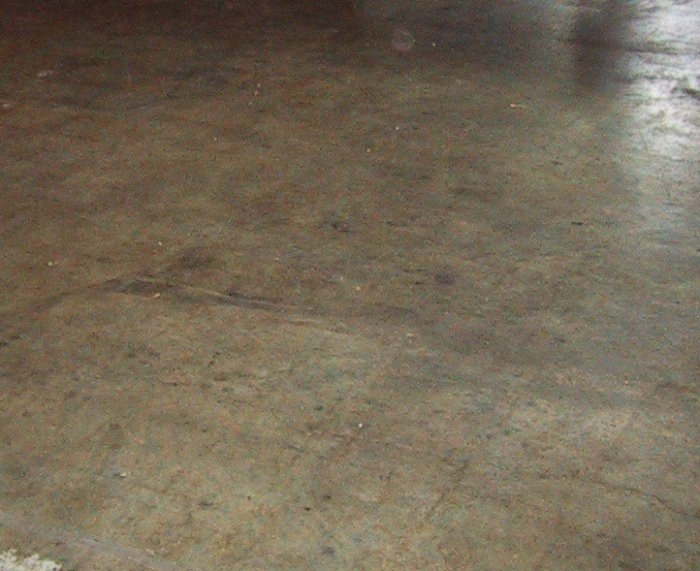
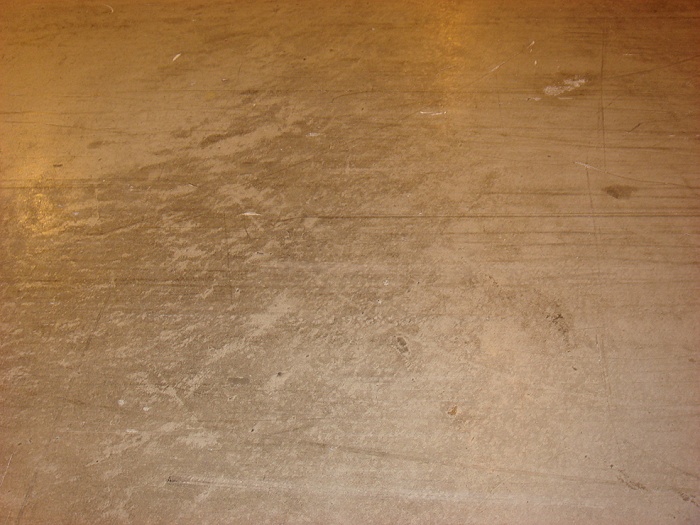
(Photos 1-2) When the existing concrete floor coating is removed during a renovation or remodel, you may find that the floor is not usable in its existing state. Generally, though, any imperfections that exist will be removed, or can be fixed, during the remanufacturing and restoration process of patching, grinding and polishing. Typically, when replacing an existing floor covering, you must take into account:
- Removal of the existing floor covering.
- Disposal of the existing floor covering, either in a landfill or by transporting it back to the manufacturer thousands of miles away.
- Preparation of the floor for a new installation, sometimes requiring floor profiling.
- Reinstallation of the new product that has been shipped, on average, several thousand miles.
- Have ongoing maintenance costs of $1.50 per square foot annually.
- Producing a potentially negative impact on indoor air quality.
- Having to repeat the process three to 10 years down the road.
Polished concrete vs carpet
By replacing the floor covering with polished concrete, you are short-circuiting the vicious cycle that is caused by the higher life-cycle cost of carpet in general. The breakeven point for investing in polished concrete, with or without color, is on average only one to two years, and that comes without the additional costs of tear-up, removal and preparation of carpet replacement. In a recent education case study on Benjamin Franklin Elementary School in Kirkland, Wash., a LEED project completed in August 2005, BuildingGreen.com addresses the optimal flooring products for schools, adding the importance of indoor environmental air quality for children.
The case study highlights polished concrete as a prime example of the proper flooring. It states, “For example, the RetroPlated concrete floor finish provides the school with an extremely durable finish, a surface that only requires hot-mopping for cleaning, and improved air quality (by avoiding applied adhesives and surfaces on which dust and mold could collect).” Old or new, polished concrete eliminates a lot of costs and concerns.
 |
 |
|
Restoration of a carbonized floor
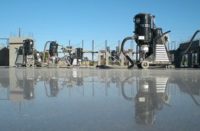
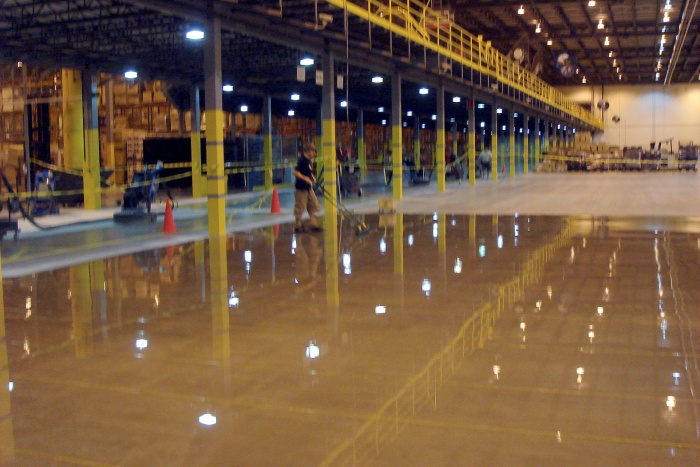
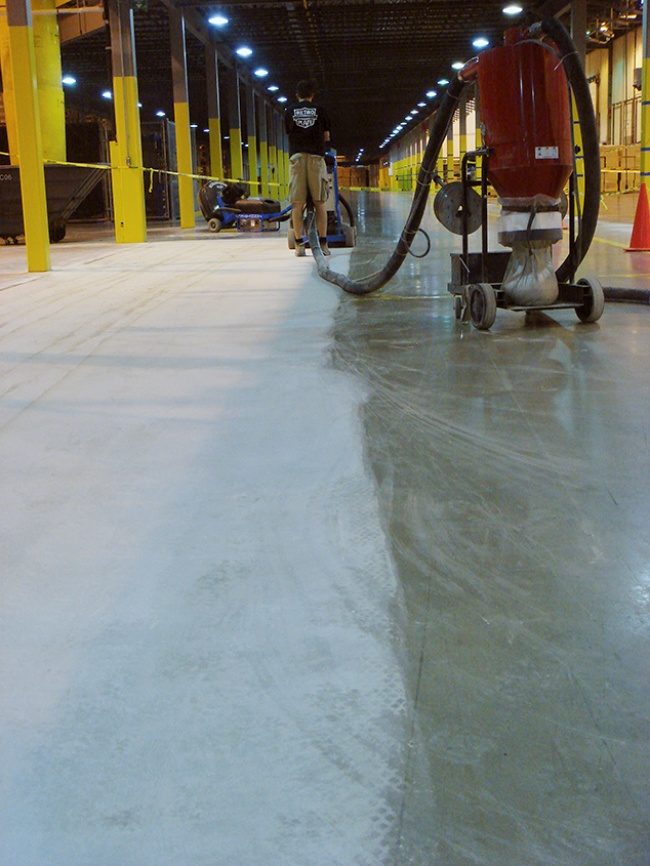
(Photos 3-8) Sometimes your restoration isn’t about replacing another coating or covering, but is instead throwing a lifeline to an existing concrete floor that is failing. Two examples are weather damage and carbonization. Generally, weather damage on floors is evident up front, so you are really “saving” a new slab. Carbonization, however, does not become apparent until the slab has had exposure to daily wear over a period of time.
Carbonization occurs during the curing process when you have exposed the new concrete to excess carbon dioxide exhaust from propane-powered heaters and construction equipment. Generally, this condition occurs in colder climates when an enclosed job site lacks adequate airflow to stop the exhaust from settling on the surface of the curing concrete. As the exhaust settles, the carbon dioxide, due to its low solubility in water, interacts with the cement paste and interferes with the hydration process, causing the surface area to dry out. This creates a floor surface that is weak and porous, one that won’t reach its normal strength and performance.
 |
 |
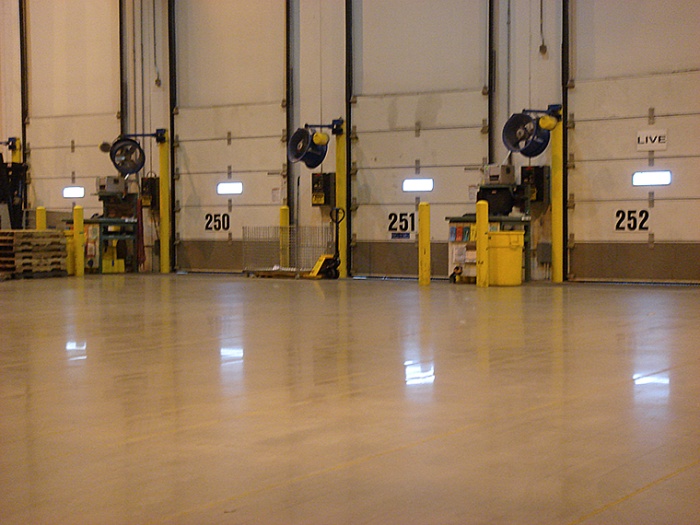 |
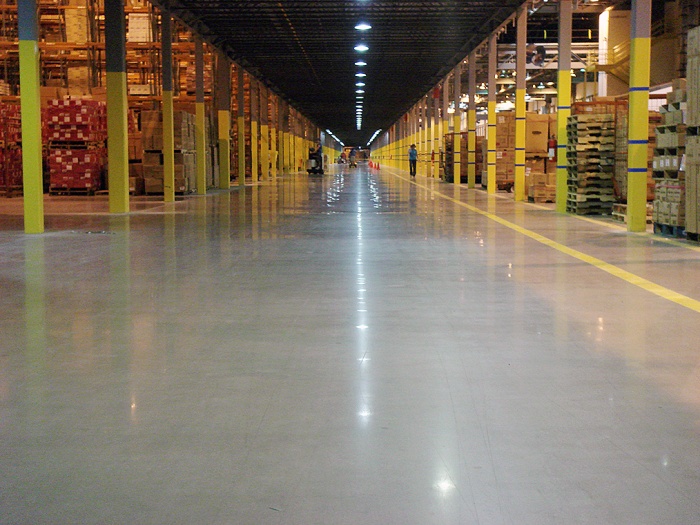
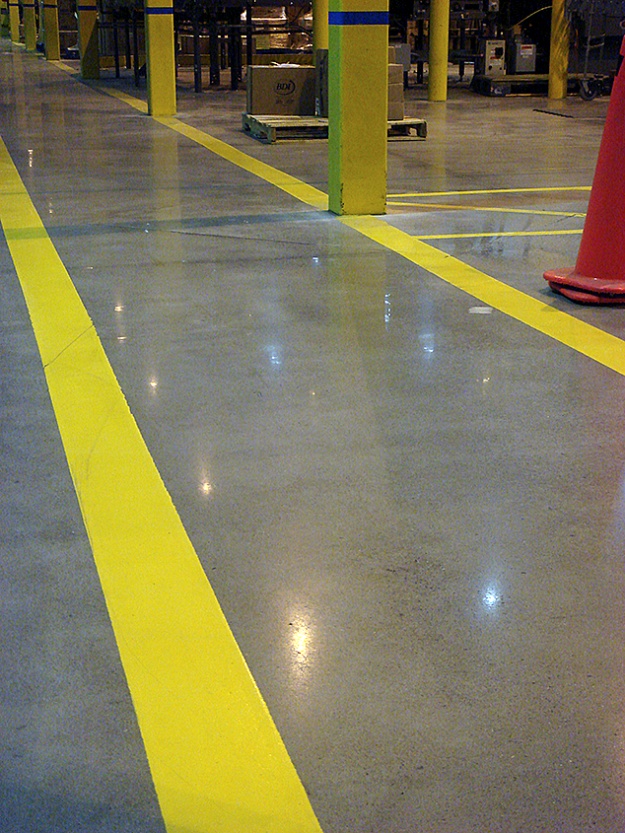
A prime example of this is a Target Distribution Center in upstate New York where Surface Tech, a RetroPlate certified applicator, is restoring 650,000 square feet of carbonized concrete in the 9-year-old facility. To simply densify the floor will not provide a permanent fix to the problem, as you would simply be placing a hard cap over a soft lower layer. To effectively solve the problem, you must first remove the soft cap through diamond grinding, and then follow your normal densification and polishing steps. Bottom line: You have eliminated the need to remove and repour the existing floor, saving time, energy and material waste.
Adding color to an existing polished floor
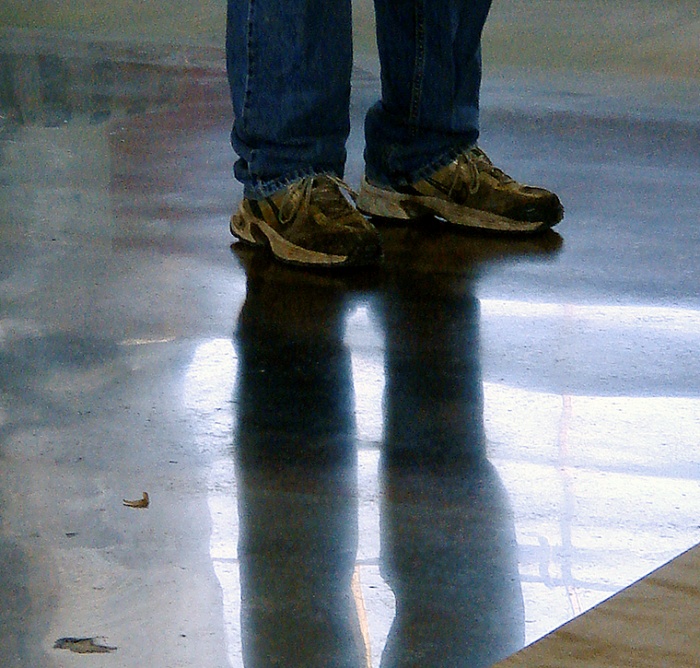
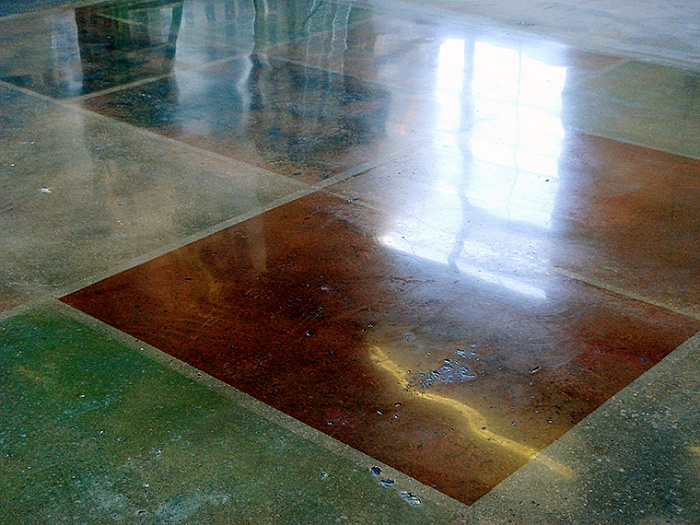
(Photos 9-12) Last month I had the opportunity to perform testing at the manufacturing facility of American Decorative Concrete (ADC) in Springdale, Ark. In the past couple of years, ADC has addressed two of our most vexing problems when it comes to applying color to polished concrete floors with the introduction of their Ameripolish dyes for polished concrete.
The first hurdle is environmental, and ADC, along with ColorMaker and DCI, have turned to dyes that utilize acetone or alcohol as their carrier, as opposed to acid stains that have a VOC component that is environmentally unfriendly. From a green/LEED viewpoint, it is important to know that although acetone does have a distinct odor, it is VOC-exempt, along with being a Non-HAP (Hazardous Air Pollutant) product per the Clean Air Act. Follow manufacturer safety guidelines during application.
 |
 |
Second, and this where ADC shines. Their Ameripolish dyes come in powder form, avoiding the shipping hurdles of acid stains and dyes which ship premixed. You neither have the shipping limitations nor high costs related with shipping these products, and you are not paying to ship the weight of a liquid. If you need material to make 250 gallons of dye shipped overnight, Brown can do it, or FedEx or UPS. The shelf life of the dye does not begin until after you have mixed the product. Additionally, it is available in 23 standard colors. The dyes can be used stand-alone, or to enhance acid stain.
More reasons dyes shine
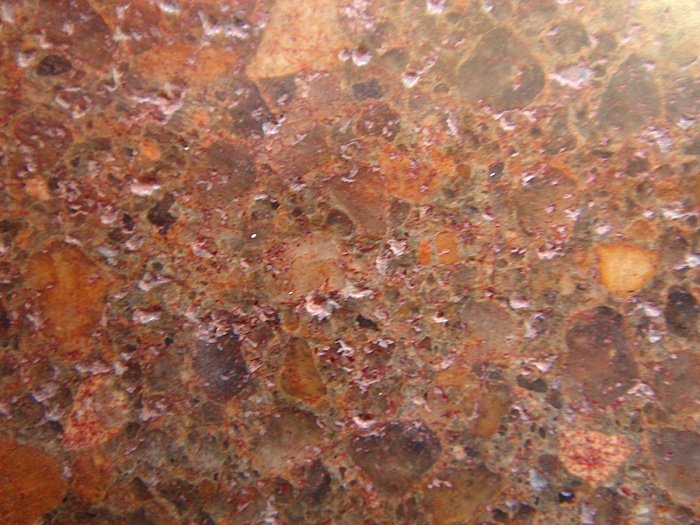
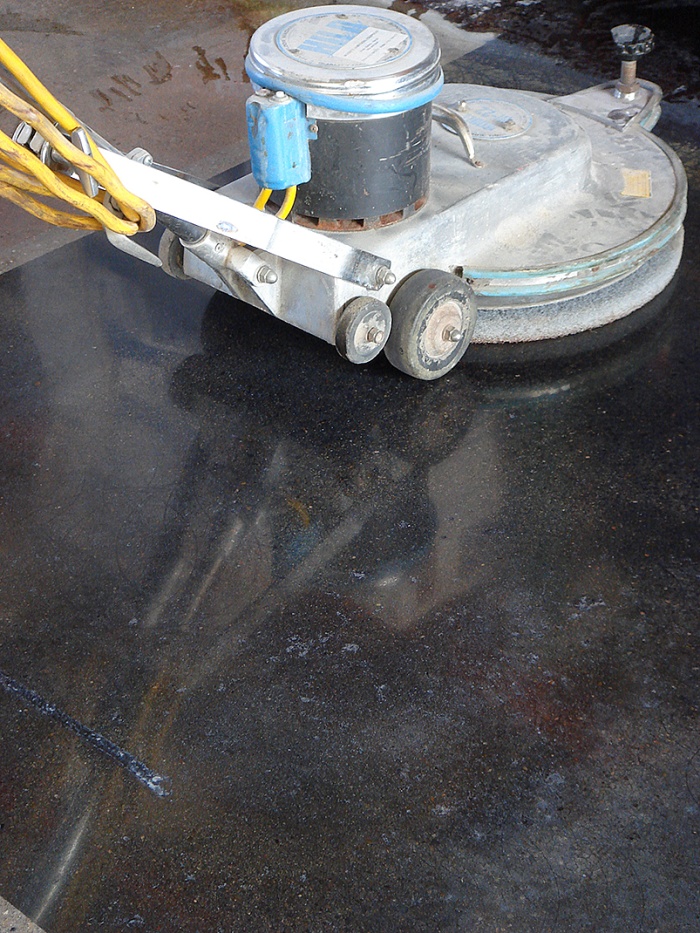
Although these first two attributes are reason enough to be excited about the dyes, it was the addition of ADC’s penetrating agent that really packed a punch. From testing to date, it is being shown that the Ameripolish dyes, when combined with their penetrating agent, can introduce vibrant color into previously polished and densified concrete. Now that’s truly making a product renewable. You now have the ability to take an existing polished floor and add color to it after the fact. The opportunities are endless.
 |
 |
Color or not, polished concrete is the truly renewable floor.
Not all floors will be candidates for this method to add color to an existing floor. As with any polished concrete floors, it is necessary to test the floor before moving ahead, especially with a restoration. You have to establish whether the floor is so tight that it will require diamond steps to open the floor to accepting the color, or whether some type of sealer or stain protection was applied that would create a bond barrier. If it only requires a few diamond steps, you’re still way ahead of the curve in time and cost savings.