
Special Effects
by Amy Johnson
Glow-in-the-dark large sand aggregate from Ambient Glow Technology was hand-seeded
between the sinks of this vanity. | Photo courtesy of Ambient Glow Technology
Decorative concrete contractors are an inventive lot. They are always finding ways to add sizzle to their work. Sometimes they improve on time-honored practices. Other times they come up with entirely new ideas and the methods for making them happen. These are just a few examples of unique upsells that demonstrate this industry's outstanding creativity. Some of these examples are unique finishes, as you might expect. Others go much further.
![]() |
![]() |
| AGT aggregates, about the size of grains of rice, add a striking accent to the vanity in daytime. At night, the sky blue afterglow becomes the star attraction. | Photos courtesy of Ambient Glow Technology | |
Aggregate that sparkles and shines
The oldest methods of adding glitter to concrete are shiny aggregates - mica, glass, bits of mirror and so forth. More recent additives include silica carbide, spar, and "pixie dust" made of small glass beads.
Making concrete sparkle is not as simple as waving a magic wand. Unusual additives and aggregates require specifically formulated mixes to keep them in place.
For example, Bill Kulish, owner of Quintechs LLC in Wilmington, Del., adds VCAS white pozzolan from Ball Consulting Ltd. to a basic countertop mix to increase strength and density and reduce porosity. He also adds Ball's Forton VF-774, which also reduces water and increases strength but has the added benefit of allowing a dry cure, so it is not necessary to keep the surface hydrated for the cement to reach full strength.
The sparkle aggregates are applied next, usually surface-seeded to deliver maximum visual impact. Contractors can give their customers the best outcome by working with suppliers who can provide proven formulations, training, and even licensed systems.
To go beyond concrete aggregates that reflect light to those that actually radiate it, designers are discovering photoluminescent aggregates. Early experiments with a countertop 10 years ago led Peter Tome, founder and president of Ambient Glow Technology (AGT), to develop powerful glow aggregates specifically for decorative concrete, cement, terrazzo, stucco and floor epoxy systems. Available in a variety of colors, AGT aggregates absorb light during the day and glow for more than 12 hours in the dark. They have a life span of more than 20 years, with the brightness diminishing very gradually over that time.
Photoluminescent aggregates in countertops are a friendly feature for people enjoying midnight snacks or making nocturnal trips to the bathroom. They are a great special effect for outdoor bars and patios too. "Everyone that has seen the glowing aggregates is blown away," says Tom Ralston, president of Tom Ralston Concrete, Santa Cruz, Calif. "The first client I showed them to wanted the AGT fine sand dusted on his porch like a galaxy of stars with the constellation of Cancer (his wife's zodiac sign) seeded in larger aggregates."
Photoluminescent aggregates light up more prosaic applications too. "They may find a lasting home in the field of safety," Ralston explains. For example, he has filled saw cuts on stair edges with glow aggregates so the steps would be clearly visible in the dark. Glow aggregates can be stamped into pool decks, used to light stepping stones outside cabins or cottages, or provide ambient light for a path from a beach house to the water.
Some AGT aggregates are as fine as sand and others range from 1/4 inch to 1/2 inch in size. AGT aggregates can be used in both precast and cast-in-place applications, as well as in stamped concrete. The incorporation process is like that with any other exposed aggregate. "Pour your batch, then before hard troweling, hand-broadcast the glow aggregates over the surface. Cover with the cream, and then when cured, grind or polish to expose the aggregates." Tome recommends using recycled glass or other decorative aggregates as well, "so during the day you don't have blah gray concrete. The recycled glass gives it a beautiful aesthetic. Then at night the surface comes alive."
www.ambientglowtechnology.com
www.lithocrete.com
www.pacificpalette.com

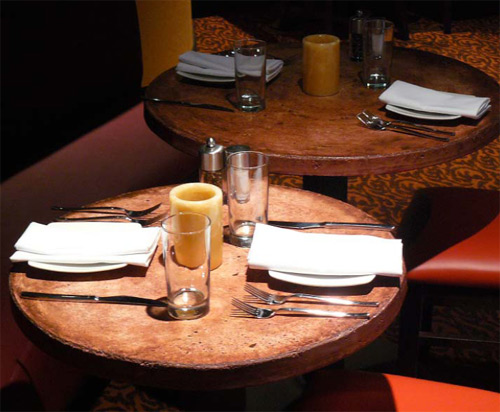
These tabletops infused with the aroma of espresso and vanilla complete the coffeehouse
experience. | Photo courtesy of Quintechs LLC
Concrete that smells delicious
Artisanal concrete is a treat for the eyes, but what about the other senses? Bill Kulish, owner of Quintechs LLC in Wilmington, Del., and self-described "foodie," asked himself that question. He put his chef's skills to work to devise a way to add delicious-smelling, long-lasting fragrances to concrete.
Kulish started experimenting with vanilla about five years ago. His current "recipe" is to cook black Madagascar vanilla beans in water, simmering them into a thick oily substance. "It's like a reduction for a sauce," he says. Then he adds a scent-free carrier like isopropyl. Smaller pieces, like sculptures or stands for animal dishes, can be immersed in the mixture right in the pot and left on low heat for three or four hours.
For larger surfaces like kitchen counters or tabletops, Kulish puts the concoction in a spray bottle. He sprays the underside of the cured piece before it is installed because the oil could interfere with a countertop sealer. The natural wicking ability of the concrete pores draws the mixture into the slab. He recommends spraying multiple times, paying special attention to the edges that will become the counter overhang, as that is where the underside is most exposed. He also recommends concentrating the scent in the part of the counter that will be over the dishwasher or near the stove, because warm concrete releases more of the fragrance.
Building on his early successes, Kulish has branched out into other fragrances. For example, thyme or lavender is nice for a powder room or a bedside table. "Any essential oil will do," he says, "and they are already reduced, so they only need to be diluted with alcohol to be ready to use." Essential oils can be purchased at bath shops or home decorating stores.
The smells of hot drinks are popular too. Kulish made two round "coffee tables" using a Buddy Rhodes colored brown with an Elite Crete integral color. Once they were in the forms, he added a cream-colored mix and stirred it in circles through the brown to get the look of cafe au lait. Then he completed the effect with a scent created from an espresso reduction. Another time he combined coffee and cocoa scents. "Concrete can feel cold, hard and boring," he explains. "These scents make it warm and fuzzy."
Of course adding scents only increases the importance of samples and mock-ups. Kulish has samples of each of his scents in the Quintechs showroom. "Customers look at me like I'm a mad scientist when I invite them to smell it," he admits. "But once they do, they love it. They ask, "Why doesn't everyone do this?'" He has never been asked to try to remove or mask a scent. Usually he is asked to make scents stronger. In these cases, or if the scent starts to wear off, another round with the spray bottle usually does the job.
Family and guests gather in a kitchen full of wonderful aromas. People love to luxuriate in a bathroom or spa smelling of relaxing herbs. Now they can enjoy these scents even when there are no cookies baking or there's no fresh potpourri on the shelf.
www.quintechs.com
Photos courtesy of Quintechs LLC
Scent, embeds and human ashes, all in one countertop
Concrete artisans are adept at dovetailing different techniques to amplify the impact of their finished work. Bill Kulish, owner of Quintechs LLC in Wilmington, Del., had a once-in-a-lifetime opportunity last year to combine a couple of the special effects described in this feature (and a couple that aren't) in a highly personal kitchen counter.
![]() |
![]() |
His Yorklyn, Del., client wanted to celebrate her victory over cancer and her joy in life by preserving mementos and treasures in a sculptural countertop. She invited loved ones to send her objects that meant something to them and to her. She compiled a collection that included petrified wood, a dog bone, ammonite, a fossil, marble pieces, a quarter, river stone, rocks from various backyards, shells, quartz, buttons, gemstones and a string of beads.
Then, in a gesture of love and remembrance, she also asked Kulish to incorporate the ashes of her late husband, whose favorite room had been the kitchen, into the concrete mix.
To create the counter, Kulish arranged hundreds of items in a melamine form. He added bits of tumbled glass and mirror and placed photoluminescent stones in the shape of the Little Dipper.
With the objects in place he mixed concrete using a terra cotta liquid integral color from Elite Crete Systems. Since human ashes are carbon-based, they had little impact on the mix. He placed the concrete by hand around the mementos in the form.
Then he took the remaining concrete, added a charcoal color, and hand-placed that around what he'd already done to create the look of darker currents running through the red. He added more black to the remaining mix and repeated the process.
Once the concrete was cured Kulish added a vanilla scent (using the process described in this feature). Then the counter was ready for grinding and polishing. Here, Kulish says, his client was the risk-taker. He thought he was done polishing, but she urged him to keep going. Objects near the surface became near abstractions - "There's just a hint of the quarter," he says. But the overall effect, a piece molded with a rock edge and polished to a burnt red, was just what the client wanted.
Now at night the kitchen glows with the starlight of the Little Dipper and warm tea-light candles release the vanilla aroma. "It's a very spiritual experience," Kulish says.
www.quintechs.com
Salting your slab
Tom Ralston, president of Tom Ralston Concrete,
![]() |
| Photo courtesy of Simple Solutions/Salt Roller Inc. |
![]() |
| Photos courtesy of L.M. Scofi eld Co. |
![]() |
To get the look, Ralston scattered rock salt here and there on the fresh pour, along with drops of retardant. After washing away the salt and retardant the next day and attacking the concrete with an acid-water solution and a wire brush, his team had the aged, corroded effect they wanted.
A rock-salt finish can give a slab a vintage feel even without any other weathering effects. Coarse rock salt is hand-broadcast into concrete just beginning to set, pressed in so about half the salt protrudes above the surface. It's left until the slab has cured enough to be walked on. Then the salt is washed or swept off, leaving behind small holes of different sizes and shapes.
This handcrafted technique has several difficulties. One is the challenge of achieving even coverage. Of course the randomness is part of its charm to a point, but it doesn't look natural if the pressure is too uneven, if there are big bare areas, or worse, if it looks like a bag of salt got spilled in one spot. Which leads to the second challenge - mistakes are almost impossible to correct. The salt cannot be rescattered and the surface retroweled.
Third, the process is quite labor-intensive and requires experienced workers. It is slow going, so the finish is most popular for smaller projects, such as pool decks, or for partial areas of larger decorative installations.
Even in small areas, texturing with embossing skins is a faster way to achieve a more uniform salt finish look than hand-broadcasting.
Like most stamped or textured concrete, rock salt finishes usually look best with colors in neutral earth tones, according to Cam Villar, director of marketing for L.M. Scofield Co.
Bob Zieger, artisan and president of Simple Solutions/Salt Roller Inc., a Chandler, Ariz., tool company, once bumped up against the limitations of rock salt when a large residential developer asked him to use it to texture the sidewalks, clubhouse patios and driveways of model homes. He had trouble with bare spots, and production was slow because he had to take people away from placing the concrete in order to spread the salt. He hit upon the idea of a roller with protrusions shaped like salt pellets. The client liked the result so much that the same technique was specified for another project.
With some improvements to the original ad hoc design, Zieger has come up with a durable, lightweight steel tool that can easily be used by one person to texture 1,600 square feet (20 cubic yards) in time to place a second pour in the same day. The roller requires no release agent, just periodic cleaning with water like any other finishing tool. Even though salt is a natural substance, it can wreak havoc with landscaping, so with no salt or finishing agent to wash off, the roller makes cleanup simpler and safer.
Between hand broadcasting, embossing skins and the Salt Roller, designers and contractors who want the antiqued, aged look that a rock salt finish gives to decorative concrete have more options now than when the first rock salt was spilled on the first concrete pour.
www.scofield.com
www.saltrollers.com