


Friday night, 9:45 p.m., at the start of a long Fourth of July weekend … The Incident.
I don’t remember a sound. Rather, I remember a sense of being swallowed. The fireball flashed and briefly expanded. Temperature: 1,800 degrees.
The blast had traveled from my left to my right — this was obvious from my skin (or the lack of it) on the left of my uncovered legs and arms. It was fast and it was violent, like a shotgun blast. Messy!
I was fortunate. I was still on my feet, pump-up sprayer with dye concentrate in acetone (an explosive flammable liquid) still in my hands. Even more fortunately, I had apparently held my breath, as my esophagus would’ve otherwise been seared. I would’ve died then and there.
I was strangely calm. I knew what had just happened. I surveyed my situation. The red rosin paper masking burned on the walls of the basement. The floor was on fire and my Tevas didn’t offer much protection. In fact, they had partially melted, and melded, into my feet.
I’d best get out! Headed for the door. The sliding glass door. Chose poorly. Hit the glass. Missed the open door. Fell. Now I was on the floor and in what remained of the flames. Up. Through the correct side this time. Breathed. Coughed. Breathed again deeply and dove into the swimming pool.
My client, an architect and good friend, Chris Heinritz, was able to put out the fire with a garden hose. I got out of the pool and came upon his wife, Cindy. The look on her face told me that things weren’t good. And she was looking at me, not the house. She’d look and then turn away. She steeled herself and led me upstairs to the shower.
Chris called 911. The fire department arrived. First-responders assessed the situation and suggested that they wrap me in wet towels. I didn’t require an ambulance but they’d best get me to an emergency room. Quickly!
Their youngest son, Trevor, was along for the ride. “Cool, Dad! He looks just like the Mummy.” And I did.
I had been dressed in typical Friday-night summertime garb: Tevas, shorts and a T-shirt. Where my skin had been covered, it was intact. My right side wasn’t great but it wasn’t so bad. My left side was disgusting! The skin was either missing entirely or was in tatters (hence Trevor’s mentioning the Mummy). There were a few chunks of flesh missing and what skin remained looked like decomposed strips of raunchy gauze. Luckily these were my favorite sandals, as they were now a permanent part of my feet. I was now even more minimally clothed, in a damp beach towel, and shivering.
Made it to the Kaiser emergency room. They doped me up a bit, then began to remove skin that wasn’t structurally intact. Tidied me up. Dressed my wounds. They eventually transferred me by ambulance (I only kinda remember this, as by this time, I was not only doped up but pretty deep in shock) to the burn unit at U.C. Davis Medical Center, where I was to spend the next three weeks.
After one helluva lotta drugs, daily debridement, surgery involving skin grafts, and torturous physical therapy, Neen was finally able to bring me home. This was heaven! But hell and its minions weren’t quite through with me yet. We were presented with a bill for just under a quarter of a million dollars, and various treatments and procedures were to continue for over a year. And yet, truly, I was blessed.
Debriefing
What had just happened here?
It was Friday, mid-afternoon, July. Kelley and I had just finished sending off the crew and packing up our truck. This was the end of three warm days of patina staining. A driveway. A really pleasant colorist project in the Napa Valley.
Halfway home, unwinding as we roll, my cell phone rings. It’s The Ritz, Chris Heinritz. “Hey, Ritz!” “Miller, I need a really big favor.” And so it began. He and Cindy had designed and built a really bitchin’ home in Auburn, in the Sierra Nevada foothills. He had a nearly completed basement rec room, at pool-deck level, with an unfinished gray concrete floor. They were throwing a big Fourth of July party.
“Any chance you could get this floor stained, maybe tonight, before the party? Oh, and by the way, you and Jeannine are invited.” “Ugh!” I agreed, with the stipulation that I needed to get home first, shower, eat, kiss Neen and catch my breath. He’d have to make sure that the space was cleaned and masked. I wouldn’t stain it, but I would be able to dye and solvent-seal it. I’d be there around 9 p.m., and he and Cindy would have to accept whatever my first few shots at color produced. He agreed. It was on.
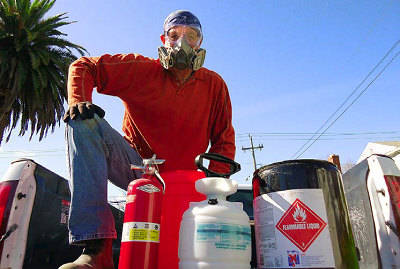
When you’re the pilot of a plane, you always complete a preflight checklist. This safety precaution is a given. A matter of course. When you’re the concretist, working with solvents, you do the same.
But not this evening. Bad circumstances. I was tired. I was rushed. It was warm and I was dressed inappropriately. (Long pants, long sleeves and shoes and socks would probably have kept me out of the hospital.) Chris had done a great job of cleaning and masking. He had masked with opaque paper — including over a closet containing a water heater. I neglected to ask about potential points of ignition. He didn’t know enough to offer.
We assess the space, talk color, and off I go! First pass down. Chris and Cindy and their young daughter Annalise come down for a look and to offer an opinion. “Maybe a little more color, Mike. More saturated and more yellow.” I’m a softy — they’re best friends after all. I agree to take another shot at it. They leave. I make a quick color adjustment. Begin to spray. And, halfway through the room — BOOM!
I thank God that I was in the room and not the Heinritzes. I thank God that this type of accident has never happened to any of my employees — although it has happened to an employee of a really close friend of mine, and it was bad.
Chris and Cindy’s place didn’t burn down. In fact, the damages were minimal — but in yet another incident, a second close friend of mine burned a beach house down to the ground!
There are clients who will say, “I’d just die for a floor like that!” But, of course, there’s no decorative concrete worth dying for. So, do as I say, and not as I did. Please, be careful out there.
www.theconcretist.com