
Follow Me on Pinterest

Search
Subscribe
  • Concrete Decor Show
  • Customer Support
  • Contact Us
  • Advertising
  • About Us
  • Home
  • Departments
  • Archives
  • Digital Issues
  • Blogs
  • Product Guide
  • Training
  • Videos
  • Bookstore
  • Technology

Vol. 11 No. 5 - July 2011

Order this Issue
Subscribe

  • Vol. 12 No. 3 - April 2012
  • Vol. 12 No. 2 - Feb/Mar 2012
  • Vol. 12 No. 1 - January 2012
  • Vol. 11 No. 8 - Nov/Dec 2011
  • Vol. 11 No. 7 - October 2011
  • Vol. 11 No. 6 - Aug/Sept 2011
  • Vol. 11 No. 5 - July 2011
    • Artisan in Concrete: Rockerz Inc., Warrendale, Pa.
    • Cool Concrete
    • the concretist: I Have Seen the Future, and It Is Gray
    • Carlton's Corner: Your Next Customer Is Shopping Online
    • Trowel & Error: Understanding Our Rocky Relationship with Overlays
    • Recipe: Two Substrates United
    • Product Focus: Glo-Kote, From Super-Krete International Inc.
    • Wet-casting an Apron-front Sink without the Corner Cracks
    • When Concrete Meets Glass
    • Project Profile: Tampa Museum of Art, Tampa, Fla.
    • Don't Get Pushed Around --Get Paid
    • Project Profile: Toucan Ridge in the Assiniboine Park Zoo, Winnipeg, Manitoba, Canada
    • How I Design Decorative Concrete Installations
    • Product Focus: Stone Essence, from Increte Systems Inc.
    • Project Profile: Rainbow MagicLand, Valmontone, Italy
    • Project Profile: Safe House, Warsaw, Poland
  • Vol. 11 No. 4 - May/June 2011
  • Vol. 11 No. 3 - April 2011
  • Vol. 11 No. 2 - Feb/Mar 2011
  • Vol. 11 No. 1 - January 2011
  • Vol. 10 No. 8 - Nov/Dec 2010
  • Vol. 10 No. 7 - October 2010
  • Vol. 10 No. 6 - Aug/Sept 2010
  • Vol. 10 No. 5 - July 2010
  • Vol. 10 No. 4 - May/June 2010
  • Vol. 10 No. 3 - April 2010
  • Vol. 10 No. 2 - Feb/Mar 2010
  • Vol. 10 No. 1 - January 2010
  • Vol. 9 No. 7 - Nov/Dec 2009
  • Vol. 9 No. 6 - Sept/Oct 2009
  • Vol. 9 No. 5 - August 2009
  • Vol. 9 - No. 4 - June/July 2009
  • View More


View Newsletter


Countertops & Precast Concrete

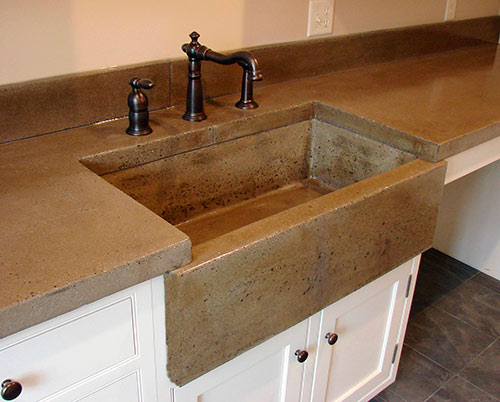
Wet-casting an Apron-front Sink without the Corner Cracks

by Mark Celebuski


They say that the definition of insanity is doing the same thing the same way and expecting a different result. If that’s true the majority of concrete countertop makers I know are nuts (including me). Sometimes the status quo is not working and you need to make changes.

I have kept an eye on my old projects for clues on how to improve future projects. One thing I noticed is that it seemed like a lot of the wet-cast apron-front sinks I cast had developed very fine hairline cracks in the corners. The cracks never opened up but would show up when the sinks got wet. I don’t know if the sinks cracked during striping and handling or from concrete shrinkage later — all I knew was I had to stop them.

I tried higher dosages of fiber but that lead to more problems, such as an unworkable mix and more bug holes. Remember, the sinks had to match the counters. Plus, the way the cracks started at the top and worked their way south did not lend itself to a fiber reinforcement fix. The cracks would open like a zipper.

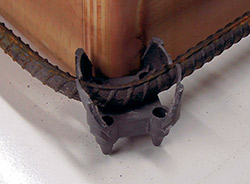
I believe it was the French who originally used iron bars to reinforce concrete. Their solution worked for me. I used a single piece of No. 3 bar very precisely bent and placed exactly where the concentrated stress was occurring. “Chairs” made for architectural precasters hold the bar in place in the corner.
Any crack that attempted to start would now have to stretch steel to keep running.

I’ve achieved 100 percent crack-free apron-front sinks since turning to this method of reinforcement several years ago. I will never again cast an apron-front sink without the 50-cent piece of steel.

Mark Celebuski is a partner in Pennsylvania-based Concrete Countertop Plant and Pinnacle Cast Concrete. He holds monthly concrete countertop training sessions for industry professionals. Reach him at?mark@pinnaclecastconcrete.com.


Steps for Setting Up an Apron-front Sink Mold
I often get the question of how to assemble an apron-front sink mold. How do you get into those tight spaces inside the mold to caulk them?

The answer is you don’t.

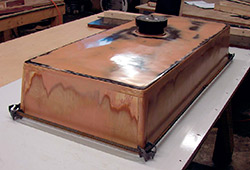
Start by securing the sink mold to the base form. You can screw through the base form or bolt solid through the center of the drain hole.

Temporarily attach the form sides and check all dimensions.

Mark the location of the form sides and remove.
Caulk the sink mold.

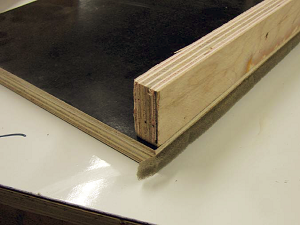
Use a gasket material to seal the bottom of the form sides — this will prevent concrete leakage and discoloring. Precast supply companies sell gasket material or you can use gasket made for screen doors. The gasket should compress easily.
Reattach form sides and cast!


Home  |   Departments  |   Archives  |   Digital Issues  |   Blogs  |   Products  |   Training  |   Videos  |   Bookstore  |   Science

©2012 Concrete Decor Magazine. Unauthorized reproduction of any information on this site is a violation of existing copyright laws. All rights reserved.