
Over the last several months, I have been helping to plan the Green Matters Conference, which will be a part of the Concrete Decor Show in San Antonio, Texas, next February. I’ve talked to experts on everything from LEED terminology and concrete polishing to sustainable coatings and organic materials. In this process, I’ve noticed that just when you think you know what green means, something changes.
Going green is a process better thought of as “greening” our business in every aspect. No other topic presents more challenges for us, and it’s getting more complicated every day. We live in an exciting time, when revising our fundamental definition of the best practices is a necessity. We are all seeking materials that are safer for the environment, but also for the contractors who use them. Methods we use in every step on the job must contribute to going green but also reduce costs and use of resources during construction. Meanwhile, contractors encounter changing codes and standards, each of which have limitations and can increase the burden of documentation required, but there aren’t more hours in a day.
Much is written about the USGBC’s LEED certification program. Undoubtedly, it has become a dominant force influencing product selection. That’s just a little odd, because LEED certifies projects, not products. It was set up to influence the design and construction process and result in buildings that are healthier for occupants and better for the environment. In practice, the point system often will recognize products for being less harmful than in the past, but it doesn’t always highly rate products that have zero VOCs or are wholly organic and earth-friendly unless the industry has set up its own certification standards for them. There are great gaps.
Still, let’s not discount LEED. The way it awards points has increased demand for many types of specialty concrete, including pervious concrete and polished concrete. So it’s important for anyone in architectural and decorative concrete to understand and be able to use the terminology if they want to talk to architects and specifiers. At the Green Matters Conference, Chris Sullivan will present a seminar on “The Vocabulary of LEED” to provide a quick way to learn to use these terms correctly. He thinks his seminar is just the starting point. Chris tells me this: “Replacing traditional building materials with new green materials and systems often requires new processes, equipment, and at the very least, education for installers. This all takes time and money. It’s well-spent time and money and an investment in the future, but it needs to be factored in on the front end.”
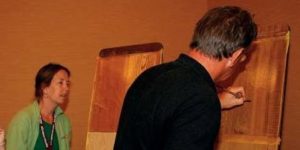
The Green Matters Conference is held side by side with the Concrete Decor Show for exactly this reason: As innovative products and new methods come to market, it is a challenge for contractors to evaluate when, where and how to use them. Timing, tools and procedures may change. Suitability for the climate and local needs have to be considered. Talking to someone who has experience can save time, costs and headaches. Reading about it is one thing, watching a project start to finish or even getting hands-on in the field is another. Educators call hands-on workshops “experiential learning” but I call them “making mistakes before getting on the job where they cost money to fix.” I look forward to stepping away from the computer and going to see for myself in the Demo Pavilion at the Concrete Decor Show.
Green building changes everything from job-site practices to basic concrete ordering. For example, there is quite a debate about green mix designs. These seem good on paper until you consider how reduced cement content results in challenges on the job site, such as increased set times, longer curing times and altered color. More importantly, is a green mix design going to produce the same long-term durability? This topic will explored in more depth in a panel discussion called “Environmentally Friendly Concrete Mix Design: Balancing Sustainability, Performance & Economy.” Also, Ward Malisch will provide a seminar to help contractors know how to handle what he calls “sustainability-at-all-costs” requests.
The opening speaker at the Green Matters Conference — David Shepherd, director of sustainability for the Portland Cement Association — will provide an update on new research as well as provide an outlook on emerging trends and issues for architectural and decorative concrete. Here is a taste of his perspective: “Research resulting from life-cycle assessment has revealed that the majority of impacts are not from what the building materials are, but rather what the building does,” he says. “This is where you see the design innovators working today. Cheapest first cost is not the answer to the issues we face — sustainable, versatile and durable is where value can be derived.”
From fundamental mix design challenges to innovations such as infrared reflective coatings, the Green Matters Conference will cover a broad range of topics. Seminars and panel discussions provide current information on innovative uses of concrete to provide cooling and storm-water management, advancements in functional resilience, environmental benefits of polished concrete, and an update on new scientific research translated for nonscientists.
The conference brings together experts to talk about current problems, pragmatic methods, new technologies and trends that will impact the future — every shade of green to help us learn more of the things we need to know now.
Sherry A. Boyd is conference director for the Green Matters Conference at the 2012 Concrete Decor Show. A USGBC member, she gained knowledge of the decorative concrete market from eight years as head of marketing for a leading manufacturer of concrete coloring materials.