



Proper reinforcing and good mix design go hand in hand to prevent problems with concrete countertops. The materials you use to reinforce your concrete countertop are just as important as those you select for your mix. To understand which materials are best to use for reinforcing your concrete countertop, you first need to understand how reinforcing works.
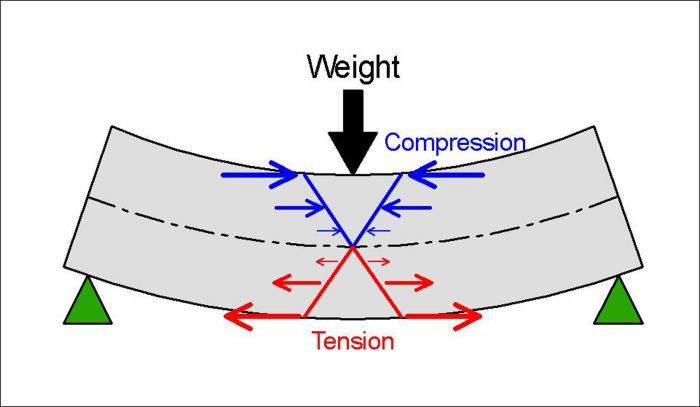
Concrete countertops are essentially beams that span an open space. When a force is applied to the top of the countertop, it causes compression on the top surface and tension on the bottom surface.
Concrete has much more compressive strength (e.g. 3,000 psi) than tensile strength (e.g. 400 psi). Therefore, it needs help where the tensile forces occur — at the bottom of the slab/beam.
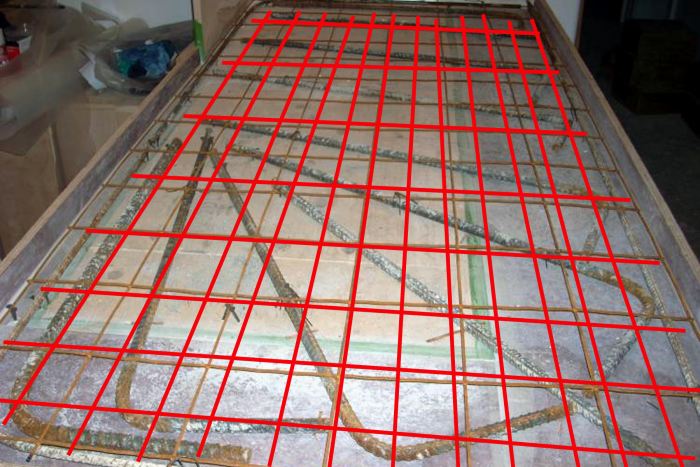
Those tensile forces occur in a straight line along the length of the slab, just like a rope being pulled in a tug-of-war. Therefore, reinforcing should be placed in straight lines along the long axis of the slab. You do need cross strands because there is some force along the short axis of the slab, but the long axis is the primary concern.
Now that you understand tensile forces and the tug-of-war principle, you know where to put the reinforcing. But what materials should you use and why?
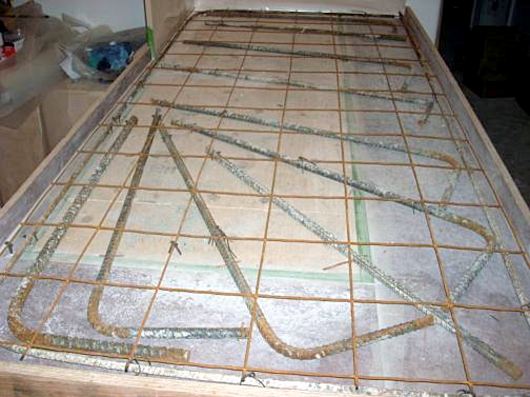
Since concrete is weak in tension, you need high-tensile-strength materials that meet structural standards and have known characteristics. The materials should be the right size to fit in thin slabs.
Let’s review the materials commonly used (or misused) for reinforcement and see how they stack up.
Materials such as chicken wire, stucco mesh, wire screening, expanded metal, fence wire or fiberglass cloth should never be used as primary reinforcement because their properties are too variable or they are not sufficiently strong. You cannot rely on these materials.
Rebar
You can think of reinforcing material as being like a spring that stretches more when you apply more load to it. The weight of the concrete slab is what drives the bending, and the more strands of steel
reinforcing used, the lower the load each individual strand of steel feels.
You should use lots of small strands of reinforcing, rather than one big strand, to limit the amount of stretching and, therefore, hairline cracks. If you use rebar, you can’t fit enough strands into the countertop slab.

Furthermore, even No. 3 rebar (3/8-inch diameter) is too big to fit into a 1.5-inch thick countertop slab without causing telegraph cracking. There is simply not enough concrete above the rebar. The same applies for any large steel reinforcement such as cattle grate. These materials are very strong — they are just too big.
A good rule of thumb is to use reinforcing less than 3/16 inch in diameter for concrete that will be less than 3 inches thick.
Fibers
The use of fibers in concrete for shrinkage cracking control. Polypropylene and nylon are typical fiber materials. These materials are not structural — they do not have the strength to withstand tensile forces.
There are some fibers that have structural strength, such as hooked steel, chopped carbon, polyvinyl alcohol (PVA) and chopped alkali-resistant (AR) glass. These fibers help control crack size by distributing the tensile stresses throughout the beam. Instead of one large crack, a beam with adequate fiber reinforcement will instead have many smaller cracks that are difficult to see. If a client can’t see a crack, it is effectively nonexistent.
However, fibers do not provide primary structural reinforcement and cannot replace steel. They provide secondary shrinkage control and crack control.
What about GFRC?
Like other mixes reinforced with fibers, glass-fiber reinforced concrete (GFRC) cannot substitute for reinforced concrete when true load-carrying capacity is required. It’s best used for complex, three-dimensional shells where loads are light.
The orientation of the fibers is important. The more random the orientation, the more fibers you will need to resist the load. That’s because, on average, only a small fraction of randomly oriented fibers are oriented in the right direction. A common mistake for concrete countertop makers is to neglect rolling the fibers. This leaves the fibers in a random arrangement that is much weaker than rolled fibers.
Masonry-block ladder wire
Use ladder wire for constructing masonry block walls. Lay the wire in the mortar joint between horizontal courses of block.
Ladder wire is usually 9-gauge structural wire that conforms to ASTM A82. This wire has a tensile strength of 80,000 psi. Rebar has a tensile strength of only 60,000 psi.
Ladder wire is less than 3/16 inch in diameter, making it a perfect size for reinforcing concrete countertops. That, combined with its strength, makes ladder wire an ideal reinforcing material.
Carbon fiber grid
Carbon fiber grid is a semiflexible mesh of flat carbon fiber ribbons woven into a 1-inch grid and bonded together with epoxy. The mesh is very flat, roughly 1/32-inch thick on average.
Each strand of the grid has a breaking strength of about 250 pounds. It’s possible to replace a single strand of 9-gauge steel wire with no fewer than four strands of carbon fiber.
Carbon fiber grid is very useful for reinforcing thin sections, cantilever sections and curved sections. Take care when working with it, as the carbon fiber is brittle and any sharp kink or stress on the fiber will cut or weaken it.
How much reinforcement to use
Once you’ve decided on a type of reinforcement, how do you know how much to use? There is no simple answer to this question, as it depends on many factors, including the size, thickness and shape of the piece.
In general, more is better, unless there is so much reinforcing that there is not enough concrete around it to hold together. In general, spacing ladder wire strands longitudinally about 1 to 2 inches apart will in most situations give you adequate strength and peace of mind. Add cross strands at about one third the number of longitudinal strands, assuming the piece is long and rectangular. The more square the piece, the more longitudinal strands you need, because the forces are approximately the same in both directions.
The peace of mind you get from using the right reinforcing materials, and placing them in the right amounts in the right locations, is worth the extra effort.