



Search
Subscribe
  • Concrete Decor Show
  • Customer Support
  • Contact Us
  • Advertising
  • About Us
  • Home
  • Departments
  • Archives
  • Digital Issues
  • Blogs
  • Products
  • Training
  • Videos
  • Bookstore
  • Science

Vol. 12 No. 1 - January 2012

Order this Issue
Subscribe

  • Vol. 12 No. 2 - Feb/Mar 2012
  • Vol. 12 No. 1 - January 2012
    • Fundamentals of Business
    • Artisan in Concrete: Gaye Goodman, Faux Real LLC, Albuquerque, N.M.
    • Stars of the Strip
    • Decorative Concrete Around the World
    • Carlton’s Corner: Getting the Most Out of Educational Opportunities
    • Product Focus: Deco-Con Wizard, from Depiction Software
    • Project Profiles: Faux Ice and Water, Calgary, Alberta, and four citiies, Florida
    • Product Focus: ALX and MACoat from Westcoat Specialty Coating Systems
    • Project Profiles: Three Bar Tops, New England
    • Project Profile: Southern Ute Cultural Center & Museum
    • Working with Your Ready-Mix Supplier to Maintain Color Consistency in Large Decorative Pours
    • Project Profile: National History Museum of Los Angeles County
    • How Reading the Specifications Can Help Your Wallet
    • The Four Types of Overlays and How to Choose One
    • How To: Prep for a Staining Job
    • Trowel & Error: Coloring Concrete in Winter Weather
    • How Stamping Contractors Should Handle Maintenance
    • Project Profile: Silicon Valley Sculpted Hillside, Saratoga, Calif.
  • Vol. 11 No. 8 - Nov/Dec 2011
  • Vol. 11 No. 7 - October 2011
  • Vol. 11 No. 6 - Aug/Sept 2011
  • Vol. 11 No. 5 - July 2011
  • Vol. 11 No. 4 - May/June 2011
  • Vol. 11 No. 3 - April 2011
  • Vol. 11 No. 2 - Feb/Mar 2011
  • Vol. 11 No. 1 - January 2011
  • Vol. 10 No. 8 - Nov/Dec 2010
  • Vol. 10 No. 7 - October 2010
  • Vol. 10 No. 6 - Aug/Sept 2010
  • Vol. 10 No. 5 - July 2010
  • Vol. 10 No. 4 - May/June 2010
  • Vol. 10 No. 3 - April 2010
  • Vol. 10 No. 2 - Feb/Mar 2010
  • Vol. 10 No. 1 - January 2010
  • Vol. 9 No. 7 - Nov/Dec 2009
  • View More


View Newsletter

Decorative Concrete Around the World

Seasoned globetrotters tell how to survive and thrive when doing decorative concrete overseas

by Mike Archambault, with John Anderson and Cathye Rankin

In the United States, decorative concrete is advanced at a level that it is not at anywhere else. When you’re overseas, be prepared to educate.
Here at Moderne Methode in France, we have brought in some American stars from time to time to do workshops. Often they assume we have the same products and tools they are used to. They get frustrated and look at me with this “Are you in the Stone Age?” look. It is not backward here, it is just different. I had one guest trainer from the States doing a countertop class with me who nearly boiled over when we did not have a product that he said was available all over the States. Look — it’s not the States anywhere but in the States.
When doing decorative concrete business overseas, there is a small list of things to consider before packing your bags. Do your homework in advance, and don’t forget to learn about the culture you’re visiting. Knowing a little about where you are going will help.
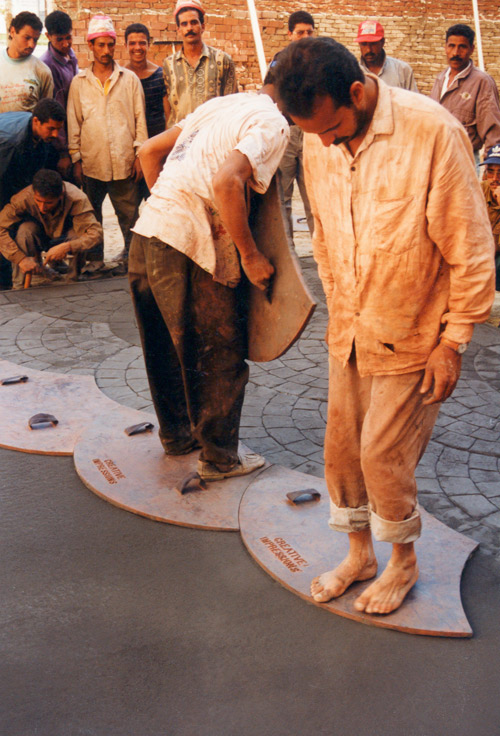
Decorative Concrete Around the World, work barefoot in concrete
Photos courtesy of Mike Archambault.
Some of these guys work barefoot in concrete all day long. As a trainer you want to say something about following correct procedures, such as protecting your feet. But I’ve learned that as an American we are perceived as telling others to be more like Americans. I learned to accept the differences, concentrate on good concrete practices and get along as one of them. However, I never went barefoot in the concrete myself.

Here are a few more tips.
Translation of American documents can often be incorrect. In 1991, one project for Euro Disney that took up a lot of my time was the Lake Promenade, a large paving project surrounding a small lake near Disneyland Paris. When I arrived work had already commenced. I noticed quickly they were using foam isolation material in a keyway joint. When looking over the specs, I saw that a bond breaker was called for. They had translated this as “foam.” The result was voids that were freeways for mice.
Another time, I was doing a big placement and stamping job at the presidential palace in Alexandria, Egypt. Things went well. The guys were putting down 1,000 to 1,500 square feet of good-looking work per day right out of the gate.
The crew now well out in front, it was time to wash, detail and seal. With no buffer or pressure washer available, my only choice to get off the excess release agent was using a mild acid solution the way I and my crews in Texas had done many times. Muriatic acid does not exist in Alexandria, so the search was on to find something, and something was eventually found at a pharmacy. It came in an unlabeled blue-looking wine bottle with a cork in it. Well experienced with acid, I put a very small amount in a bucket, and it went into convulsions like a volcano, spewing fumes and mist from the bucket. I was lucky I was afraid already and was standing as far back as I could. I could have been burned very badly. The stuff must have been 90 percent hydrochloric acid. Wow.
Acid is packaged differently in Europe too, and it’s available at DIY stores and supermarkets. There are two types and two strengths. Some manufacturers are helpful and put a photo of a swimming pool on the label — this would be equivalent to muriatic acid. The other strength has a picture of a toilet for decalcifying. This one has a much higher percentage of acid. Be careful!

Lumber — wood in general — will disappoint all Americans. American wood has a quality and price only to be found in America. Here in Europe it is all rough-cut. Running an edger is a pain in the butt because of all the splinters. If you can find milled lumber, prepare to pay an arm and a leg. We at Moderne Methode carry Metal Form Corp. plastic forms and lately find it difficult to keep enough in stock.
Concrete Work by France-based Moderne Methode.Working with ready-mix concrete companies in Europe is a nightmare. If they know about stamped concrete it will be because of Bomanite’s tremendous presence all over Europe. However that was at its peak many years ago, just coming out of the cookie-cutter stamp days, where three-eighths pea gravel was used. Many plants have this old mix design that is difficult to get changed.
When you order concrete you basically get a menu. You have to choose from the menu. Getting the mix design you want takes an act of Congress. Ask a plant guy what’s in the mix design and you would think you have asked what color underwear his wife wears. They will tell you some of the mix design but not all. Each company has what they call proprietary mix designs that are so-called special and secret. And they charge a little more just because they name it a stamp mix or an exposed aggregate mix.
Smaller independent plants are much easier to work with. With the big boys, they are all afraid that some one will share or divulge what is in their mix design. I am not popular among these people knowing what most American concrete contractors know about mix design. This threatens most of them.
In the States ready-mix companies are way more cooperative and work together going after the cast-in-place market. Here, no. There have been exceptions, but few.
Here in France most drivers are independent, a horrible system. I do not know how a ready-mix company can guarantee concrete when drivers will roll down the road with their mixing bowls not turning to save on diesel. Or they will go to lunch with a fully loaded truck in the parking lot. You don’t need to wonder why your concrete set up too fast.
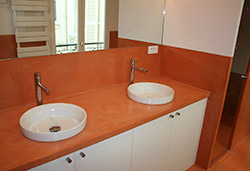
I was once on a job in Paris where the driver saw wheelbarrows, told the Portuguese boss he would not take the time to pour into wheelbarrows and drove off. They make money per load. Frequently, extra concrete that remains in the mixer is sold. It is called béton noir, “black concrete.” When my wife’s father built his house, the whole floor and foundation was béton noir and he paid practically nothing. A little cash in the hand is all it took. Who knows how old the concrete was?
Work by France-based Moderne Methode.The United Kingdom is not a part of this mess and they are far more cooperative. The Mideast is cooperative as well.
Finally, be careful bringing over equipment that may need accessories, fuel or parts. It is best to have machines that are marked for European Union units of measurement. If they’re EU-marked, you will have an easier time looking for what is compatible with your machine. For example, we bought a 2,500-rpm propane burnisher not marked for the EU because the company had never worked outside the U.S. We had a heck of a time getting it converted to the French system.
www.moderne-methode.com




Mike Archambault is co-owner of French manufacturer and distributor Moderne Methode and of training school Béton Academy. He can be reached at ma@moderne-methode.com.


Six Issues to Keep in Mind When Working Abroad
by John Anderson
I guess decorative concrete around the world is one of my specialty areas, as I have been involved in decorative concrete projects in more than 25 countries. After attending the World of Concrete for 11 years and working in the United States for Brickform as the area manager in Nevada and Arizona, I am able to compare how the decorative concrete business is approached in the U.S. with how it’s done in other countries I have worked in. The cultural practices and business models from country to country are unique in every way possible: techniques, materials, tools and construction practice regulations.

I would like to point out some of the basic issues that come up when planning a decorative concrete project in another country and how to reduce the risks involved.
 

Getting supplies
Several things seem to catch most people. The first hurdle is that getting materials, tools and equipment from a local source may be more difficult than expected. There is more chance of winning the lottery than finding a home improvement chain store or speciality concrete supply house in other countries. With this in mind, you should plan to ship everything but the kitchen sink, and if you’ll need one of those, ship it too.

Local contacts
In most cases, you will have a local contact who is supporting you while you are working in their country. Remember that this person is a key figure but most likely not an expert in the field of decorative concrete, and this is why you are there in the first place. Extreme planning at this point can save time and money when you arrive to discover that what you thought you asked for is not available. When communicating with your local contact, you should be very specific about your requirements and even send pictures of the items you request. The terminology used for some tools and equipment is not always the same as what you use at home, and the word for what you want may not even exist in other languages.
 

Shipping and clearing customs
If you are shipping products to the country, make sure this is done well in advance of the project start date. They can take months to arrive and clear customs. Just because something has arrived in the country does not mean you will be able to access it. In some countries, customs officials will hold the materials until you cross their palms with silver, which can mean your local contact has to begin negotiating. How desperately you need the products will affect how much you will have to pay. Therefore, ship well in advance and make sure all the relevant paperwork is correct to reduce delays.
 

Training the local work force
Sometimes you will be expected to use local labor to work with you on the project. Don’t expect to find ACI-certified concrete finishers or anyone that understands ICRI surface prep. It is more likely that you will need to spend several days training them in the most basic skill you will require. Make sure to allow for this when planning the time schedule for the project.
 

Work visas and travel status
Research the visa requirements for the country you’re going to work in. You need to apply for some visas months in advance while others can be done in just a few days. Check the travel status for the country with the U.S. government. You can do it online at Travel.state.gov. You would be shocked at the number of countries that are not safe to travel in.
 

Researching the country
It is always good to do a little research on the country and get to know the cultural, political and religious beliefs that are common there before you arrive. Getting to knowing the dos and don’ts could save you from some embarrassing situations like, for example, taking a case of Jack Daniel’s to Iran or getting arrested for taking a photograph in the wrong place.

We all know that planning, communication and managing expectations are key to success in any decorative concrete project, but that’s even more true when working in other countries. You need to take additional time to think and ask questions that normally would seem simple.


John Anderson is an architectural concrete consultant based in the United Kingdom. He can be contacted at contact@surfacespecialist.co.uk.


Making International Travel and Shipping Plans
by Cathye Rankin

While in the course of business these days, you will sometimes be asked to travel outside the United States to do decorative concrete work. The pitfalls are many, but the windfalls can be huge.

Photos courtesy of Cathye RankinThe very first thing to do is to make very sure that your contracts are clear and concise on who is paying for what. You should also try to get your client or your general contractor to recommend a reliable shipper and a safe place to stay.

In the case of most other countries there are a number of issues to consider, such as the transportation and storage of your equipment. Remember that the reason you are being hired is that they can’t find anyone local to do what you can do or who has the tools needed, not to mention the materials. This is also why these jobs pay well. So quadruple-check your list. A good rule of thumb is if you didn’t bring it you probably won’t be able to get it, so check that list just one more time.

Your shipper is going to require an amazing amount of paperwork that is extremely detailed: an IMO Dangerous Goods Declaration, MSDS sheets, a letter of clearance for any machine that uses oil or gasoline (with all fuel removed and the equipment shrink-wrapped), a manifest of items that are being shipped, and a complete list of what will be used and what will stay in your host country. (There will be a duty charged.) Most importantly, you will want a very detailed list of items for temporary usage that will be coming back with you, i.e. your equipment. The lists need to be submitted, stamped and approved by a customs clearing office.

This is why you might want to hire someone who is adept in shipping to your destination. Ask your shipper if they have someone at the other end who can help you get your shipment through customs in a timely manner. Be nice to everyone — don’t be an ugly American.

Having a few dollars to spread around certainly won’t hurt your cause. Just remember you are going to need these same people in reverse when you try to leave.

So we are now going to assume that you have everything you need in the container. We are also going to assume that you have been informed that you must supply the appropriate hazard placards for the container so that it can be transported.

Does every member of your crew have the appropriate documentation, a passport and a current criminal background check along with the application for work visas that you should have applied for the minute you knew you had the job? Time can be cruel. Hopefully these are also things and costs you have spelled out very carefully in your contract.

You’ll want to try and gauge your arrival as close to when your container comes out of customs as possible. Nothing will kill your bottom line faster than giving an entire crew a couple of days paid vacation while you are waiting for customs to clear your equipment and materials.

Fast forward — your job is complete, your client is happy and life is good. You have made sure that anything that could be on the punch list is done, that your portion of the project is protected and that you have your money. Again, make sure before you leave that your returning items have been properly stored, that your paperwork is good and that your shipper has the proper instructions.

Cathye Rankin runs ad agency Rankin & Associates Productions, where her specialties include marketing for decorative concrete manufacturers and the marine industry. She is also director of sales and marketing for Couture Concrete Systems. Reach her at cathye@coutureconcretesystems.com.


Home  |   Departments  |   Archives  |   Digital Issues  |   Blogs  |   Products  |   Training  |   Videos  |   Bookstore  |   Links  |   Glossary

©2012 Concrete Decor Magazine. Unauthorized reproduction of any information on this site is a violation of existing copyright laws. All rights reserved.