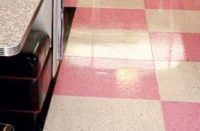
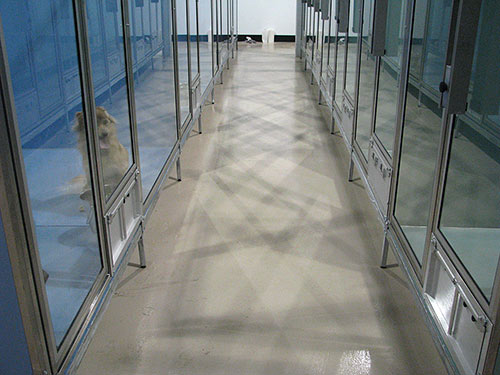
Many contractors are used to hearing this line from their clients: “I want a floor that’s slip-resistant, but I also want it to be easy to clean.” Broadcasting or mixing aggregate into resin or acrylic coatings is an easy way to satisfy this common request. Aggregate roughens up floors, giving them the consistency of sandpaper. Some aggregates add a layer of skid resistance without taking away from the effects of existing decorative applications, and others have decorative qualities of their own.
Since liability is a concern in workplaces, aggregate broadcasting is a common application for floors in restaurants, schools and hospitals. In places where skid resistance is crucial but aesthetics are not, such as distribution centers and manufacturing plants, heavy-duty aggregates can provide a high level of strength and durability. In residences, broadcast aggregates can be beneficial on garage floors and pool decks.
The physical process of broadcasting aggregate into coatings is straightforward and leaves little room for error. The key to a successful aggregate broadcasting job is in the preparation: knowing the unique qualities of each type of aggregate and how to choose the perfect aggregate variety for the job at hand.
Six types of aggregate
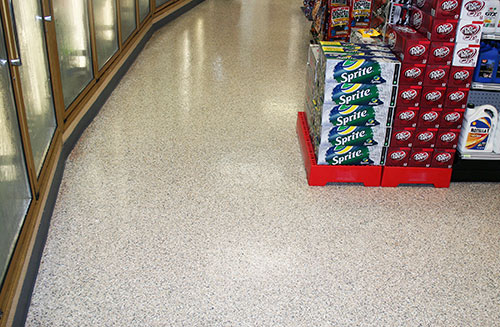
There are six primary types of aggregate that can be used with coatings: silica sand, aluminum oxide, colored quartz, glass beads, synthetic aggregate and flint silica. All aggregates come in a variety of sizes ranging from coarse to fine, but each type is accompanied by limitations in regards to application method, compatible coatings and maintenance.
For an industrial job where the floor’s primary requirements are skid resistance and surface-quality longevity, your best bet is aluminum oxide. It’s an extremely hard aggregate that does not get polished by wear and tear. Instead, it fractures in the face of intense abuse and maintains its angular, sharp profile.
Silica sand, on the other hand, is semiangular in shape, wears down after heavy contact and is typically applied in small amounts until the desired level of skid resistance is achieved.
Flint silica differs in that it’s round and uniform in size, which leads to a slightly smoother result.
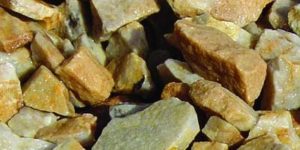
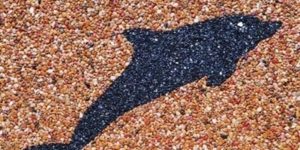
If aesthetics are just as important as skid resistance, colored quartz is the way to go. Available in about 30 colors, colored quartz can be applied in a single, uniform shade or in a combination of colors. To seal in color, manufacturers coat colored quartz pieces with epoxy or ceramic material. The ceramic coating absorbs more resin than the epoxy coating, so you’ll need to use more resin if you’re going to cast ceramic-coated colored quartz into it.
Glass beads and synthetic aggregates are the least invasive types of aggregate that still produce some level of skid resistance. Glass beads, in particular, are practically invisible — they allow you to produce a skid-resistant floor without changing the floor’s original appearance.
Keep in mind that glass beads and synthetic aggregate can be combined with acrylic coatings as well as resin coatings (epoxy, urethane, polyaspartic and polyurea). Silica sand, aluminum oxide, colored quartz and flint silica aggregates can only be used with resin coating combinations.
Another special quality of glass beads and synthetic aggregate is that, due to their light weight, they can be mixed in with coating materials prior to application. The four remaining, heavier types of aggregate must be broadcast by hand (as I like to call it, “feeding the chickens”) directly after applying the coating material. For larger aggregate broadcasting jobs, a heavy-duty industrial blower can be used to distribute the aggregate.
Also, think about your client’s planned cleaning schedule as you consider different types of aggregate. Mopping is an efficient cleaning method for floors broadcast with glass beads and synthetic aggregate. But surfaces broadcast with any one of the heavier types of aggregates are more difficult to clean, meaning they should be reserved for places where pressure washing is a regular occurrence.
Application options
By asking your client a few simple questions about the surface, you can easily determine the appropriate aggregate for the job. What will the floor be used for? How will it be cleaned? And what qualities do you want the floor to have?
Once you’ve settled on the best type of aggregate for the job, it’s safe to say the hard part is over. But there are still a few things to keep in mind during the application process.
First, consider how strong and skid-resistant the floor needs to be. For floors that are likely to endure a high level of abuse, you’ll want to apply a large amount of aggregate, fully saturating the floor coating material. (This is called “broadcasting to the point of refusal.”)
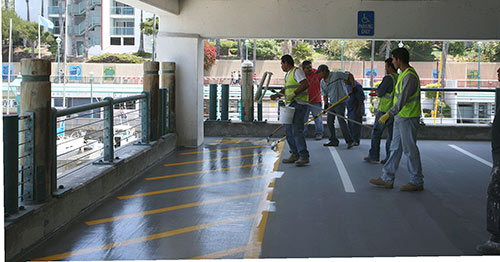
For floors that don’t need to be as strong, you’ll want to complete what’s called a random broadcast. One worker broadcasts aggregate, throwing the material onto the floor randomly, while a second worker follows behind him and back-rolls the surface, evenly distributing the aggregate throughout the coating material.
I primarily consider aggregates to be functional — add them, and you’ll have a tough, safe surface to walk on. But by incorporating certain types of aggregate, you can produce a floor that’s both functional and beautiful. Whether on a welding shop floor or a pool deck at a multimillion-dollar home, aggregate is a cost-effective no-brainer if you’re looking to boost a surface’s strength.