 Let’s face it. Concrete is going to crack.
But controlling those cracks with properly designed control joints to aesthetically enhance the slab “is what separates the men from the boys,” according to many of today’s artisans who are carving a name for themselves in the decorative concrete field.
“Cracks are not appealing,” notes Lee Levig, president of Concrete Works in Fairfield, Calif.
“If you’re doing decorative work, that’s something you don’t want to introduce … so joints are the key. We never try to prevent cracks. The object is to control and then disguise them in the most decorative way possible.”
Since joints are simply pre-planned cracks, the whole trick, he notes, is to “fool the eye” into seeing beauty, not imperfection.
“I like to use the joints as part of the decoration,” Levig adds. “If you take the time and think out what’s going on, it’s not that difficult. It’s all in the prep work and the tools. The more you carve it up, the fewer the random cracks.”
“You have to plan the cracks,” echoes Bud Stegmeier, manager and partner in Stegmeier Corp. of Arlington, Texas. “The primary function of joints is to break up the slab in geometric patterns to cause it to crack in a uniform way. Whether you’re doing regular or decorative concrete, the joints should look nice.”
Turning those joint “patterns” into distinctive decoration has become a finely honed skill for many concrete craftsmen around the country. Instead of using a canvas and paintbrushes, today’s concrete artisans are taking advantage of newly developed manufactured products and coming up with creative techniques to turn concrete pours into works of art.
 But fashion should never take a back seat to function, many caution. Joints perform a vital function in concrete work. What makes for stellar concrete is when the architect/contractor can combine both function and decoration together to create a beautifully crafted slab of concrete.
Richard Smith of West Hills, Calif.-based Richard Smith Custom Concrete, puts it this way: “We don’t tell concrete what to do — it tells us what to do. But there’s nothing that can’t be done.”
Depending on the type of joint, environment and the circumstances of the pour, practitioners use various techniques, products and methods to get the effect they’re after. They may score or saw cut, they may add a colored seal, or they may use grooving techniques to distress harsh lines. Some contractors are even turning to new joint materials to create a stylized decorative look. Artflor by Tri-Co, based in San Deigo, has recently begun using such metals as brass, copper and stainless steel as joint components.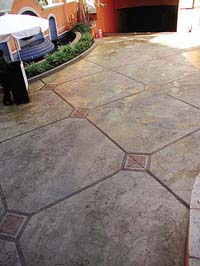
“It’s strictly for aesthetics, but it’s still functional,” notes Penny Steward, director of sales and marketing. “It really enhances the design … and gives the concrete a great look.” Steward noted that as nightclubs become “major players” in using decorative concrete as part of their décor, all sorts of cutting-edge techniques are being developed.
“There are just a lot of exciting things happening out there right now,” says the company official, who is based in Las Vegas. “Our guys look at their work as an art form… and they try to be innovative in what they’re doing.”
The joint jive
In all concrete work, there are basically three types of joints — construction joints, contraction joints and expansion joints.
Construction joints are surfaces where two different pours of concrete meet. Contraction joints are used to create weakened planes and control the location of cracks resulting from changes in thickness. Expansion joints separate slabs from other parts of a structure, and permit independent movement between the parts, helping to minimize cracking when movement is restrained.
Various methods are used to create joints. One of the most common is to groove over concrete by using a grooving or jointing tool. The cutting edge of the grooving tool is “v” shaped so that a “v” joint can be cut partly into the concrete. This reduces the slab’s thickness so that cracking can be localized. As the concrete dries out and contracts, the joint opens up further to accommodate the volume change. A dummy joint can be installed after the concrete has been edged and prior to finishing the surface.
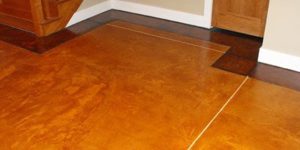
Decorative control joints are most commonly accomplished by scoring and saw cutting. For aesthetic purposes, the cuts need to be only 1⁄4-inch deep, but to serve their function, they must be about 25 percent of the slab.
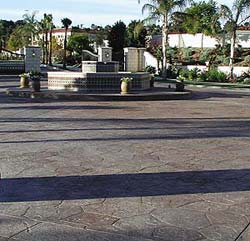 Scoring is done with a groover tool when the concrete is fresh. Score lines can be cut straight, but also may be done diagonal to the edges. Conversely, saw cuts are accomplished when the concrete is hardened. Geometric shapes can be saw-cut into the slab and then stained to create a contrasting look.
In recent years, contractors have begun cutting joints with electric or gasoline-powered saws equipped with shatterproof abrasive or diamond-rimmed blades. The blade cuts a joint into the hardened concrete as soon as it hits the surface, so as not to tear or otherwise damage the concrete with the cutting action. Newer, faster and cleaner versions continue to be developed, making saws increasingly attractive for use in decorative work.
But artisans like Levig prefer to cut all their joints by hand.
“We like to keep a more natural look in joints,” he says. “We cut back and trowel right over the rounded edge to give it a more distressed look, being careful not to close the joint. You can stamp it and it becomes part of the pattern or look. It doesn’t look hand made; it looks natural almost like slate or rough stone.”
Although many contractors will never tackle a curved joint, Levig says it’s occasionally worth undertaking for the sake of the design.
“You always run a risk when you turn a joint because that crack may not follow where you wa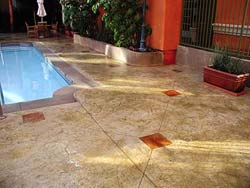 nt it to go,” he says. “If you do it, you have to do it by hand. With some, I like to back up the area and make it smaller for more joint control. You then take 1⁄8-inch piece of steel — almost like a chisel — and for the last trowel, break the concrete while it’s still wet so it breaks where you want it to break.”
Once joints have been inserted, the surface can be textured, preferably just after the water sheen has disappeared and just before the concrete becomes non-plastic. To get the texture they’re after, some contractors use such techniques as burlap drag, artificial-turf drag, wire brooming, grooving with a roller or comb equipped with steel tines, or a combination of these methods. The method chosen depends primarily on the environment, as well as the speed and density of expected traffic.
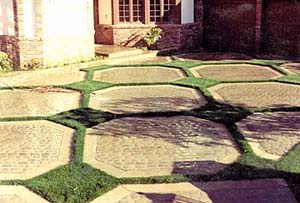 To seal the joint, manufacturers such as Vinylex Corp. have been developing products that take much of the headache out of decorative work. One of the most effective, says Mike Mitchell, the company’s product manager, is VX-Seal. The product, which comes in a variety of custom colors, creates an abrasion-resistant joint seal that is easier and less costly to install than traditional sealant products. It features a tear-away top that recesses for superior abrasion resistance and finishing. Using the product also eliminates the need for other traditional sealants.
“It’s installed at the time of the pour and it’s permanent,” says Mitchell. “So when the concrete is poured, you’re done.”
The best part, he adds, is that “It lasts the lifetime of the concrete.”