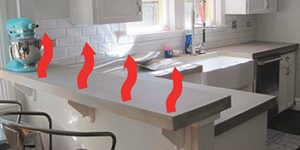

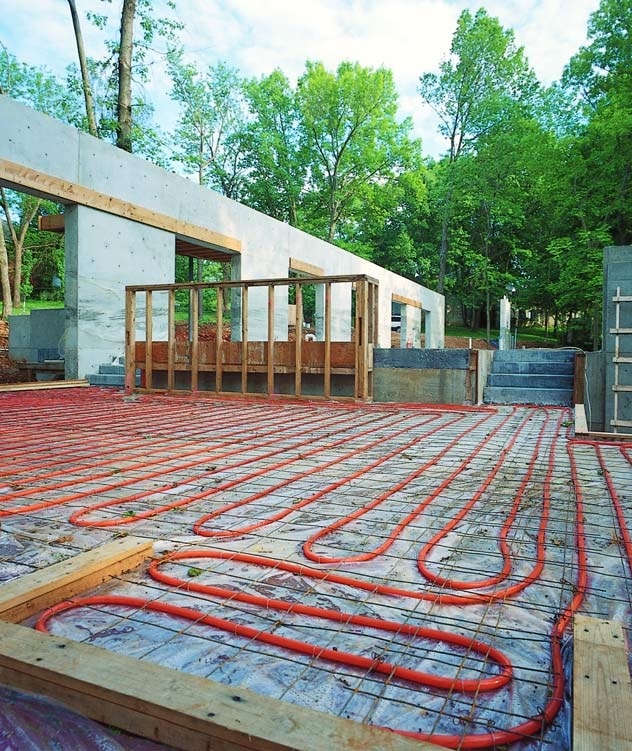
 When a technology has been in use for some 2,000 years you’d be right in thinking that the originators might have had a pretty good idea. Of course, the technology of radiant heat has improved through the centuries. And, today, many people are giving radiant floor heating another look as an option in commercial and residential applications.
Radiant heat delivers warmth without ducts and registers; heats evenly, in an energy-efficient manner; and is silent. There are hydronic (hot water) and electric systems.
“A lot of smaller jobs [such as baths and kitchens] and retrofits are done with electric systems,” reports Hoyt Corbett, a consultant and publisher of The Radiant Flooring Guide,” based in Seattle. Electric systems are growing fast, especially in conjunction with tiled floors, as the electric elements can be embedded in the thinset layer, he adds.
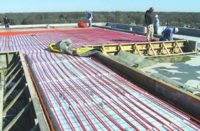
Most big projects are hydronic, Corbett says, because there is a better level of control with regard to water temperature and circulation. “In 2002, there was approximately 130 million square feet of [new construction] hydronic radiant flooring installed—and about half of that was installed in concrete slabs.”
And Corbett reports that the installation of radiant heat flooring is growing at about 20 percent to 25 percent a year. So, it makes sense, he observes, for concrete contractors to investigate and form a relationship with radiant heat installers in their area. “The fit is very good!”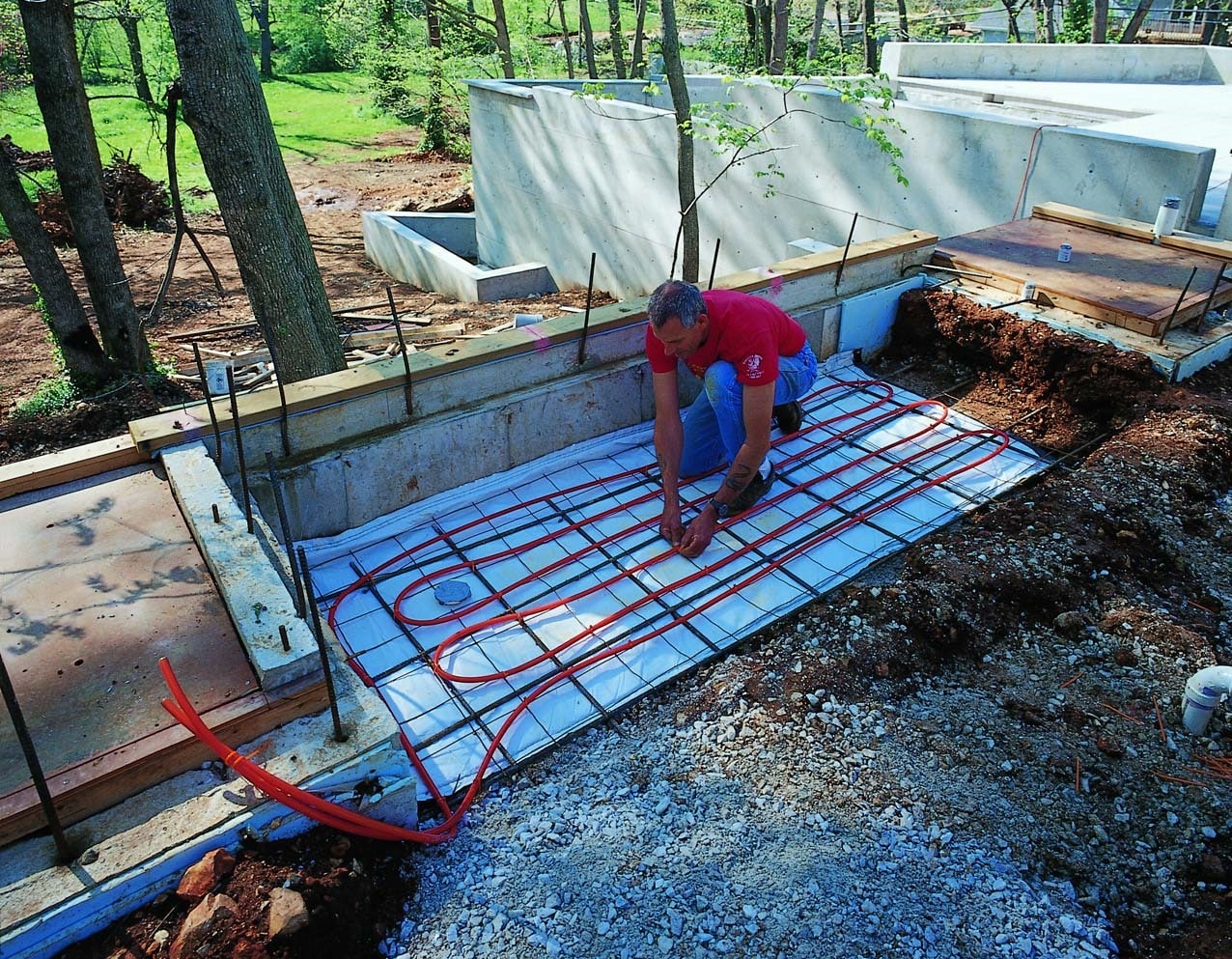
It’s what you do anyway
>Whether or not radiant floor heating presents an opportunity for concrete contractors depends on the area of the country you’re in and the usual method of construction there.
Radiant floor heating is a natural in on-grade concrete slabs. The heating tubes are normally fastened with plastic ties to 6-inch by 6-inch concrete mesh so the tubing winds up in the middle of the slab. These slabs expand and contract more frequently than slabs without radiant heat, so all care of the normal steps should be taken with the pouring and curing. But hydronic tubing is very flexible, so some cracking should not be problematic, just cosmetic. Corbett explains that in Europe the systems are typically done in two pours, with the tubes embedded in a topping slab.
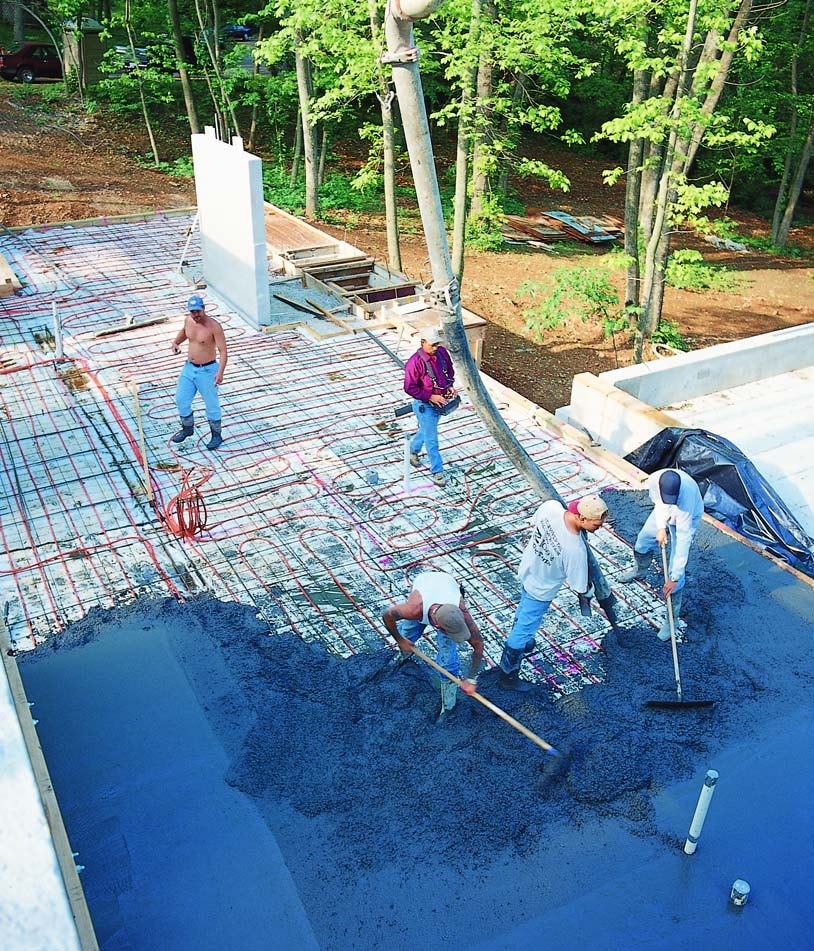 If radiant floor heating is to be installed without a slab on-grade or on the second floor — or higher — the standard installation involves attaching the tubing to the subfloor, and then, most frequently, a 11⁄2-inch slab of concrete or gypsum-based cement product is poured on top. (In some applications, the tubing is attached under the floor, between the floor joists, but that doesn’t really apply to this discussion.)
The good news for concrete contractors is that concrete floors have the highest output of radiant heat, and the best heat retention. The cost to install radiant floor heating runs from about $3.50 to $14 a square foot, depending on where you are in the country and how elaborate the system, according to Corbett. And, he says, there is a shortage of installers.
“Today, radiant heat is the fastest growing segment of the heating industry,” said Mike Chiles, president and general manager of Watts Radiant, a leading supplier of radiant heat products (www.wattsradiant.com). “We’re seeing an incredible rise in interest among those in the concrete industry — not just for the popular PEX tubing, but also for synthetic rubber tubing, and electric radiant mats in, and over concrete. Commercial hydronic installations are rising fast, both for large concrete floors and large snowmelt systems. We’re seeing a lot more of these with stamped concrete finishes.”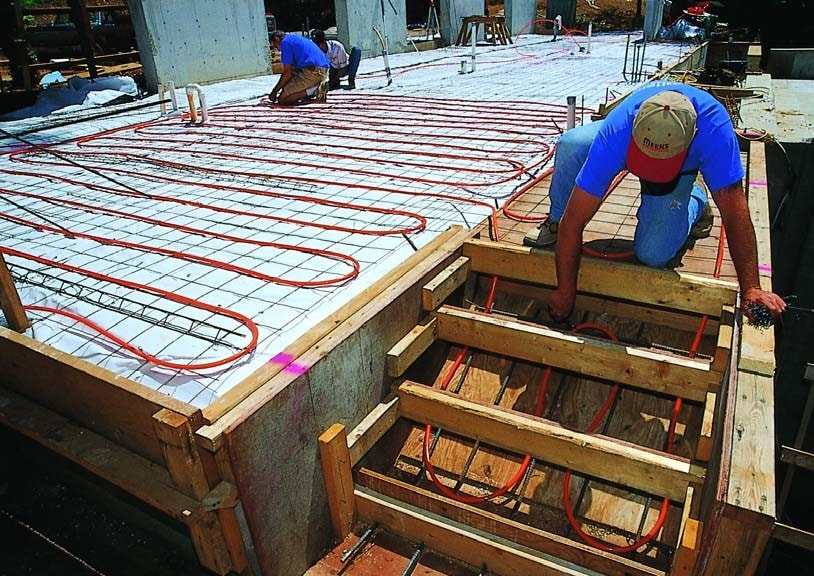
Beautiful warm floors
Dave Pettigrew, owner of Diamond D Co. in Capitola, Calif., works the Bay area and has plenty of experience with radiant heat floors. When it comes to installing the systems, he lets the plumber take care of laying the tubing, but Pettigrew is the concrete specialist.
“When I saw [concrete] staining about 12 years ago, I knew I was interested and I took that on to the next step, to find the best market, which was radiant heat,” Pettigrew recalls. Not only does a concrete floor conduct, hold and radiate heat well, “it’s beautiful with stain and art work.”
 Pettigrew says he’ll do just about any kind of decorative surface his customers want, but, generally, he uses stains and colored micro-toppings. He also prefers pouring the slabs in two layers: a structural slab, then a 3 1⁄2-inch concrete layer with the radiant heating tubes. In between the concrete layers is an insulator.
What about applications with plywood subfloors? Pettigrew has developed his own system for that, too. First, waterproofing goes down, then the tubes are attached. Pettigrew uses a pea gravel concrete to fill up to the top of the tubes or coils — about three-quarters of an inch thick. He lays a crack isolator on top of that, and then pours 11⁄2-inch concrete for the decorative concrete work. “One and a half inches of concrete weighs about the same as marble,” Pettigrew says. He adds saw cuts at pressure points to minimize random cracking.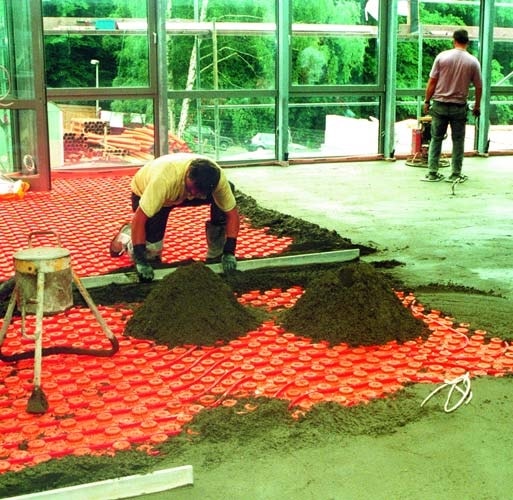
Valerie Wells, a decorative concrete contractor and owner of ArtScapes in Albuquerque, N.M., has been applying her hand to radiant heat floors for about eight years. She comes in after-the-fact — after the concrete with the embedded tubing has set up. Her specialty is decorating the floor surfaces. “Decorative finishes are more costeffective than other floor coverings,” she reports. “It’s comparable to carpet, cost-wise.” For customers who are wary of decorative concrete by itself, she says some customers have had her apply a decorative finish and then they add area rugs.
Wells favors decorative cuts and acid stains to achieve her decorative effects. She has also applied overlayments for stamped textures. Flagstone and rock textures are popular in the southwest. As in other concrete work, expansion joints are important, says Wells, however, hairline cracks can be used to decorative advantage. For example, hairline cracks can add to the design of a faux marble finish.
 Decorative concrete artisans might like concrete radiant heat floors for another reason — they make it easier to work in cold weather. “Sealers are temperature-sensitive, so radiantheated floors are good to work on in the winter,” Wells points out. She typically uses a two-part epoxy sealer with urethane over it because it is more environmentally friendly, but she also uses solvent-based sealers and solvenated acrylics in commercial applications.
More about the “G” word
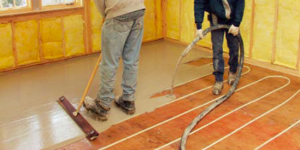
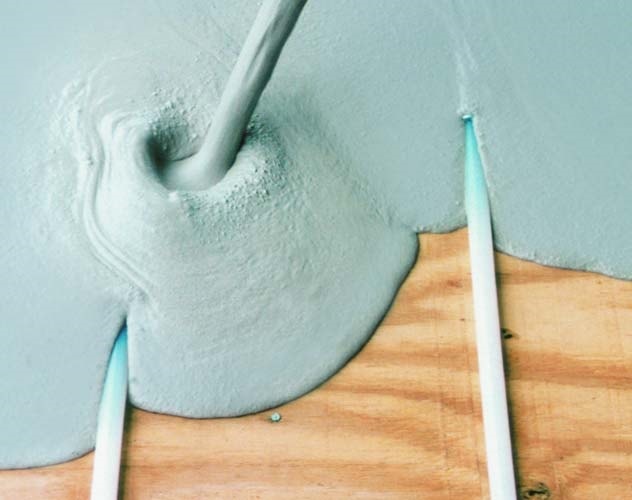
Depending on whom you talk to, Gypsum-based cement products such as Therma-Floor, Gyp-Span and LEVELROCK may have a couple advantages over cement with regard to radiant floor heating systems. Gypsum-based cement products adhere well to various subfloors and adhere to and seal the radiant heating tubes so you don’t have air bubbles to worry about. These products can be poured in a thin layer, are lighter in weight than concrete and don’t shrink as they cure. In addition, they cure quickly and virtually any kind of finished floorcovering can be applied on top.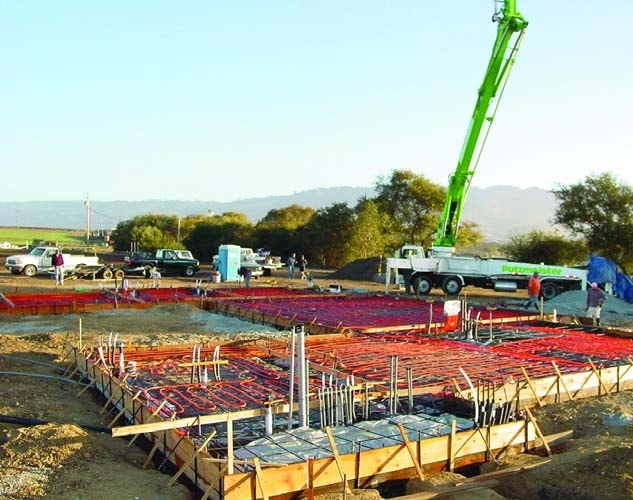
On the negative side, gypsum-based cements are not a wearable, finished floor surface, with one exception todate. United States Gypsum Co. has introduced PROFLOW to its line of LEVELROCK Brand Floor Underlayments. According to the manufacturer, PROFLOW can be used as a finished floor when it is “coated with an approved decorative finish from Richard James Specialty Chemical Corp.” Don Brandt, market manager for LEVELROCK products, reports the decorative finish is a specially-developed acrylic-based epoxy topical coating. Brandt says PROFLOW can be integrally colored and you also can mottle the topical coating to achieve a faux finish.
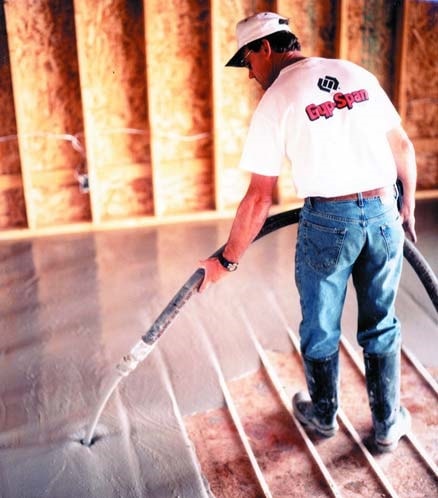 Beyond the pros and cons of using gypsum-based cement products, concrete contractors may view them as another way to expand their business. Sharon Goerlach, marketing assistant for Construction Products Network Inc. in Prospect Park, Pa., says “There is a lot of crossover in concrete contractors who also install [gypsum-based cement] products.” A lot of the same application techniques apply: raking it into place and floating it out. But it requires specialized equipment and training. “Only trained, licensed applicators can install it,” reports Michelle Thompson, marketing communications coordinator for Hacker Industries Inc. in Newport Beach, Calif. Concrete contractors interested in learning more about these products and available training opportunities should contact the various manufacturers of gypsum-based cement underlayments.
Other things you might see in the field
If you, as a concrete contractor, decide to enter the radiant heat floor market, there are a couple of fairly recent items that you might encounter or decide to use.
When pouring slabs on-grade, a moisture barrier is important. If your slab will integrate radiant heat, you might consider an insulating moisture barrier.
Innovative Energy Inc. developed TUFF-STUFF, a high-strength, insulating moisture barrier, especially for use below heated concrete floors. Warner Buchelt, the company’s national sales manager, says you typically don’t lose a lot of heat to below the slab, but “having an insulating barrier will increase the efficiency of heating the building.” It will ensure the heat is directed upwards, not lost, either to the soil below or to groundwater, which can carry away heat. TUFF-STUFF reduces downward heat loss by more than 50 percent.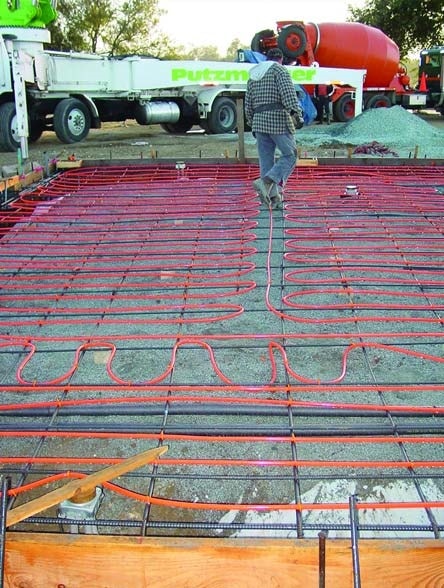
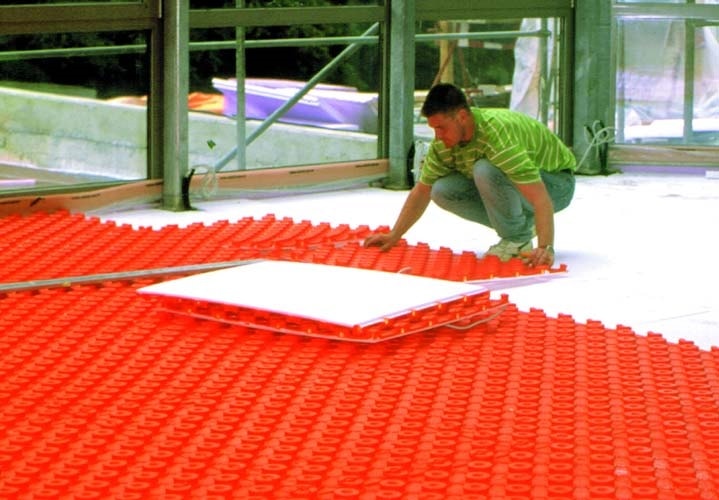
Contractors who cross over into the radiant heat flooring market or pour gypsum-based cement underlayments may encounter the BEKOTEC Modular Screed System, which allows for continuous screed surfaces without control joints or saw cuts. Kimberly Rielly, public relations coordinator for Schluter Systems LP, the manufacturer, explains that the system’s lightweight studded polystyrene panels are placed over the substrate, the radiant heat tubing is looped between the studs and a screed or gypsum-based cement product is applied on top. Any microfine cracks that develop during curing occur between the studs, which “confines the curing stresses to each module, eliminating the need for control joints in the screed.”
For more information about radiant floor heating systems, visit the Radiant Panel Association’s Web site at www.radiantpanelassociation.org.