
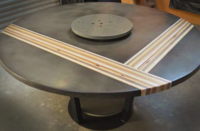


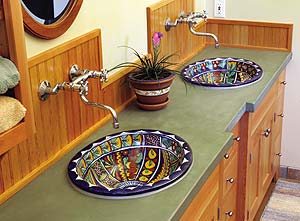
 Concrete is making a permanent place for itself as a material of choice for countertops across the country.
Concrete countertops are more than a trend. As more and more homeowners and designers specify concrete countertops in new homes and in remodeling projects, concrete is making a permanent place for itself as a material of choice for countertops across the country.
Of course, the cost of countertop materials varies around the nation, but if you compare concrete to other popular products what you would probably find is this: A typical tile countertop is less expensive than a concrete one. Solid surface materials run about the same or a little less. Granite and marble often cost more.
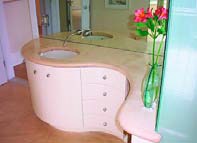
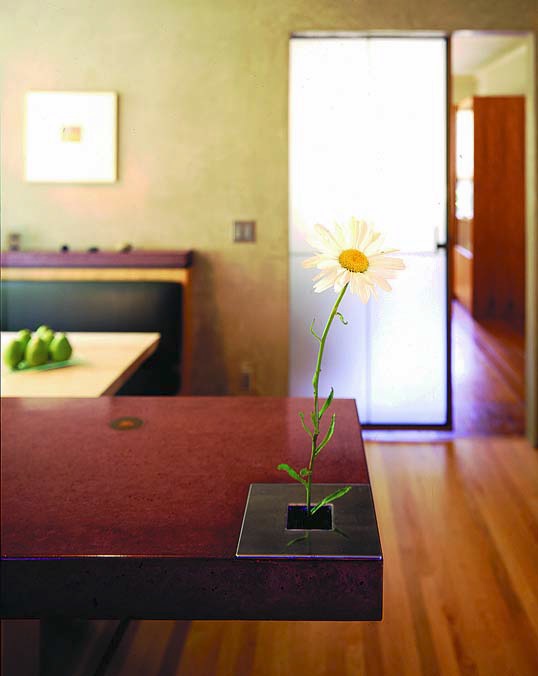 The advantages of concrete as a countertop material range from its physical characteristics to aesthetics — from its durability to its flexibility. As Michael Karmody, a founding partner of Stone Soup Concrete in Northampton, Mass., points out, “With concrete, you can have any shape you want. Concrete is a structural material; you can vary textures. We can grind it to expose the aggregate or leave it as it comes out of the mold. … It’s easy to inlay [and] emboss textures. It’s a really good sculptural material.”
Creative potential aside, there are some who may wonder about the weight of concrete countertops. However, weight really isn’t an issue any more than natural stone. Karmody explains that a granite countertop weighs about 22 pounds a square foot. Concrete 1.5 inches thick weighs about 18.5 pounds a square foot; at two inches thick it weighs about 25 pounds a square foot.
Concrete has some disadvantages, such as its vulnerability to staining and it not being as rock-hard as granite. As Fu-Tung Cheng, principal and chief executive officer of Cheng Design in Berkeley, Calif., philosophically observes, “I frequently tell people that you have to be objective about concrete. You have to play to the strengths.” Fortunately, the contractors who have enjoyed the challenges of creating concrete countertops for many years have worked out many of the “bugs,” and the results are more reliable and consistent.
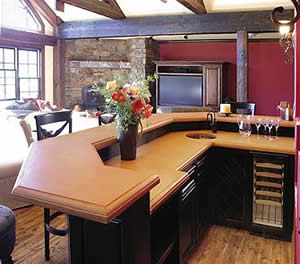 Concrete countertops are not for everyone, though. “Concrete has an earthy aesthetic — mottled color, some crazing. It’s OK for it to have some patina,” Cheng says. If people want “slick,” concrete is probably not the material for them.
“There are criteria people use in selecting countertop materials — granite is a typical standard,” Cheng explains. It boils down to the issue of what constitutes what’s acceptable, he adds. “Contractors who experiment or push the envelope will help set the standard of what’s acceptable.”
How-to depends on whom
Each contractor who has experimented and refined his or her concrete countertop technique has found individual solutions to this creative process.
Karmody says his “mix design is not too different than what they used in the Hoover Dam,” but he does use admixes, fiber and fan-shape reinforcement, and other innovative techniques to create unique products for each of his clients. “Everybody wants something different, so all colors are custom and are included in our standard product.”
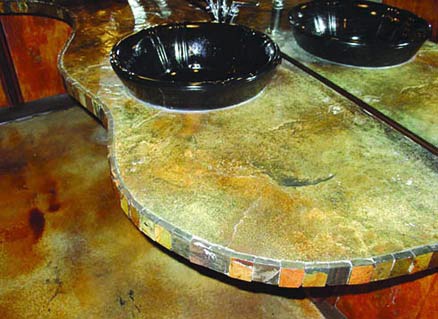
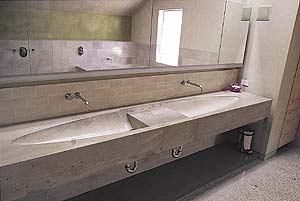 His custom finishes include marbling colors, adding dye late in the mix so the colors appear like flames in the finish, acid etching, and embedding objects, such as sea shells, stones, brass and voids for drainboards.
Steve Eyler, owner/operator of Eycon in Myersville, Md., created his mix design based on a Glass Fiber Reinforced Concrete design — tweaking it to work with and enhance his product. “It gives it more structural and flexural strength. [I’m] not as concerned with compression strength, but more concerned with flexural strength.”
Another technique Eyler has been perfecting is using sandwich panels to reduce the weight when a thick slab is required. He has developed specific procedures that allow him to sandwich in a lighter material, such as Styrofoam, inside the center of a thick slab without compromising the countertop’s structural integrity or finish characteristics.
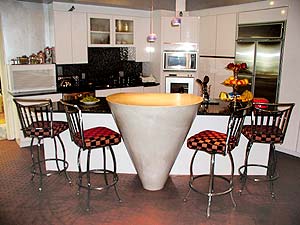 Many contractors prefer to pre-cast concrete countertops for many reasons: It is less risky. You have more creative control and more artistic options. And you can get a better surface. But there are times when pouring on site is the only option. For example, Cheng pours on site when he is creating a wall that becomes a cantilevered countertop in one monolith pour.
Pre-casting means seams. Contractors use a variety of materials to fill them: from silicon caulk, to grout, to marine epoxy. Something most contractors agree on, however, is that seams don’t have to be a negative. If they can’t be placed inconspicuously, they work well if they play into the overall design of the countertop.
Concrete is making a permanent place for itself as a material of choice for countertops across the country.
 The overlay option
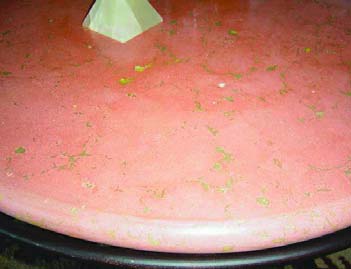
Some contractors have been busy refining the use of engineered cement overlay products to create countertops.
“I’ve found a lot more advantages than disadvantages,” says Matt Jecker, owner of Stone Craft L.L.C. in Springfield, Mo. “The biggest advantage is the fact that we can pour our overlay material less than a half-inch thickness, allowing it to dry faster — speeding up production.” From start to finish, he can complete a job in five days. And, he adds, the material is stronger than standard concrete.
Rune Borgir, founder of Cement Elegance Inc. in Bend, Ore., also uses an overlay product for his countertops. “One of the keys to our success is we have fast-drying, fast-curing time. We can pour in place — seamless, one pour — regardless of the configuration.”
The material is often poured over a plywood or MDF substrate.
Jecker says by using overlay he can fashion sculpturally-detailed edging. “We manufacture all our own edging and we’re able to create very fine detailed forms. … We can shape the edge in advance so you can pour curved contours, arches, round table tops” and more.
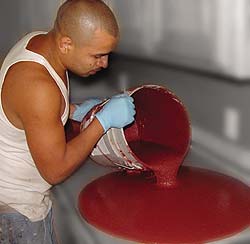 Engineered cement overlay products lend themselves to numerous coloring options. Borgir explains the primary coloring methodology is integral color, but you can also get creative with dyes. “Color washes — generally subtle tints — bring color and life to the surface.” Then there are faux coloring and faux imprinting techniques which have “become more popular because we can mimic stone patterns.”
Acid stains, chemical stains, inlays, colorations in the sealer, it all adds up to unique, one-of-a-kind countertops. Top engineered cement’s denser, tighter matrix with a finish coat — again, from polyurethane to high-level epoxy, depending on the final effect desired — and you wind up with a nonporous surface that, Borgir and Jecker report, is maintenance free.
Breaking into this market segment
Concrete contractors can often make the transition from sidewalks to countertops fairly easily because they are familiar with the characteristics of concrete. But concrete experience is not required.
Ric Filiaci and Joy Zimberlin, co-owners of Something Concrete L.L.C. in Schenectady, N.Y., say there was a lot to learn about concrete and techniques when they launched their business in 2002. Both have degrees in design, but Filiaci did a lot of networking and learned the basics of the craft by reading, and talking to and mentoring with people already in the business.
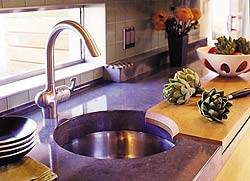 “It’s amazing how different the product is with each craftsman that applies himself to it,” observes Zimberlin. Now, with the basic process and techniques down, they are working to establish their signature look.
They are entering the market place by offering their services through kitchen design houses. Something they have found very useful is creating 1-foot-square, 11⁄2-inch thick sample boards for each project. Each sample board has two treatments. “One side has more grinding to expose the aggregate. The other side has just gentle sanding and buffing — more like right out of the mold.” Zimberlin explains. There also are two different surface treatments on each side for client comparison. “A food-grade penetrating sealer, buffed with wax, and a food-grade topical sealer, which has a more plastic look.” The sample board shows clients what they can expect and gives them a better reference to make choices about the surface finish and sealer they desire.
The advantages of classes and premixed products
“Classes are a great segue in getting introduced to the potential [of the medium],” Cheng points out. “Getting your hands into it gives you a good head start; more than reading a book.”
Classes also help contractors know what kinds of problems they may run into.
 “It’s important to know potential hazards,” Jecker cautions. “It’s important to know how to address those issues.”
Many contractors are saving themselves a lot of trial and error by using prepared mixes.
As Marshall Hoskins, sales and technical representative for Specialty Concrete Products Inc. in West Columbia, S.C., explains, prepared mixes, such as DURA-TOP Countertop Mix, make for an easier installation process. The mix incorporates all that is needed, so it eliminates the need for many installation steps needed for regular concrete, such as admixtures and, in most cases, a steel support system. Pre-colored mixes, he adds, also help ensure consistent color match from batch to batch.
Multiple-size aggregate is used, depending on the thickness of the pour, as well as colored glass and Terrazzo aggregates that can be exposed by grinding.
 “Tops can be both pre-cast or poured in place. Generally, the job scope, dimensions and the contractor’s ability determine which method is best for a job,” Hoskins says.
Prepared mixes are an especially good choice for contractors who don’t necessarily want to specialize in countertops, Cheng says. “Buying a mix that’s ready to go is for the contractor who wants to add a product line to what they already do. … They don’t have something that’s foolproof, but you have a mix design that’s researched and tested.”
Cheng, whose company offers NeoMix, points out that prepared mixes eliminate the need to warehouse material and let contractors get right into the creative process. “We’re trying to make it so easy and so cheap, why should anyone do anything else?”