
Liquid and powder release aren’t a contractor’s only choices when considering release agents for concrete, and Richard Smith’s contracting company seems to have explored many of the alternatives.
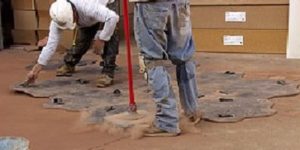
They’ve used ground seashells, 120-grit silica sand, and all kinds of aggregates.
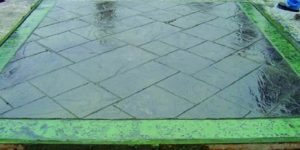
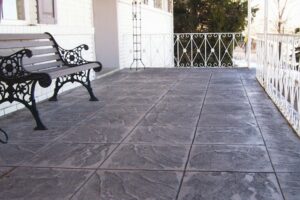
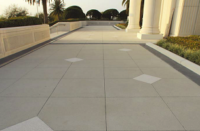
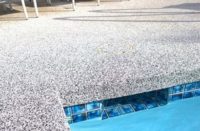
Decomposed granite residue is “just dirt, for the most part,” Smith says, but as a release agent, it gives a slab the varied hues of real stone. Shells, when used with a rough stamp and a limestone color, leave behind concrete that looks like an exposed fossil bed. Making one thing look like another is what decorative concrete is all about, Smith says. “We’re trying to simulate and emulate the real thing.”
On one job at the home of a famous Hollywood couple, Smith’s firm put down thousands of dollars worth of 1/8-inch and 1/2-inch dice as a release agent, not the normal liquid or powder release for sure. At one point, the couple asked if every little die could have the same number showing. “We get a lot of weird, weird requests,” Smith says.
About Richard Smith
Rick Smith, owner and president of Richard Smith Custom Concrete of West Hills, California, subscribes to a business maxim that he believes is crucial to the success of any contractor business, or, in fact, any business: Do more listening and less talking.
“It all boils down to honest and open communication,” he says. “If people would just try to keep their mouths closed and their ears and eyes open more often, there’s virtually nothing that can’t be done. We all need to do a better job of listening to our clients.” (That advice would probably save many marriages as well!)
Not that you should stop talking entirely, however. The ability to clearly communicate your ideas, your strengths as well as your weaknesses, and your concerns about a given project are also crucial, Smith adds.