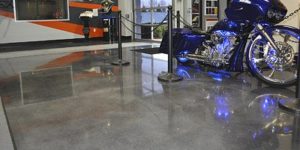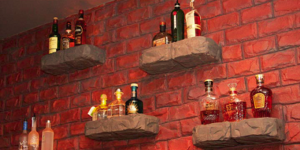



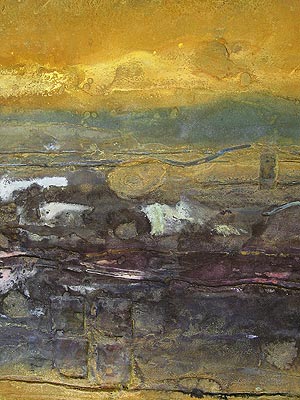
Concrete dyes are quickly becoming a favorite coloring method for decorative concrete contractors. With overlays, stamping or stenciling, using a combination of dyes and reactive stains gives concrete floors and walls endless possibilities for color.
Decorative concrete just keeps getting more … decorative. Does anyone use gray concrete anymore? Why would they, when concrete dyes can provide just about any color, however subtle or vivid? By using dyes either alone or in combination with reactive stains, designers and contractors can achieve just about any look imaginable. “If you think of a watercolor artist, that’s the way you might think about using dyes,” says Mike Miller, managing principal of The Concretist in Benicia, Calif.
Dyes or stains — what’s the difference?
Sometimes the words are used interchangeably, but understanding the difference helps contractors choose the right products to get the effects they want. Basically, a dye is a coloring agent, usually supplied in concentrated form, that is diluted in water or solvent (alcohol or acetone) to the desired shade. The dye may be mixed with other colors on site. It is usually applied with a pump sprayer, but may be applied with an airless sprayer, airbrush, sponge or brush, depending on the desired effect and the size of the area to be colored. The solvent or water carrier penetrates the concrete, taking the color with it. The final effect is transparent, so the concrete is visible through the color.
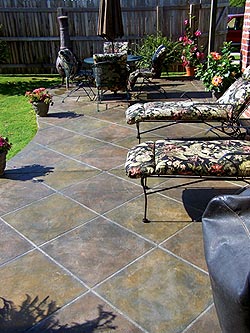
Chemical or acid-based reactive stains color concrete by a very different mechanism. The acid catalyzes a chemical reaction with the lime in the concrete, creating a variegated, dappled effect. Pigments in the stain impart color. Colors of reactive stains are similar to colors that occur naturally in stone, so the palette is somewhat limited.
“Not all concrete can be reactive-stained,” says Janine Lutz, CEO of SuperStone, Opa-Locka, Fla. “A stain has to set at least four hours and then you have to wash and neutralize it. With a dye, you just put it on and seal it — no washing, no neutralizing.”
There are some water-based stains on the market, consisting of pigments in a water-based carrier, usually acrylic. Because they don’t react with the concrete, they are often confused with dyes. Gary Jones of Colormaker Floors, British Columbia, explains the difference. “The particle size of a dye is one thousand times smaller than the pigment in a water-based stain, so the dye penetrates more deeply into the concrete, while the stain is a more opaque-looking surface color.” Art Pinto, president of Decosup Inc. in Miami, Fla., adds, “A water-based stain is an acrylic resin with a pigment. A dye isn’t carried in a resin and there is no binder. So a dye penetrates the surface, while a water-borne stain lies on the surface.”
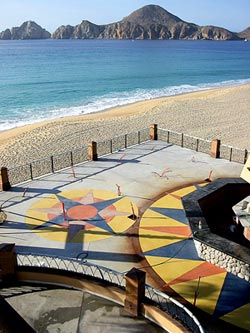
Smith Paint Products, Harrisburg, Pa., makes a water-borne stain that performs more like a dye by grinding pigments to a smaller molecular size so they penetrate more deeply. The effect looks more like acid staining, but the water base allows a greater color palette. This “dye-stain” also offers greater resistance to ultraviolet (UV) and alkali degradation than regular dyes, so it can be used outdoors.
In terms of the final appearance, there are two major differences between dyes and reactive stains. “The thing with dyes is they offer much greater color variety and brightness than stains, and also better color control,” says Mike Miller. Basically, according to Lutz, “You get what you expect.”
Dyes and stains — a winning combination
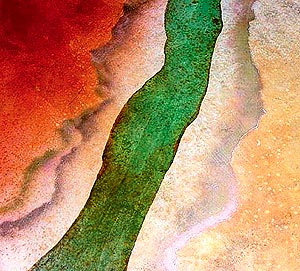
In spite of, or maybe because of their differences, dyes and reactive stains work wonderfully together. For example, a customer may want the graphic variegation of a reactive stain, but in a color not available. A dye can be applied over the stain to give a brighter color while allowing the pattern created by the reactive stain to show through. Dyes might also be applied by hand over parts of a stained surface to “paint” a picture or add highlights or accents.
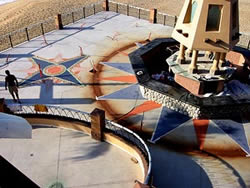 Dyes are often applied over stains to even out variations in the reaction. For example, if the stain fails to “take” in one area, it can be colored with a dye to be more consistent. “Acid stains sometimes don’t turn out as expected,” Pinto says. “Contractors can dilute a dye with acetone, spray it over the floor and seal it and it looks just fine. I know some people who take stain color charts and match dyes to it so they can deliver predictable color.”
Miller expands on this idea. “I consider every stain job a dye job too,” he says. “I always bring dye with me even if I don’t use it. If you have to correct a simple stain application with a dye, it will only take an extra hour. So I build in that hour as a margin of safety.
“I use the dye for fine adjustment. It enables me to do colors others can’t do and to be a bit more fearless on a stain job.” Miller also uses tints added to the first coat of sealer, saying, “That way I’ve got three shots to get the color right on the job. I hardly ever sample a job anymore, I just send the stain in the direction it’s going to go and then work with whatever happens.”
 A note of caution
As versatile as they are, dyes cannot be used in every application. While some contractors use them outside, most agree that dyes will fade when exposed to sunlight. Lutz is one who recommends dyes only be used inside, for countertops, for example. Pinto likes them for what he calls “go-to-Vegas disco” — commercial and retail interiors where bright colors accent the theme of the business.
Lutz recommends applying dyes only to unsealed concrete. Pinto, on the other hand, uses dyes to color-correct applications that are already sealed. “A stain job can’t be fixed without removing the sealer,” he says. “But you can spray a dye over the sealer — the acetone re-emulsifies the sealer, the dye goes through, and you reapply the sealer. It rejuvenates the color and fixes the problems quickly and safely.”
It is imperative to seal any job with dye on it. Otherwise the color can be washed away over time.
Finally, as with any decorative application, the concrete must be sound. “A thin coat of dye or stain won’t help bad concrete,” says Chuck Brunner, Sr., of Smith Paint Products. “It won’t seal cracks.”
Special effects
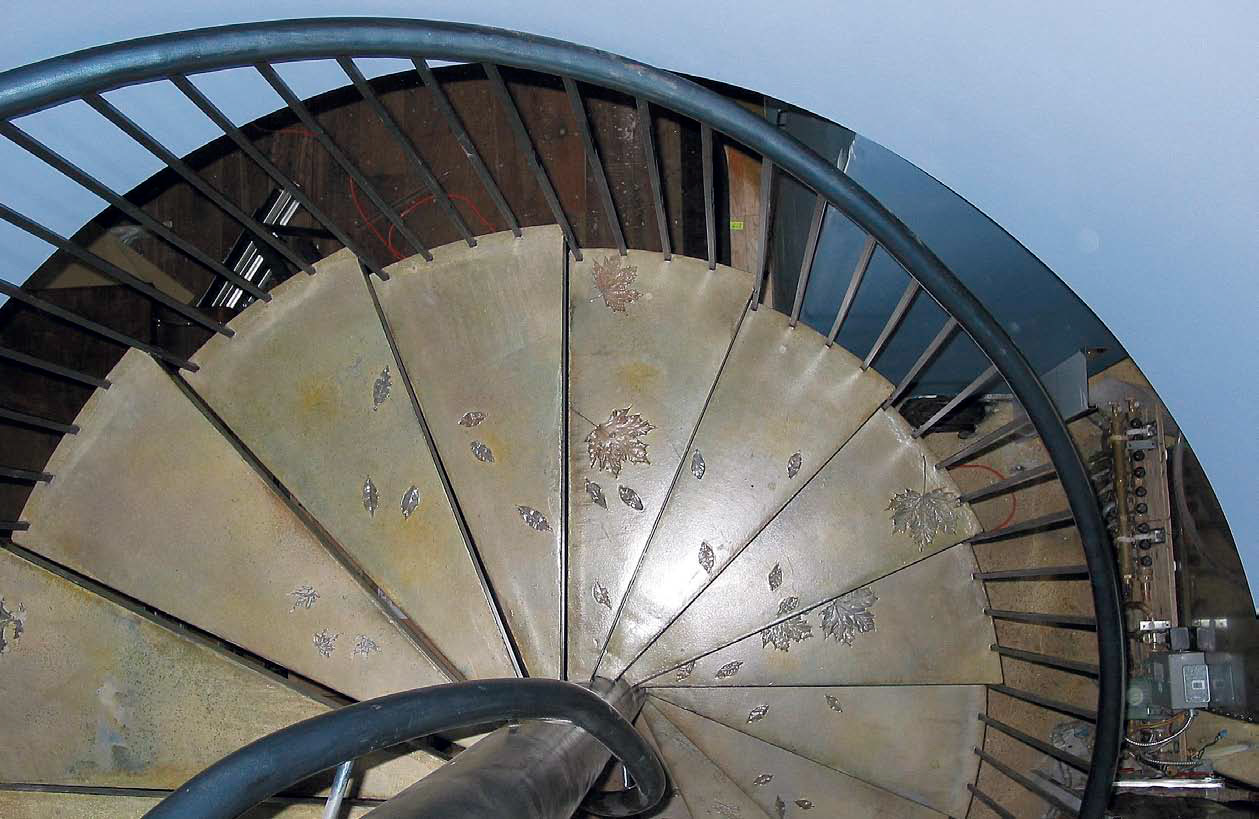
Dyes are great to use with stencils, bleeds and resists. They can be applied by hand to small areas to create intricate patterns. Colors can be layered on top of one another. The same color can be diluted to give gradations of color. For example, Miller describes a job designed to echo Lake Tahoe, with deep blue in the center becoming progressively lighter and warmer toward the edges.Typically, more vivid colors are achieved with dye carried in solvent. Also, acetone flashes off so quickly that according to Lutz, “when you spray it on, you can step on it right away. Dyes in acetone are very popular for polishing applications.” Gary Jones agrees. “We have a big following of those using solvent-based dyes at a ratio of one part dye to one part solvent on polished concrete.”
But Jones likes water-based dyes too. They smell better. He also likes the fact that these dyes remain workable longer. “With water you can move the colors around a bit,” he says. “You can mop the dye around, mix colors on the surface, or layer it. It will take differently to wet surfaces than dry ones, so you can get some nice variations.”
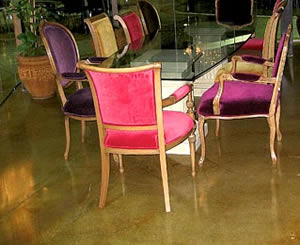
And the next generation? “There’s new technology every day,” Brunner says. “We’re working on flip-flop colors that change as you walk past them. Think of the scales on a fish mounted on the wall.” He also says metallic colors are making a comeback and pearlized colors are popular.
So dyes, originally viewed by some as a corrective for stain jobs gone awry, are coming into their own. Used with reactive stains or by themselves, they give contractors and designers more options to be creative in concrete.