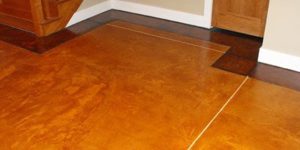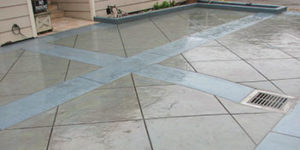


You’ve put a lot of time and effort into creating a beautiful concrete surface. You’ve even been realistic enough to include a pattern of joints to control cracking. Now, what can you do to make the joints as attractive and useful as possible?
The good news is that there are several options for filling or sealing the joints. However, you have to decide which type of product is most appropriate for your project.
Protecting joints from traffic
The first thing to consider is the environment your slab is in. If joints in industrial floors are not filled properly, they can be damaged by forklifts and other vehicles. “The primary function of all of our (joint-filler) products is to protect the joint edges and provide load transfer from one slab to another,” says Alana Mallat, inside sales director for Metzger/McGuire. “It prevents the concrete from breaking off under the hard wheels and heavy loads that would typically be traveling across the floor in a warehouse or distribution center.”
Metzger/McGuire makes two lines of industrial floor joint-fillers: semirigid epoxies and semirigid polyureas. They can be tinted to any desired color. The difference between them, Mallat says, is a matter of convenience. “MM-80, which is an epoxy, usually takes about eight to 12 hours in an ambient floor, whereas our polyureas typically set up in anywhere from 30 minutes to two hours.”
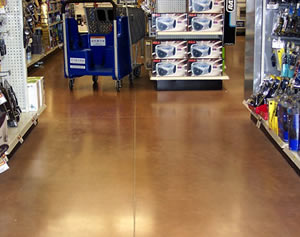
To protect the slab edges effectively, it is important for the joint filler to be flush with the floor surface. This is accomplished by overfilling the joint and then, after the filler has become solid but not hardened, using a scraping tool to shave off the excess material. Because overfilling the joint can stain adjacent concrete surfaces, Metzger/McGuire makes a companion product, SPF. Treating surfaces with this stain-preventing film before filling the joint protects the concrete’s appearance.
Euclid Chemical Co. formulates its Euco 700 two-component semirigid epoxy joint filler in 11 standard colors to match dry-shake color hardeners. Custom colors can be formulated, and a water-based stain prevention film is also available. However, like other epoxy products, Euco 700 can discolor when exposed to ultraviolet light. “Euco 700 cannot be used outdoors,” cautions Jennifer Crisman, Euclid’s technical marketing manager.
Sealing out contaminants
“It’s very important to use a joint sealant,” says Mike Murphy, technical service rep for Pecora Corp. “You want to keep water out, because water can have detrimental effects on the concrete itself and any other substrates the water can come in contact with.”
For vertical joints, Murphy recommends Pecora’s 890NST, a single-component silicone sealant that will not stain porous materials such as concrete or marble. Dynatred, a two-component polyurethane sealant, is his choice for floor joints. “The Dynatred is stiffer,” he says, “and it’s more resilient to taking a lot of foot traffic.” Both products are available in an array of standard colors, with custom matching also available.
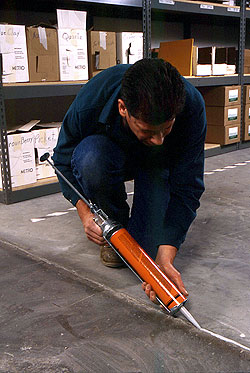
“You’ve got to give the concrete 30 days to cure, and make sure all of the moisture has evaporated out of the concrete,” Murphy says. Then apply either type of sealant with standard caulking equipment, and tool it to a slightly concave finish. “Give it seven days to cure, and that’s about it,” he concludes.
Water is not the only intruder that can accumulate in control joints, and other debris can be downright ugly. “The main reason you seal joints in decorative concrete is you don’t want to have dirt accumulate in joints of countertops or decorative floors,” says Norm Lambert, president and technical support director of Epoxy Systems.
Besides an epoxy sealer for industrial applications, Epoxy Systems makes a single-component polyurethane sealant and a dual-component polyurea product. “Formed joints tend to be bigger than saw-cut, so you tend to go to the two-component materials,” Lambert says. He recommends using the single-component product only on joints less than about 3/8 inch wide. “The dual-component product cures at depth just as quickly as it does at the surface because it’s a chemical reaction between the two components,” he explains. Curing quickly can avoid potential problems with water — for example, near a swimming pool or if rain is on the radar. “The dual-component product is available in a lot more colors,” Lambert adds. “Besides, it costs less.”
Other considerations
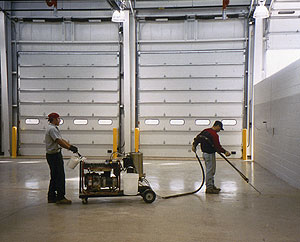
Obviously, you want to select a joint sealant that will protect the concrete and look good doing it. Some products are well suited to specific environments. For example, Epoxy Systems’ Product No. 916, a two-component polyurea joint sealant, exceeds ASTM test requirements for sealants exposed to continuous immersion in liquids.
Another product to consider for swimming pool decks is Deck-O-Seal, a two-part polysulfide-based joint sealant. “It’s going to be resistant to the chlorine and the chemicals in the swimming pool,” says Jim Dill, division manager for the Deck-O-Seal Division of W. R. Meadows. After mixing, the sealant is applied with a squeeze bottle or caulking gun. “It self-levels,” Dill says. “It sets up and becomes like rubber.”
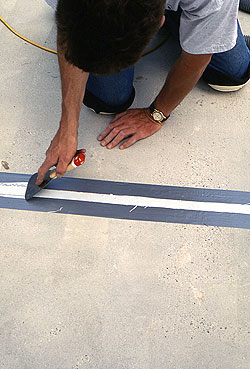
When comparing products, read the installation instructions. Check to see whether a primer is required or recommended for a particular product. Find out whether a stain-preventing film will be needed, or if the joint should be masked with tape before applying the sealant. Consider whether the product is self-leveling, or if tooling or scraping will be needed.
Most control joint sealants are applied with standard caulking equipment, but other options are available. For instance, Speed-E-Joint, by W. R. Meadows, is a rigid, preformed joint available in 10-foot lengths and several depths. The installer simply presses the joint down into the wet concrete after creating a clean, vertical seam with a straightedge cutting tool. A top segment that ensures insertion to the proper depth is then peeled off, and the concrete is floated to fill the voids alongside the joint filler.
Making choices
Making a selection among filler and sealant products depends on many factors. “It would depend on the amount of movement taking place, the kind of abuse the material would have to accept, whether it’s point loads or rolling wheels, things like that,” explains Bill McCann, industry relations manager for the Building Systems unit of BASF Construction Chemicals. “If there’s a specific project involved, normally what I’ll do is refer people to our local rep, let them come out and take a look at it and say in this case, it might be SL 1 or SL 2 polyurethane or it might be an epoxy or a polyurea joint filler. It’s not going to be one size fits all.”