
 Concrete sealers help protect and beautify concrete work. But choosing the right one from a bewildering assortment of products is not always easy. Making the best selection depends on several factors: the application, desired aesthetics and maintenance requirements. Knowing the basics can help you make the right choice for each project.
Concrete sealers are sometimes grouped either as film-formers or penetrants, based on how they integrate with the concrete surface.
Film-forming sealers do just that — they form a protective film on the surface of the concrete. “Film-formers create a surface barrier for stain prevention and ease of maintenance,” reports Jim Glessner, general manager of White Mountain Products, a division of Triangle Coating Inc. in San Leandro, Calif. Film-formers typically have a glossy sheen, which can enhance decorative concrete.
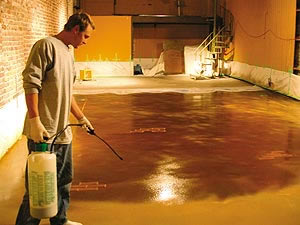 Straight acrylics, urethanes and epoxies are examples of film-formers. Sometimes these are said to be penetrating, but that can be misleading. As Jerry Churray, Pittsburgh-based regional manager of L&M Construction Chemicals Inc., explains, film-formers’ penetration extends only into the surface pores.
Penetrating sealers migrate into the top layer of the concrete surface and work well to repel moisture and stains. Sometimes these sealers are described as reactive. Silanes, siloxanes and fluorinated resins are examples of penetrating sealers. These sealers typically do not change the appearance of the surface, leaving the concrete with a natural look.
“Most sealer technology is available in solvent and water systems,” says Frank Livingston, president of OKON Inc. in Denver. Which formulation you go with also depends on the application and the desired appearance.
If you get confused by the wide range of products on the market described as concrete sealers, you are not alone. “Sometimes sealers are confused with caulking materials, which are at times referred to as sealers as well,” observes Livingston.
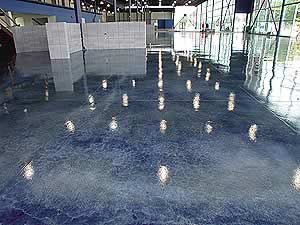 Sealer-hardeners, too, are considered concrete sealers by some. These products seal and densify the concrete surface, so, for this discussion they exceed the parameters of “sealer.”
Boiled linseed sealers used to be used a lot, but little today, according to Churray. These “fringe products” are not very environmentally-friendly because they are oil-based. However, Livingston observes that these sealers are often still specified by state DOTs as an anti-spalling agent for bridge decks.
For the most part, concrete contractors will use either film-forming or penetrating sealers. Here’s a look at the basics:
Acrylics are a popular choice
Acrylic sealers are used frequently by decorative concrete contractors — indoors and out — for several reasons. “They are inexpensive, they have a nice initial shine and they provide relatively good protection against water and chloride [salt] intrusion,” observes Churray. But you need to be careful. There are many different grades of acrylic sealers, he says.
Max Iwaniec, owner of Silverback Sealants in Salt Lake City, says that acrylic sealers are thin and allow the concrete to “breathe.” However, he also observes they “can break down faster then other coatings.”
Solvent-based acrylics enhance color better than water-based technology, reports Glessner. But, he adds, it’s important to understand that many of these products have been reformulated since the federal VOC requirements were changed in 1999. To meet Federal VOC requirements, most products must meet ASTM C1315, which requires 25 percent minimum solids. Products with high solid percentages can be problematic, he explains. “From an application standpoint, 15 percent to 20 percent solids is ideal for acrylic application.” Problems occur because contractors often thin [higher solids content] products that have met the VOC requirements. Thinning changes the chemical makeup of the product so you can’t expect the same longevity and wearability as the unaltered product. Two light coats at 25 percent VOC material will make an ideal sealer.
As most acrylic products are non-yellowing, they allow the surface colors to shine through. These products also can be tinted to enhance the color of aggregate in exposed aggregate applications or to enhance integrally-colored concrete. But beware. Bob Fininis, operations manager for Sierra Design Concrete in Sparks, Nev., says coloring with a tinted sealer “can be tricky — a hit or miss deal.” He advises purchasing sealer and tinting from the same manufacturer for the best results. And, most importantly, “test it before you take it to the job.”
For maintenance, surfaces sealed with acrylic products should be kept clean. These sealers are easy to apply and repair. As a general guide, exterior applications should be resealed or refreshed every 18 months to 2 years. Indoor use can last longer if a sacrificial wax is used regularly.
Urethanes and epoxies are tough
Urethanes and epoxies are good choices when durability and stain resistance is important.
Iwaniec explains, “Epoxies are a thicker product. They are an indoor application which has more abrasion resistance than some of the other products. They can be tinted to custom colors and are ideal for industrial environments. Urethane is designed to be able to last the longest. It is thinner than an epoxy coating, but still has the high impact durability.”
On the down-side, urethanes and epoxies are more expensive than acrylic products. Most are generally considered for indoor-use-only (although Vexcon’s new Breathable Technology epoxy and urethane systems are formulated for both exterior and interior applications) because they are sensitive to moisture, and they typically require specific surface preparation and careful application.
If quick turn-around time is important, these products may not be the way to go, reports Wes Vollmer, a decorative concrete consultant and owner of Alternative Finishes in San Antonio, Texas. “The time requirements for epoxy and urethane are huge — 12 to 16 hours dry time for heavy traffic — depending on the specific product. Acrylics usually dry very quickly.”
Urethanes can last five years to eight years; epoxies can last five years to 15 years. Life-expectancy can be dramatically increased with the use of a well-maintained sacrificial wax. Both epoxy and urethane are reported to be difficult to repair.
Penetrating sealers
Because they actually penetrate into the concrete surface — 1⁄8 to 3⁄16 of an inch on average, Churray says — these sealers are particularly effective. Glessner reports silane and siloxane sealers provide very good water resistance, while fluorinated resins are designed to resist oil penetration.
These sealers are expensive but easy to apply. Because they do not change the appearance of the concrete surface, they may be a good choice when a natural appearance is desired. However, in some applications, the lack of sheen can be considered a disadvantage.
Churray points out that these products are often used by state highway departments on bridge surfaces. “Parking garages are another good application.”
Jeffrey Potvin, owner of Architectural Concrete Consultants Inc. of Lutz, Fla., explains some penetrating sealers are used as a “water” blocker with a film-forming sealer applied on top.
Surface preparation and maintenance are keys to longevity
“Surface preparation cannot be emphasized enough,” Livingston says. “Proper cleaning, surface pH, surface temperature, surface dryness…. If there is any question about whether a surface has been cleaned properly, clean it again!”
Vollmer emphasizes that it is important to mop several times with clean, clear water. “The No. 1 problem is using water that’s not clean and not cleaning your mop regularly. Then, wait for the floor to dry before sealing.”
 “Over acid stains or over acid cleaners, you need to neutralize the surface before sealing,” says Glessner. “Water-based acrylics are particularly prone to destabilization in contact with acid.” (Neutralize by adding a basic material such as baking soda or ammonia. Flushing with plain water does not neutralize an acid).
Mark Donaldson, director of operations for Skookum Floors USA in Seattle, cautions, “Each system requires different surface preparation, although you will almost always find that the surface must be free from all sealers, waxes, dust contaminates and other potential bond breakers. Some systems require a minimum surface profile, while others require the product to be scrubbed into the surface. Always read the manufacturers’ recommendations for installation.”
Iwaniec agrees. “It is very important to refer to the technical data sheets and material safety data sheets for the product to determine proper application.” Depending on the product, application techniques “can vary between brushing, rolling, lambswool applicators, squeeges/trowels, low pressure pump sprayers and electric airless sprayers.”
Improper application, over-application or applying sealers too thickly can cause problems. Depending on the product used, two thin coats may be better than one heavy coat. Or backrolling or back brushing may be required. Some products are more forgiving than others. Other times you may have to sacrifice ease of application for durability.
“You have to be real careful about over-application,” says Potvin. “There will be a recommended film thickness you need to follow to ensure correct curing.”
Longevity of a sealer usually depends on the wear-and-tear of the surface and the maintenance schedule. One of the biggest problems is maintaining the surfaces properly. Vollmer recommends, “Use the proper chemicals to clean the floors — watch out for ammonia and other harsh chemicals and cleaners. Use cleaners compatible with the [sealer and/or wax] used.”Potvin says water latents (mineral deposits) can also cause problems — and do at a lot of theme parks — so it’s important to remove puddles and standing water.
Manufacturers and contractors alike recommend routine inspection of the sealed surface. Moisture should not penetrate the surface if it is well-maintained. Similarly, if the pores of the concrete surface are sealed correctly, mold and mildew should not become a problem.
Start with the application; then make your choice
There is a sealer for just about every concrete application — horizontal and vertical, as well as concrete pavers, masonry, stucco, unglazed tile, natural stone, manufactured stone and brick.
However, “there is no one sealer that can be used for all applications,” Livingston points out. He suggests you ask yourself many questions before selecting or specifying a sealer.
For example: Are you concerned about UV resistance? Abrasion resistance? Moisture, stains or chemicals? What are your state and local regulations regarding solvent-based products? Is there vegetation nearby the project that might be damaged by solvent-based products? How long will the sealer last? Does the manufacturer provide a warranty?
Don’t be afraid to ask for help. “Sealers and coatings require an educated experienced installer to successfully select and ultimately install,” explains Donaldson. “It is important to have a close relationship with the manufacturer and have all the required variables brought to the table before selecting and installing a sealer or coating system. As a beginner the easier-to-install systems usually consist of acrylic-based or one-component systems. These are a good stepping stone to eventually move into the multi-component, harder, more chemical- and wear-resistant systems.”
Doug Carlton, owner of Carlton Concrete Co. in Visalia, Calif., says that while sealers can be a difficult area to grasp, it is an area that contractors should thoroughly explore. “I believe a contractor should only seal with products they learn inside and out. Sealer is the Achilles’ heel of decorative concrete. The secret is becoming comfortable with the product you are using.”
Unfortunately, what you may need to know about concrete sealers isn’t necessarily cut-and-dry. Some manufacturers combine technologies for hybrid products; such as blending acrylic and urethane or acrylic and siloxane. In other cases, additives are introduced to help solve some potential problems. For example, fine grit or silica is sometimes incorporated to provide slip resistance.
Some sealers can be used in combination with others for enhanced results; for example, applying urethane over epoxy, or an acrylic sealer over a penetrating sealer. If you layer sealer products, though, be sure to use compatible products.
“In most cases, stick with the same manufacturer,” advises Potvin. “Most contractors aren’t chemists and are looking at dollar signs rather than compatibility. The [compatibility] problems often don’t show up until later.”
 It’s more than a price decision
In making your final decision about a sealer, remember the sealer is a small part of the overall cost of a project. As Churray points out, “It’s not the place to save pennies. You rely on customer satisfaction and word of mouth that you do quality work.”
Donaldson says, “We like to relate price to cost. A less expensive system initially might add up to a costly mistake down the road. Imagine saving 25 cents a foot initially but having to shut down operations in a year to refinish a worn and damaged sealer system. Explain this to the customer and always offer a couple options for their review.”
“So many people get stuck using one type of product because they don’t know what else is out there,” Iwaniec says. “It is important to try more than one product so you can compare your end results.”
If you can inform your customer about various concrete sealer products, you convey the appearance of someone who is knowledgeable and up-to-date with technological changes in the industry. And some customers are willing to pay more for a knowledgeable contactor and a better product. After all, making the right sealer choice enhances and prolongs the life of your hard work. Learning about the options out there and getting the support and technical assistance you need from a reputable sealer manufacturer makes good business sense.
Film Forming/Penetrating Sealer Selection Chart
|
Chemical Classification
|
Epoxy
|
Acrylic
|
Modified
Acrylic |
Silane
|
Siloxane
|
Aliphati
Urethane |
|---|---|---|---|---|---|---|
| Primer Required |
 |
No
|
No
|
NA*
|
NA*
|
|
| Adhesion ASTM 4541 |
5
|
4
|
4
|
NA
|
NA
|
3
|
| Application Rate sq.ft./gal |
75-125
|
200-300
|
200-300
|
125
|
125
|
75-125
|
| Exterior Gloss Retention ASTM G-53 |
3
|
5
|
4
|
NA
|
NA
|
5
|
| Interior Gloss Retention ASTM G-53 |
5
|
5
|
5
|
NA
|
NA
|
5
|
| Chemical Resistance ASTM D1308 |
5
|
3
|
3
|
NA
|
NA
|
5
|
| Abrasion Resistance ASTM D4060 |
4
|
2
|
2
|
NA
|
NA
|
5
|
| Impact Resistance ASTM D2794 |
4
|
3
|
3
|
NA
|
NA
|
5
|
| Non Skid Properties ASTM D2047 |
3
|
3
|
3
|
3
|
3
|
3
|
| Non Skid Applied ASTM D2047 |
3
|
5
|
– |
3
|
3
|
5
|
| Dry Time ASTM 1640 |
3
|
5
|
5
|
5
|
5
|
4
|
| UV Stability ASTM G-53 |
3
|
5
|
5
|
5
|
5
|
5
|
| Meets VOC Regulations ASTM D3960 |
|
 |
|
|
|
|
| Water Resistance ASTM D1308 |
5
|
2
|
4
|
NA
|
NA
|
3
|
| Water Repellent SSW110C |
|
|
– |
|
|
|
| Breatheability ASTM D1653B |
2
|
3
|
5
|
5
|
5
|
2
|
| Water Proofing TTP1411, TTP1098 |
|
|
|
– | – |
|


