
 Whether it’s knick-knacks or corporate logos, embedding or imprinting objects into concrete gives an unmistakably addition to the home or business. Here are some tips on how to add this finishing touch to an interior or exterior project.
Many people’s first experience with concrete art is the surreptitious addition of a handprint or some initials to a neighborhood project. But the urge to leave such a message to the future is not confined to adolescents. Whether it’s sentimental knick-knacks or corporate logos, embedding or imprinting objects into concrete gives clients an unmistakably one-of-a-kind addition to their home or business. Here are some tips on how to add this finishing touch to an interior or exterior project.
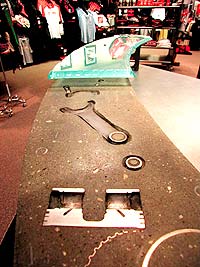 A good impression "A lot of contractors are limited by what they can buy in the store, but you have to think out of the box," says Lee Levig of Concrete Works in Fairfield, Calif.
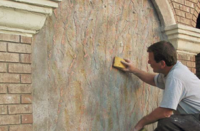
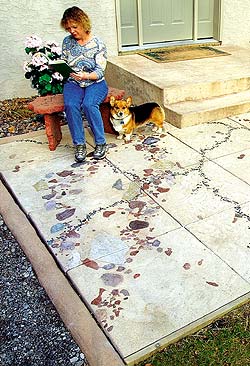
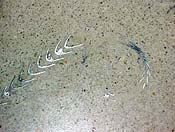
At customers’ request, he has made imprints of leaves and branches, but he also uses more exotic things, such as embossed wallpaper. "Just before the final trowel, when it’s still pliable, trowel the wallpaper border face down." He doesn’t use a release agent; he just leaves the wallpaper there until the concrete has set, then peels it up. One of Levig’s signature techniques is imprinting custom stencils, which he cuts out of heavy waxed paper used for packing produce and discarded behind supermarkets. For the home of a violinist, Levig cut out two bars of music to adorn the entrance to a music room. "It takes a lot of work to do the cutting," Levig admitted, so he generally uses this technique as an accent in a highly visible area such as a front porch or entrance. You needn’t cut your own stencils for popular designs such as flowers and foliage. Try a craft store, such as Michaels, which sells paper and plastic stencils from Plaid.
 Embedding objects
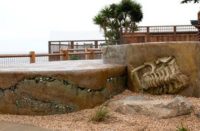
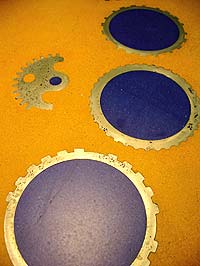
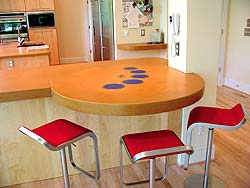
For a truly one-of-a-kind project, instead of just imprinting objects, you can embed them in the surface. Lee Levig has spotted computer chips in the exposed aggregate at the Discovery Channel Store in Sony’s Metreon entertainment complex in San Francisco. He also reports that the Animal Kingdom attraction at Walt Disney World has a faux dirt road made of concrete embellished with twigs, tire tracks, and boulders.
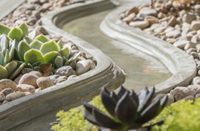
 In his book, Concrete Countertops: Design, Forms and Finishes for the New Kitchen and Bath (Taunton Press, 2002), Fu-Tung Cheng showcases countertops inlaid with marble slabs, semiprecious stones, auto parts, fossils, coins, and even Gumby. For molded countertops, Cheng attaches the objects to the mold with a very thin layer of silicone caulk, pours the concrete, then peels off the caulk when the mold is removed. The caulk recesses the object slightly under the surface, which allows him to polish the surface without damaging the inlaid object. For smooth objects such as coins, he attaches a bit of wire mesh to the back with epoxy adhesive to give the concrete something to grip.
Whether it’s knick-knacks or corporate logos, embedding or imprinting objects into concrete gives an unmistakably addition to the home or business. Here are some tips on how to add this finishing touch to an interior or exterior project.
 What works, what doesn’t
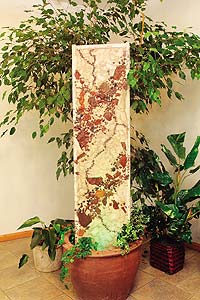
Girard, who is a civil engineer, says that not everything a client may suggest is suitable for embedding. "Wood is not really compatible with concrete because it swells with moisture (which could cause cracking), shrinks when it dries out, and can rot. Plastic may or may not be compatible simply because the concrete may or may not stick to it. Aluminum is not a good metal to embed because it readily oxidizes in the alkaline environment."
Surprisingly, glass isn’t a good candidate for outdoor applications. "It might seem like a good material because it’s chemically similar to sand, but glass actually can lead to the eventual self-destruction of the concrete," Girard says. "Most glass reacts with the cement paste to form a silica gel that surrounds the piece of glass. This is the classic alkali-silica reaction that plagues some natural aggregates. The silica gel forms at a rate different from the curing rate of concrete, and it swells with moisture.
"Over time, as the concrete’s moisture level changes, the gel swells and shrinks, causing pop-outs and eventually forming a spider web of cracks in the concrete. This is not the case with indoor applications, because the moisture levels involved are much lower."
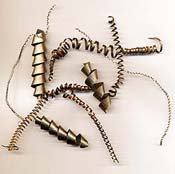
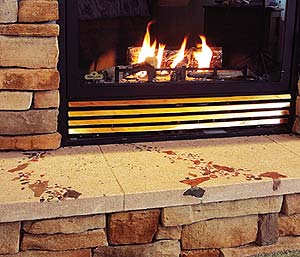 Formworks embeds a lot of ferrous metal objects in indoor countertops, and their exposed surfaces do rust, even if sealer is applied. However, Girard says that the rust adds a nice appearance to the concrete. One of Formworks’ characteristic touches is the addition of curled steel shavings to the concrete. They’re called "industrial fossils," and they do impart a fossil-like look and rusty accents to the surface.
Commercial stamps
You may want to imprint something not found in nature. If you need a two-dimensional custom silhouette or logo, Concrafter can make a custom rubber stamp from your drawing. The company also has standard designs and letters. You dampen the stamp, place it on the troweled slab, and strike it to make the imprint, then move it to another location and repeat if you want to. To add texture to the surface, Theo Hunsaker of Concrafter suggests painting retardant inside the outline of the stamp with a brush, to expose aggregate inside the silhouette. The company also has standard designs and letters.
|
|
|
|
|
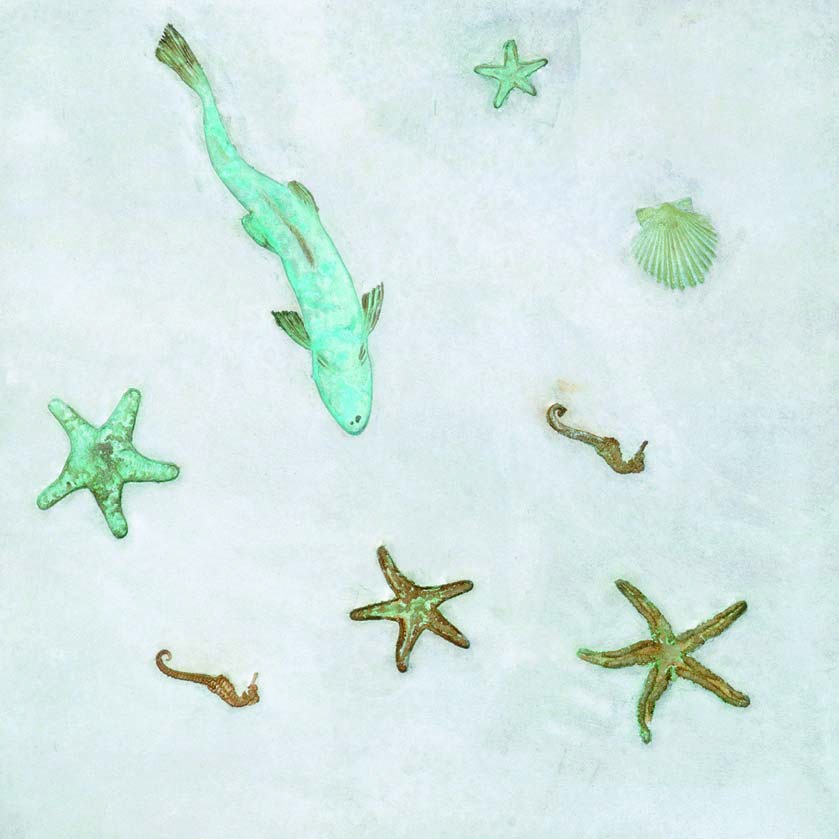
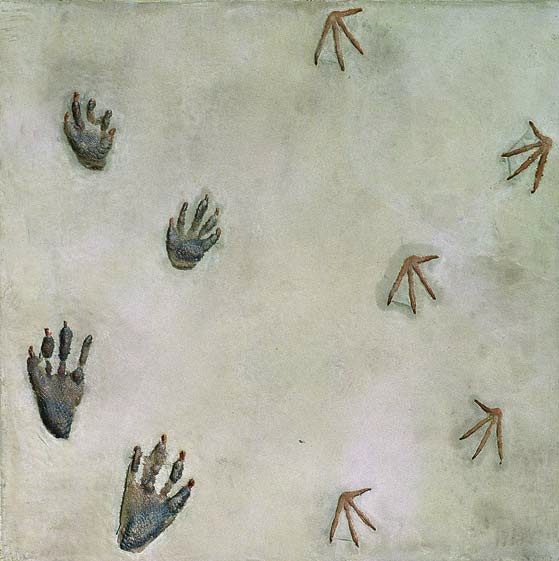
If a three-dimensional imprint is what you want, L.M. Scofield has a catalog of stamps for imprinting everything from fanciful butterflies to animal tracks. They can also cast a stamp from your three-dimensional object. Staining the imprinted image adds realism.
A little goes a long way
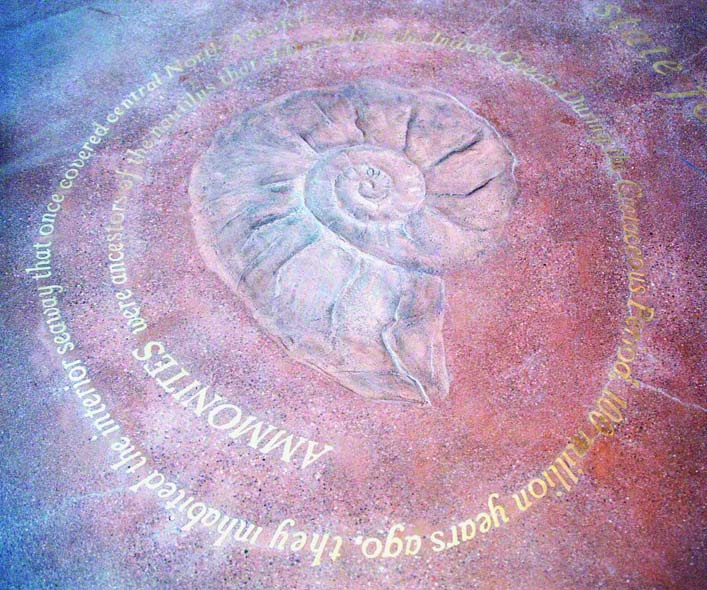 Don’t overdo impressions, or the surface will become very busy. "Less is more," observed Sherry White, L.M. Scofield’s marketing manager. "If you use it as an accent, it’s extremely effective. If you covered an entire area with it, it would be less effective. It’s like — you don’t wear three ties."Before you take custody of your customer’s irreplaceable fossil or family heirloom, experiment by embedding or imprinting objects into some sample panels so you have an idea of how firm the concrete should be before you start embedding. If polishing with diamond wheels will be part of the process, get familiar with what happens when you run the wheels around or over embedded objects. Photograph these samples for your portfolio, and you’ll have yet another technique to add value to your customers’ projects.Before you take custody of your customer’s irreplaceable fossil or family heirloom, experiment by embedding or imprinting objects into some sample panels so you have an idea of how firm the concrete should be before you start embedding. If polishing with diamond wheels will be part of the process, get familiar with what happens when you run the wheels around or over embedded objects. Photograph these samples for your portfolio, and you’ll have yet another technique to add value to your customers’ projects.
And if you do end up embedding those family heirlooms, your work will be a step toward immortality: You won’t just be creating beautiful things, you’ll also be perplexing future archaeologists.


