

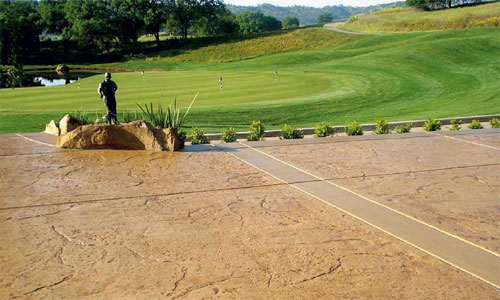
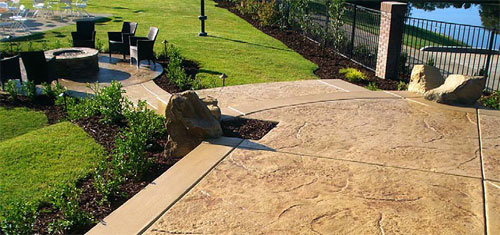
In this industry we’ve all seen our share of old and faded colored concrete that has been bleached out by the elements and is in need of some type of color fix or restoration. That was the condition of the existing stamped concrete at Diablo Grande Golf Course & Country Club, near Patterson, Calif. The owners wanted to improve the facility by updating the existing hardscape and adding a new covered concrete patio and outdoor bar, along with some new walkways and stairs to expand access from the clubhouse to the course.
The challenge was how to make roughly 20,000 square feet of new concrete and faded, outdated old concrete blend together seamlessly so no one could tell where one ended and the other began. Removing the old concrete was not an option due to cost and because it would have shut down access to the clubhouse.
That’s when my company, Staintec, received a call from Chad Pometta, who owns CP Landscape and Design, the Patterson, Calif., company in charge of the concrete renovation and landscaping at Diablo Grande. (He’s also a resident of Diablo Grande.)
After we talked on the phone about the specifics of the project, Chad arranged for me to come up to Diablo for a job walk. We also consulted with the principal owners on the best process to give them the new color and design they wanted for all the concrete, new and old.
|
|
|
|
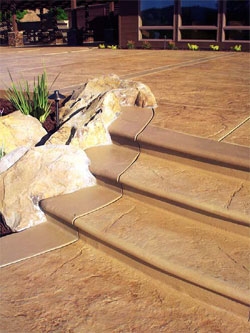
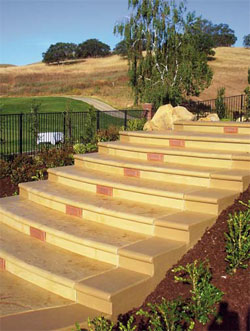
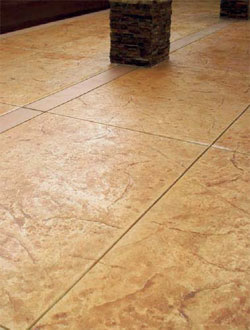
For me the answer was simple. I realized this was the perfect project for the NewLook Solid Color Stain system. I utilize this system a lot in my business, for several reasons. It’s a very cost-effective color application that allows me any color combination required for almost any concrete concept. It was capable of making the new and old concrete match perfectly. What’s more, over time, the product breaks down to a natural appearance without flaking or peeling and holds up very well to routine cleaning. This makes for hassle-free color and sealing maintenance, which in turn means no headaches down the road for the owners.
After deciding to move forward, the first step, as with any high-profile project like this, was mock-ups. We were able to demo different base and antique color combinations, along with the color for the borders, on the actual area of concrete we planned to stain – we colored back over that area when we did the job. This allowed the clients to see first-hand how the sample colors would actually look next to the palette of golden browns and earthy tans of the new pillars and stonework. These colors were a huge contrast to the original, drab salmon-colored integrally colored concrete they were so used to looking at every day.
Next, CP Landscape and Design placed 20 yards of new concrete. After a curing time of 30 days, both the new and old concrete were ready for their color makeover.
|
|
|
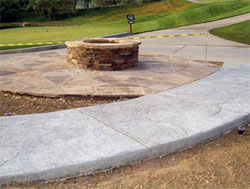
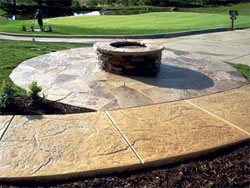
For this type of product, I use a standard method of surface preparation: a strong 5-to-1 acid wash that is amply applied by brush in a wet “soaking method” and left to “cook” for anywhere from five to 12 hours depending on the integrity of the concrete. When the acid is done working it completely “exfoliates” the surface of the concrete and you are left with what looks like a brownish chalky haze. This method assures me that all the potentially deleterious material on the surface has been chemically etched and loosened.
We then prepare a high-volume pressure-washer (3,500-plus psi at 4 gallons per minute). Using a 15-degree tip we methodically water-jet the concrete foot by foot in a 4-inch swath pattern to assure the entire surface is aggressively cleaned in the exact same manner. This completely removes the impacted silt layer of organics, loose silica and concrete salts. After this type of rigorous etching and cleaning, what’s left is a brand new pristine surface of very porous, open concrete that readily accepts and wicks in the very watery, fluid NewLook polymer stain. This makes an ideal foundation for the initial mechanical bond and is critical for the overall integrity of the product.
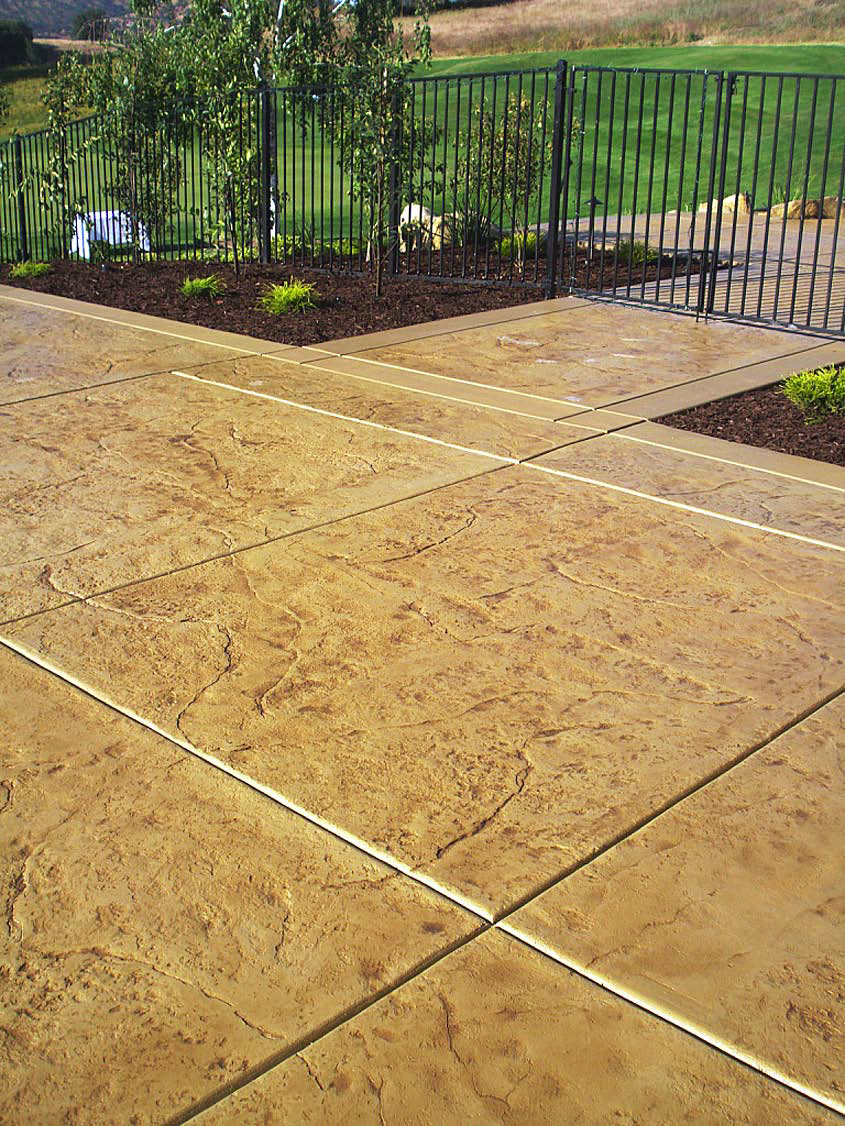
Using a unique NewLook applicator brush designed to hold wet material in the fibers, we basically flood the stain over the surface of the concrete, brushing it into joints and texture, allowing the concrete to soak in the stain for uniform coverage. Then we back-brush, almost buffing the stain in with the brush until it is dry. It is so forgiving you can actually walk on it and through it while brushing with no fear of making any footprints, just buffing out any wet areas as you go. A two-coat process is required with only a one-hour wait time in between coats. When done, everything dries equally and very opaque, giving us a new solid base color to antique.
There are a couple of precautions to take when working with NewLook stain. One, avoid working with it on very hot days. If the concrete is too hot, the material can essentially cook before it can be broomed in and dry naturally. If your shoes start to stick when walking on the stain, it’s too hot! Hot conditions will also drastically affect your cover rate and workability.
|
|
|
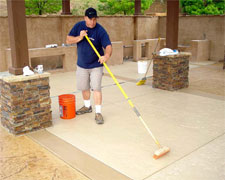
Two, control mixing and agitation for consistency of color. On large-scale projects, uniform appearance is paramount and consistent mixing and applications methods must be followed.
For this exterior stamp texture application, the NewLook Enhancer series “antique” system was applied wet but evenly over the surface using the same NewLook brush. We were careful to not overapply. Unlike with the base coat, we just let the fluid settle in all the texture and sit undisturbed until it completely evaporated, leaving only a light color film of the antique color.
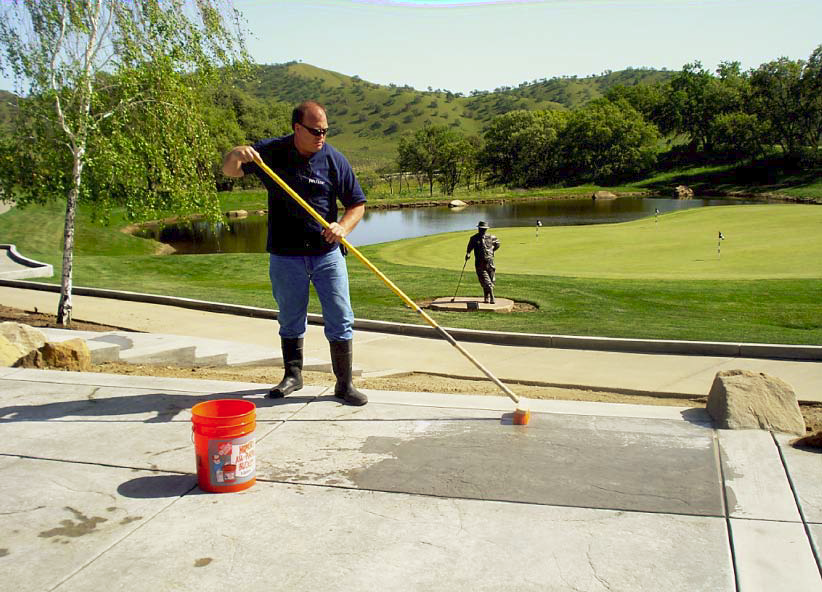
We paid special attention to maintaining a wet edge to avoid any application marks. To do this, we applied material in the shade of the morning or at dusk. We were then able to lay down large areas of the antiquing fluid without rapid drying or fear of brush marks.
The obvious choice to finish this project was a quality water-based gloss sealer applied in two thin coats and blown dry with a leaf blower. We chose a Concrete Coatings water-based sealer, SuperSeal 20WB Water-Based Acrylic, to go over the NewLook because it breaks down and oxidizes with the product over time, and after just a light power washing, you can reseal or apply a fresh touch-up color coat.
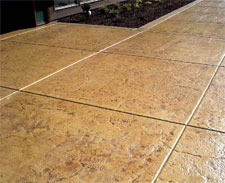
Chad Pometta describes the end result: “You can’t even tell what we went over. It all matches like everything was one continuous pour. There was a huge cost savings, too, with the concrete we were able to leave in place.”
Project at a Glance
Client: World International, LLC
Contractor: CP Landscape and Design, Patterson, California | www.cplandscapeanddesign.com
Concrete Colorist: Glen Roman of Staintec Decorative Concrete Systems, Rancho Cucamonga, California | www.staintec.com
Location: Diablo Grande Golf Course & Country Club, Patterson, California
Scope of project: Color new and existing concrete so that the color is continuous and uniform.
Products used: NewLook Solid Color Stain: Caramel (base color), NewLook Solid Color Stain: Maple (borders), NewLook Translucent Enhancer: Maple (antiquing), Concrete Coatings SuperSeal 20WB Water-Based Acrylic Sealer