Project Profiles: Faux Ice and Water, Calgary, Alberta, and four citiies, Florida
by Natasha ChilingerianIn early 2011, the designers of the new location of Canada’s Sports Hall of Fame in Calgary, Alberta, decided a hockey rink floor would be the best way to enhance their ice hockey exhibit. The owners of retail chain Leslie’s Swimming Pool Supplies had a warmer take on the same idea: coat the floors of several Florida stores to look like glistening pools. Who did they turn to for help? Decorative concrete contractors who used epoxy products to transform plain surfaces into realistic replicas of ice and water.
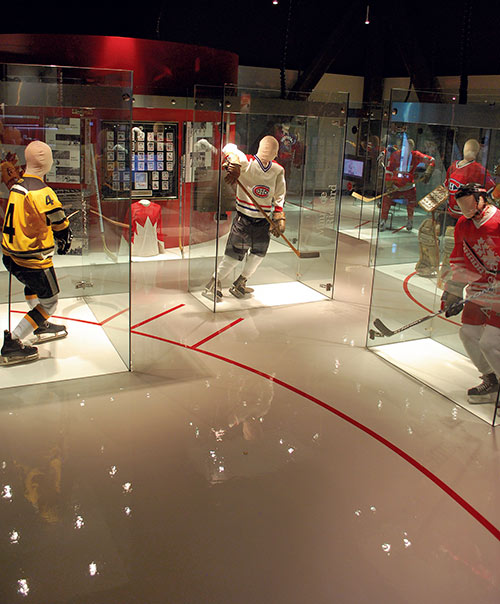
Virtual Ice Rink at Canada’s Sports Hall of Fame Calgary, Alberta, Canada
In early 2011, the designers of the new location of Canada’s Sports Hall of Fame in Calgary, Alberta, decided a hockey rink floor would be the best way to enhance their ice hockey exhibit. The owners of retail chain Leslie’s Swimming Pool Supplies had a warmer take on the same idea: coat the floors of several Florida stores to look like glistening pools. Who did they turn to for help? Decorative concrete contractors who used epoxy products to transform plain surfaces into realistic replicas of ice and water.

Photos courtesy of Tyson Long
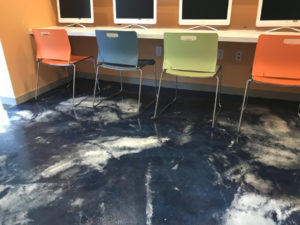
Happenstance led Tyson Long, president of Calgary-based Hardscapes Inc., to the new location of Canada’s Sports Hall of Fame museum in Calgary’s Canada Olympic Park, where he used white and clear epoxy coatings to transform the floor of the museum’s ice-hockey exhibit room into a virtual ice rink.
Long worked in the same office building as Pacific Group Displays, a Calgary-based exhibit display provider that had been hired to design and install the exhibits at Canada’s Sports Hall of Fame. Familiar with Long’s work, a member of the display company approached him about installing epoxy-crafted ice for the exhibit, and he agreed.
Using Elite Crete Systems’ epoxy products, embedded chopped fiberglass and red vinyl strips, Long turned the surface into a faux ice hockey rink in just a week’s time.
The canvas for Long’s epoxy job was a concrete slab that had been poured 2 inches lower than the floors in the exhibit room’s adjoining hallways. To allow handicapped access, workers from Pacific Group Displays added 2 inches to the floor’s thickness by placing two layers of plywood substrate on top of the concrete slab and installing tracks for holding glass exhibit displays. The epoxy material was to be placed flush with the tops of the tracks to result in a seamless look at the feet of the display cases, Long says.
Long and two crewmen put down a layer of roofing paper and metal-mesh lath material for reinforcement, followed by several coatings of Elite Crete Systems’ Thin Finish, with chopped fiberglass pieces in the first coat for additional reinforcement. Long created the white “ice” with three coats of Elite Crete Systems’ E100-UV1 Epoxy with a universal tint pigment in Titanium White.
For the ice hockey rink markings, Long and his crew placed red vinyl strips supplied by Pacific Group Displays on top of the white epoxy material. “They wanted it to be as realistic as possible,” Long says. “So we decided to bury the rink lines in the product instead of creating a painted-on look.”
On top of all that, to give the floor depth and a “flooded” look, workers applied two coats of E100-UV1 Clear Epoxy at a rate of 75 square feet per gallon.
In the first topcoat, they embedded a loonie — a Canadian dollar coin, considered a good luck charm for Canadian hockey and curling teams competing in the Olympics. The lucky loonie legend dates back to the 2002 Winter Olympics, when both the men’s and women’s hockey teams won gold medals after an ice rink maker buried a loonie in the rink used for the competition.
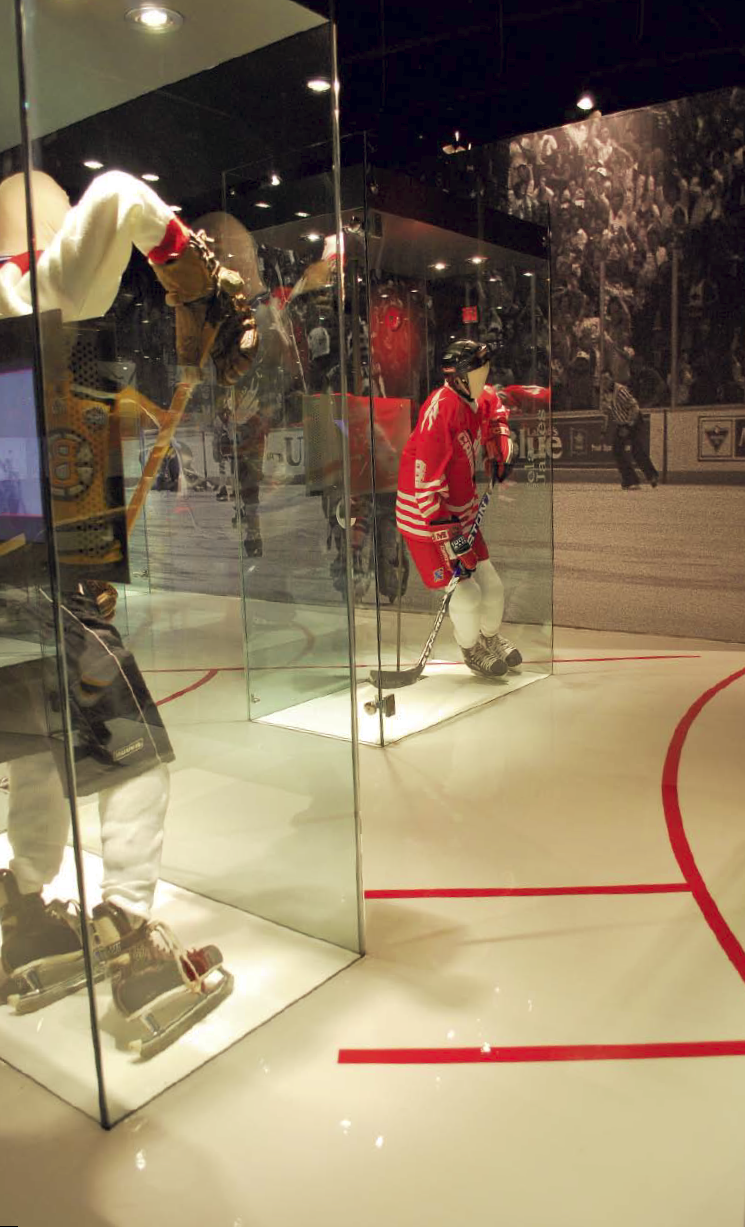
One challenge Long faced was working around the display tracks. He says that to keep the epoxy material from flowing into the tracks, he stuffed the tracks with backer rods (foam rods typically used to fill joints between construction materials).
Visitors caught their first glimpse of the ice hockey rink replica, a true salute to the popular Canadian sport, when the new Canada’s Sports Hall of Fame building opened on Canada Day, July 1, 2011.
www.concretecanada.com
Water Floors at Leslie’s Swimming Pool Supplies
Davie, Port St. Lucie, Fort Lauderdale and Bradenton, Fla.
by Natasha Chilingerian

Photos courtesy of Seal-Krete
For years, the owners of Phoenix, Ariz.-based retail chain Leslie’s Swimming Pool Supplies hired various contractors to work on their floors, hoping to see blue water-like effects beneath their customers’ feet. Their wish was granted when they met Troy Lewis, owner of Orlando, Fla.-based Exquisite Flooring of West Orange.
Lewis heard about a potential job with the pool supply company through the chain’s general contractor, Mallard Construction Inc., of Clermont, Fla. To get his foot in the door with Leslie’s, Lewis agreed to install a VCT (vinyl-composition tile) floor at one of the locations, and the store’s owners were pleased with the outcome.
“I ended up backpedaling into VCT, which is something I didn’t want to do anymore,” Lewis says. “They told me it looked great, and then they said, ‘Too bad you don’t do decorative concrete.’ But it turned out I did.”
So the pool supply chain’s owners asked Lewis to install a blue polished concrete floor at another location. Again, they were happy with the results.
However, they still faced a problem — color in polished concrete can be less than perfectly stable, and where the floor endured exposure to UV rays or a liquid chlorine product spill, the blue faded. So Lewis offered a new solution.
“I told them I had an epoxy product that would make the floors look like the water in the Bahamas as well as hold up to chemicals and UV rays,” Lewis says.
Starting with the Leslie’s Swimming Pool Supplies location in Davie, Fla., Lewis and a small crew layered on several coats of Seal-Krete’s Epoxy-Shell 1000, a 100-percent epoxy material, with a blue pigment mixed in. They finished with Seal-Krete’s Poly-Shell 7000 topcoat, bringing his Bahamas water vision to life.
Lewis repeated the application at three other Leslie’s Swimming Pool Supplies locations in Port St. Lucie, Fort Lauderdale and Bradenton, Fla., seeing improved, more realistic results each time. After completing the floor at the Bradenton store — the floor Lewis says he’s most proud of — executives from the retail chain’s corporate office came in to take a look.
“When I told them it would look like the water in the Bahamas, they didn’t believe me at first, so it was like a challenge to me,” he says. “But they agreed that the color was absolutely awesome. We get compliments on the fact that it does look like water.”
Lewis says he’s secretive about his application technique, which took him a lot of time to perfect.
“We use one color of blue, but you can mix it differently to make it lighter and darker in different areas, and we have it down to a formula now,” he says. “It’s partially in the technique and how we apply it. It’s kind of like baking a cake. You have to do it a few times before it turns out right. We’re really proud of it. We played around for a while before we got it right.”
Now, he’s scheduled to install his “water” floors at all of the retail chain’s locations in the Southeast and more, beginning with 20 in Florida and 15 in Texas. He’s currently training two new crews on the process and acquiring new equipment for the upcoming jobs. “I thank the store’s owners for allowing us to have the creativity to play around with it,” he says.
Project at a Glance
Project Specs: Four 2,500- to 3,000-square-foot epoxy floors that mimic water
Timeline: Four three-day projects over a two-month period
Client: Leslie’s Swimming Pool Supplies, Phoenix, Ariz.
Decorative Concrete Contractor: Troy Lewis, Exquisite Flooring of West Orange, Orlando, Fla.
General Contractor: Mallard Construction Inc., Clermont, Fla.
Materials Supplier: Seal-Krete
Materials Used: Seal-Krete’s Epoxy-Shell 1000 system and Poly-Shell 7000 topcoat