

 Selecting the right diamond blade to run on concrete saws is the best way to maximize your equipment investment. More and more companies offer diamond blades. But how can a contractor choose the right blade for the right saw?
How diamond saws cut
Material cutting, cutting speed, and blade life combine into blade performance. Changing one variable affects the others. Aggregate hardness and size, amount of steel reinforcing (rebar) and whether the concrete is green or cured affects blade selection. Diamond and metal power compose the diamond blade segments. Before cutting the material, the composition of the bond and the hardness, or softness, must be matched. The simple rule of thumb to remember when selecting a blade: Use something hard to cut something soft and something soft to cut something hard.
Know your concrete
The size of the aggregate affects blade performance. Large aggregate makes the blade cut slower, while smaller aggregate makes the blade cut faster. Heavy reinforcing with rebar also tends to slow the blade and make it wear faster. The time the concrete has had to cure greatly affects how the material will interact with the blade. Freshly poured or green concrete is softer and more abrasive than cured concrete. The blade will need a harder bond with undercut protection to cut green concrete and a softer bond for cured concrete.Undercutting is a condition in which the steel core of the blade wears faster than the diamond segments. Highly abrasive material grinding against the core is the cause. The best remedy is to choose a blade with under-cut protectors on the core or pol-yarc segments.
Know your saw
You must know the blade specifications required by your saw. Do not use blades not recommended by your saw manufacturer on your saw.You can control cutting by adjusting spindle speed. Increasing spindle speed makes the diamond blade cut harder, decreasing the spindle speed makes the blade cut faster. Harder, less abrasive materials require slower spindle speeds and softer,more abrasive materials need faster spindle speeds.Never operate blades at rotational speeds greater than the maximum RPM listed on the blade. Over speeding can damage the blade or cause serious injury.
Know the differences between blades
There axe several types of diamond blades from which to choose. High-speed segmented blades are the most competitively priced on the market. and make fast, smooth cutting in many materials. They provide a constant depth of cut and fewer blade changes. Most come with a 1″ arbor with a drive pinhole or a 20 mm arbor. Dry walk-behind concrete saw blades are ideal for intermittent cuts in concrete, green concrete and asphalt. They cut without water and are often used in patch/repair work or expansion joints. Dry and wet masonry blades provide a consistent depth of cut with less dust than abrasives. Segmented dry small-diameter blades are used on hand-held circular saws and most right angle grinders.
Use them on concrete block, marble, soft granite, stone, tile and other materials. Hand-held circular saw and small, right angle grinders use dry tuck-pointing blades. Routers, cleaning out mortar from mortar from mortar joints and butt (vertical) joints is a job for dry tuck-point pins. Additionally, Dry tile blades are continuous-rim blades used for chip-free cutting on tile saws, right-angle grinders and circular saws. Dry segmented cup grinders, used on right-angle grinders, they grind all types of concrete, masonry, brick, block and stone.
Segmented or continuousrim blade?
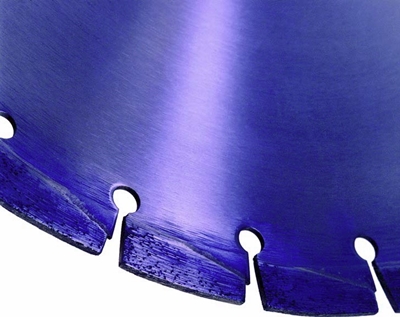
The design of continuous and segmented rim blades are for the same task. However, they offer differences in speed, performance and longevity. Segmented blades have a thicker segment and higher diamond concentration for longer life and greater ability to resist very abrasive materials. They also have a thicker core and open gullets, so they are well suited for high production and heavy use. Repairing the blade segments is easier due to laser-welding.
However, segmented blades have disadvantages. The thicker segment results in a slightly lower cutting speed and the open gullets make a rougher cut. Continuous-rim blade have a thinner rim and greater surface area that delivers aggressive cutting speeds and less dust and a smooth, chip-free cut. It’s a good choice for very hard materials such as stone, marble and decorative edges. Like segmented blades, continuous-rim blades also have downsides.The thinner rim and lower diamond concentration result in shorter blade life and wear fast in very abrasive materials. Their thinner core and no gullets means they cannot dissipate heat as fast as a segmented blade and can warp when overheated. Repairing it is not, however, possible.
Your diamond blade distributor is provided with a wealth of information from the manufacturer and can help with additional blade selection tips.