


Stain doesn’t have to mean pain, especially if you do your homework. When applying an acid stain or acrylic stain — or some combination of both — it’s important to know the composition of the concrete surface in question, what sort of color scheme is desired and, if you’re dealing with an exterior area such as a patio or walkway, what sort of weather and foot traffic will come into play.
Most experts agree that a chemical-based or acid stain is the way to go for superior wear and durability, an essential consideration if the surface is in a high-traffic area or subject to UV rays and other climatic factors.
“An acid stain reacts chemically to the lime in the concrete,” says Barbara Sargent, owner of Kemiko Concrete Products in Leonard, Texas. “And it’s permanently coloring the concrete. It’s permanent. You might walk off a sealer or a wax, but you’re not going to walk off a good acid stain.”
To preserve the vibrancy of an acrylic stain, it’s usually necessary to apply a sealer in order to lay down a maintenance coat that will take the brunt of the foot traffic or weather.
“When you’re dealing with stains, it’s more for the aesthetic look, it’s not a maintenance coat,” says Chuck Brunner of Smith Paint Products. “Your sealer or wax or acrylic fortifier is the maintenance coat. The stain is for the aesthetic look.”
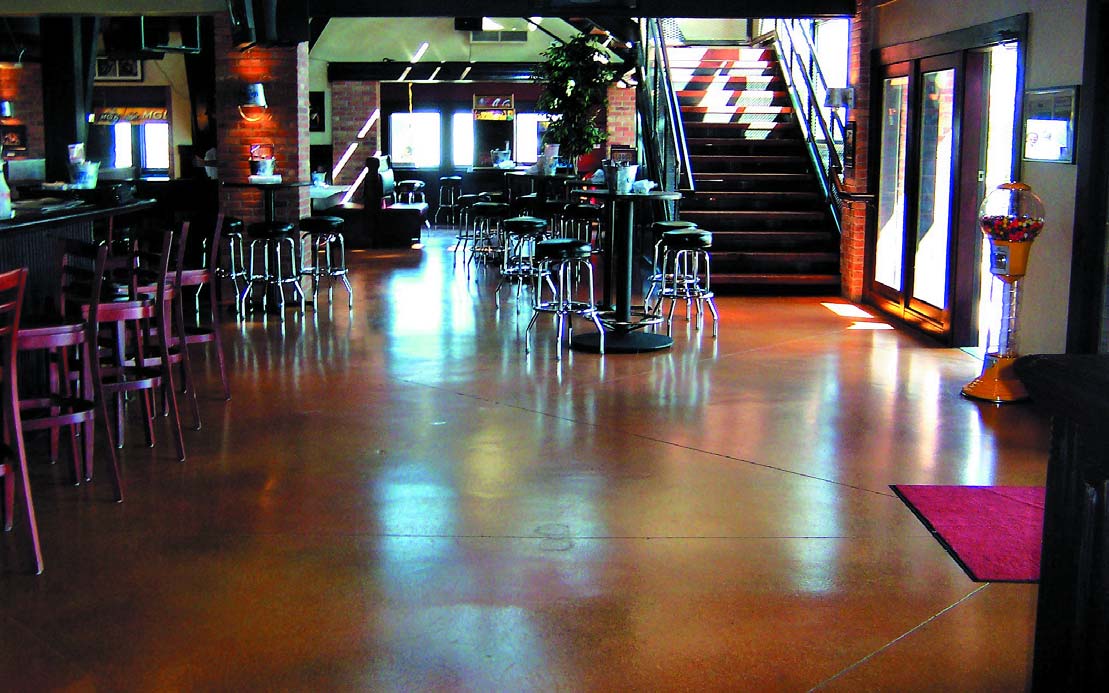
Yet with acid stains there’s an element of chance at work. After all, the stain is based on a chemical reaction and you can’t predict with certainty what that reaction will be.
“We know where it’s going when we’re using acrylics and we don’t always know when we’re using acids,” says Gerald Taylor of Images in Concrete of El Dorado, Ark.
“The polymers are more predictable,” Sargent says.
As any applicator knows, it’s difficult to tell what’s gone on previously at a given job site. Sometimes mistakes and flaws don’t show up until after the stain has been laid down.
“You can walk into a brand new home where they’ve kept the slab absolutely pristine,” Sargent says. “But unbeknownst to you, during the cure-out time, they left some paint buckets on the floor for the first 15 days of the pour. You don’t see them until you stain, then bingo, they pop up.”
Acrylic stains really leap to the fore when those unforeseen problems occur and they also work quite well for touch-ups on existing stained surfaces.
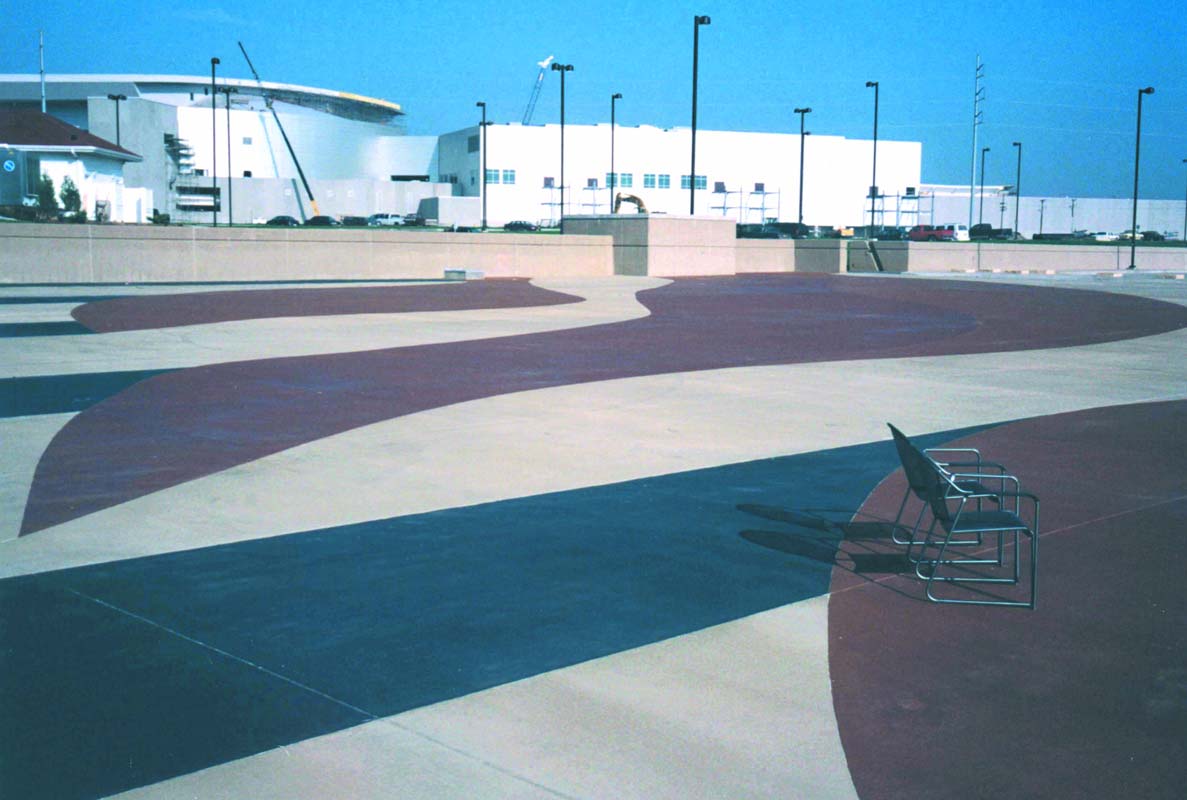
“We’ve had people put down epoxy floors, and even in some cases acid-stained floors, and seal them,” Brunner says. “The customer comes back in and says, ‘this isn’t the color you told me about,’ or ‘I just don’t like this look.’ They can use our (acrylic stain) over the top and just reseal it.”
“A lot or applicators who’ve used acid stains for years and years are finding that the new polymers work as a ‘fix-it,’” Sargent says.
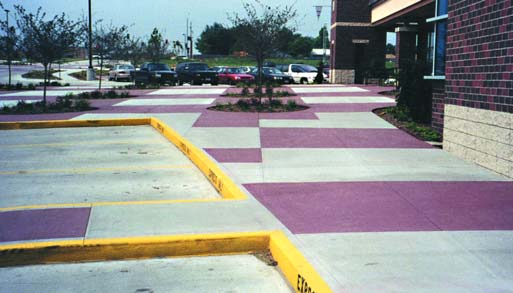
“It can be used for acid-stain deficiencies, as in when the concrete is eroded or when the surface lime is gone and the acid doesn’t have anything to react to,” Taylor says. “That’s when you can use the acrylic stain almost as a cosmetic. You use it to hide blemishes and make them blend in.”
Mike Ruggiero of Duron Wall Coverings notes that acrylic stains can be used on a previously painted surface, but that abrading the surface is necessary to create a bond.
Where to start?
It’s imperative that an applicator knows the ins and outs of the surface that will be stained. Understanding the porosity of the concrete is a good place to begin. The more porous the surface, the deeper the stain will penetrate.
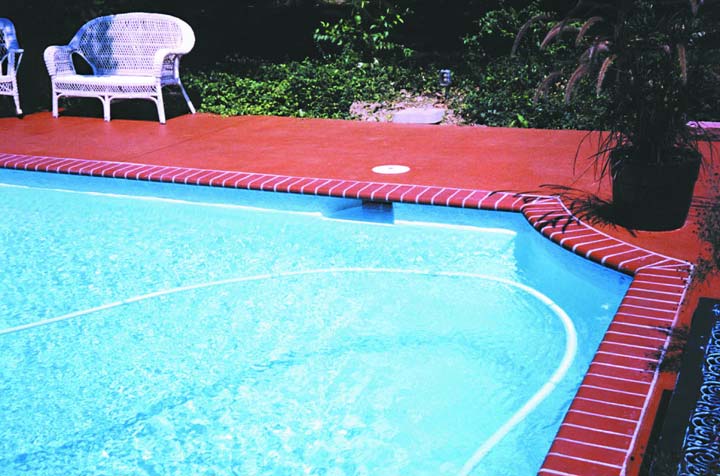
The surface must be clean, and if it was hard-troweled, opened up with muriatic acid. Taylor has developed — in cooperation with Working Chemical Solutions — a water-based, nontoxic cleaner that removes oil and grease as well as paint, glues, adhesives, etc. “I use Taylor’s Super Concrete Cleaner, about 1 part TSCC to 12 parts water,” he says. “And then scrub it and rinse it off. If it’s a hard-troweled surface, it really needs to be edged to get the pores opened. You would use a 1 to 5 muriatic acid for that.”
Ruggiero says that sufficient porosity can be achieved with an abrading pad or a power sander.
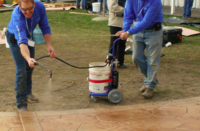
Application of the stain varies depending upon the desired effect, but most contractors prefer the relative ease of a pump sprayer. “It can be applied using a brush, sponge, watercolor techniques or an airless sprayer — an airbrush works really nicely,” Taylor says. He advises using distilled water or reverse osmosis water, not tap water, during the staining.
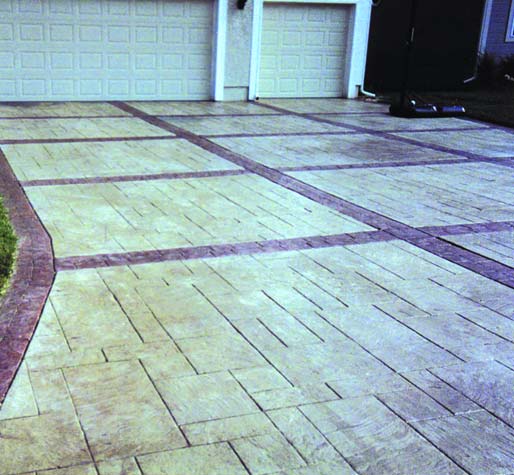
A whole spectrum of colors
While acid stains provide excellent earth tones, acrylic stains come in a hefty assortment of rich, vibrant colors. With consumers continually reaching for all things bold and bright, these stains are more than up to the challenge.
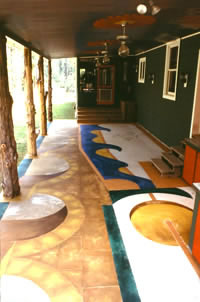
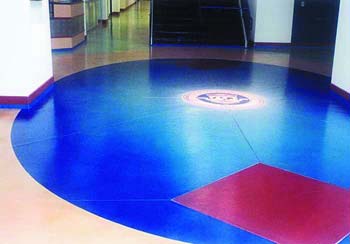
“All of the acid stains give you Mother Nature’s earth colors,” Sargent says. “We’re finding a huge niche where you have someone that says, ‘I have a day spa and I would like for it to be cobalt blue or lavender. Beauty salons, exercise centers, places where they want vibrant colors — or day-care centers where they want Disneyland red or Disneyland yellow. Now we can do that.” Sargent touts her company’s Rembrandt line of stains for such projects.
 Brunner of Smith Paint Products in Los Angeles proudly plugs the variety of colors available in Smith Color Floor stains. “We have a base range of 20 colors and we’re coming out with iridescents and pearlescents so you have metallics and different effects in pigments,” he says. “We’re also coming out with a ‘bright lights’ series, meaning your oranges, your reds, your purples and your yellows. For a specific job we can color-match anything.”
Seal the deal
As mentioned earlier, a sealer provides a hard maintenance coat that will ensure the durability of the stain. This is critical whether working outdoors or in.
“I like using a solvent acrylic sealer,” Taylor says. “If you use urethanes or epoxies you’re pretty well locked in. Let’s say you’re staining outside and the UV rays will affect it somewhat over time. With the solvent acrylic you can go in and touch it up. I recommend using a wax as your sacrificial coating rather than using the solvent as the wear surface.”
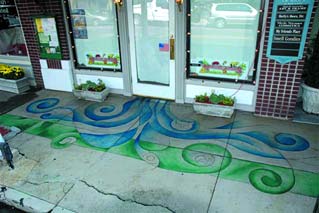
“In a high-traffic area, like a mall, you’ll want to put on a fortifier every couple of days, and in the home every month or two,” Brunner says. “With a rayon mop you can get a high-gloss seal and it will rejuvenate the floor. It acts as the maintenance coat so the traffic isn’t wearing down the sealer.”
But do all acrylic stains require a sealer? Is there room for innovation? It would seem so. Peggy Steckelberg, marketing manager of Nox-Crete Products Group in Omaha, Neb., has a solution in the form of her company’s water-repellant Acryl Pen stain.
“It’s both a sealer and a stain,” she says. “So that makes it a little bit unique. A lot of times stains require a secondary application of a sealer. This does not. It’s a penetrating combination of acrylic and silane, and it’s for horizontal broom or textured-finish concrete.”
Cleanup time
When it comes to cleaning up after the job, acrylic stains are the hands-down champs. Acid stains need to be neutralized and residue has to be disposed of properly.
 “There is a process you have to go through when dealing with acids,” Brunner says. “You have to neutralize the stain afterward with a water/baking soda wash, and that’s a hazardous waste. How you get rid of that depends on [the laws of] different states. In California, if you get caught putting that stuff down a drain, it’s a $10,000 fine. With acrylics you don’t have that step. You don’t have to neutralize.”
“Acrylic stains are environmentally friendly and exhibit ease of application and cleanup while providing an attractive appearance,” Ruggiero says. “The majority of the products sold today are water-based. However, there are a few manufacturers that still have a solvent-type stain available. Solvent-based stains are more tolerant when it comes to surface preparation, but they have a solvent odor and need to be cleaned up with solvent.”
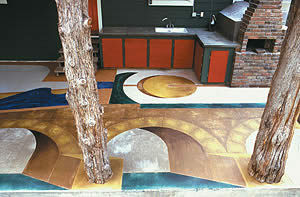
Having an environmentally friendly product also means that contractors can use acrylic stains in places where being relatively unobtrusive is critical, such as day-care centers, churches, athletic clubs and schools.
As in the case of the paint industry moving toward low-VOC products, the decorative concrete industry is finding that acrylic stains have many advantages over their acid-based counterparts. Some suggest that somewhere down the road, acrylics may even nudge acids aside.
But at least for the present, it appears that the two stains acting in concert is a fruitful combination.
“I’ve been selling acid stains since 1973, and in my opinion, I don’t see it (acrylic stains) replacing chemical-reaction stains,” Sargent says. “I see it complementing and augmenting. Almost like partners, if you will. But I don’t see it as replacing the acid stains. Someday that may be the case, but I don’t see it now.”