

 While the obvious choice is, “don’t do it,’ sometimes it’s unavoidable. Here are tips from the pros when stamping concrete in cold weather.
How much does cold weather affect concrete stamping jobs? Consider this: Some say a temperature drop of only 20 degrees Fahrenheit will double the set time of a typical slab of concrete. That’s motivation enough to make special preparations for stamping in the cold.
Freezing temperatures will slow the hydration process in a slab, extending the set time. On top of that, sunlight and rising daytime temperatures, along with wind, can cause the surface to dry faster than the colder concrete underneath, causing “surface crusting,” or splitting and cracking. The fact that stamping increases the surface area of a slab complicates things even further.
One way to get the bottom and top of a slab to set together is to draw bleed water to the surface. A pass with a wood bull float will do just that. It also won’t trap water like a finish achieved with a magnesium or metal float or trowel.
Contractors in cold-weather climates have a few more tips of their own for stamping in cold weather — beyond the idea that you should avoid it whenever possible.
Minimum temps for stamping concrete
Brad Berg, co-owner of Architectural Enhancements Inc. in Shakopee, Minn., and a former concrete contractor, says his minimum temperature for stamping was about 40 degrees Fahrenheit. “The cold does change things,” he says. “Overlays that set up in a half hour in the summer can take all day. New pours do the same but not to the same extreme. You do not want to do it if there is a chance of freezing, and if you do you stamp at seven or eight in the morning, let the sun shine on it, then cover it with insulated blankets.”
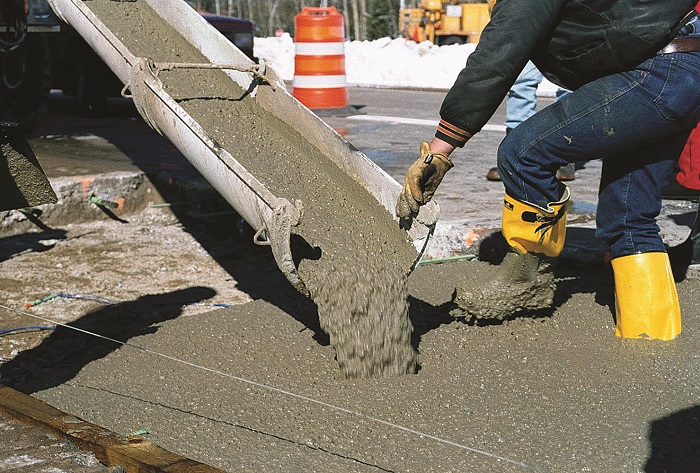
Berg’s team also used accelerants, but not often, because they could affect the color, he says.
“One thing we would do is, with large torches, heat the ground. This brings the temperature up and traps the heat under the slab, allowing for more cure time at warmer temperatures. Blanketing the ground where you’re preparing and around the surface ahead of time also helps.
“Depending on the project, you can tent it and run heaters. It all depends on the scope of the project.”
John Buteyn, technical manager with Colorado Hardscapes Inc. in Denver, Colo., says his firm will stamp in 30-degree weather.
Colorado Hardscapes workers try to limit blanket time on the concrete itself because the blanket may affect the stain, he says. They use ground heaters to thaw any frozen ground.
The use of accelerators while stamping concrete
They also use accelerators, but mainly nonchloride ones. Those don’t promote rebar corrosion like calcium chloride can, and they won’t affect color either. Calcium chloride can darken or discolor concrete, even an uncolored slab, he says. “We’ve always been told that when dealing with colored concrete, calcium chloride is going to affect that.”
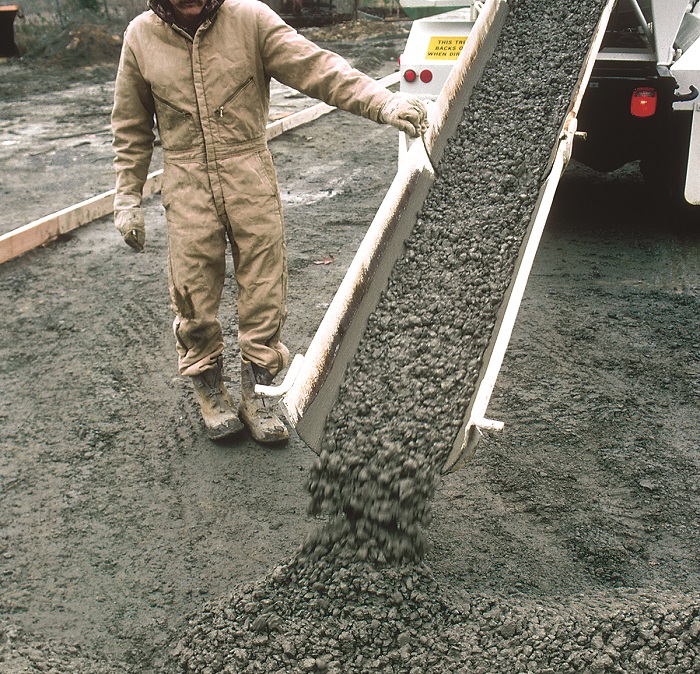
Colorado Hardscapes also counts on its ready-mix company to help with a cold-weather pour. The supplier delivers concrete mixed with water that is a minimum 68 degrees Fahrenheit. Mixing a batch with hot water instead of cold helps counteract the effects of a chilly climate. “If the water is cold, even with an accelerator you can’t overcome it,” Buteyn says.
At least two accelerating admixtures are engineered specifically for cold-weather concrete work: Pozzutec 20+, from Degussa Admixtures Inc., and PolarSet, from Grace Construction Products. Both are billed as allowing contractors to pour when the temperature is as low as 20 degrees Fahrenheit. And both are nonchloride, which means neither promotes corrosion.
PolarSet is a nonchloride admixture that accelerates hydration. The light green liquid has a special formula to shorten setting times and increase early compression strengths in cold conditions. As an accelerator, it promotes heat generation within the mixture, which helps ward off freezing in the first hours after placement. You can use it to reduce the time that concrete needs to be protected from freezing in 20-degree weather.
Pozzutec 20+ is a multicomponent water-reducing and accelerating admixture. The additive is formulated to accelerate set time and increase early and ultimate strengths in a wide range of temperatures, from subfreezing to hot. It offers superior workability and superior finishing characteristics for flatwork and cast surfaces. It also reduces or even eliminates heating and protection time in cold weather.
But while the capability of these admixtures to help concrete perform in 20-degree weather is admirable, many contractors will not stamp when it’s that cold.
Know when to say no
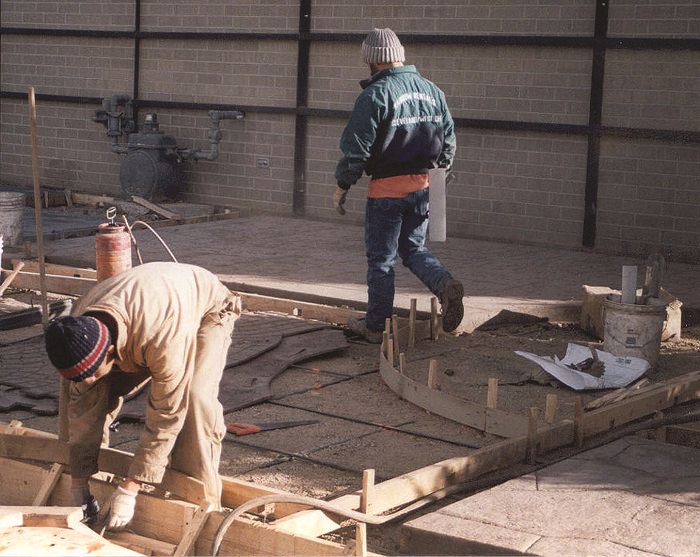
Dale Griffis II, president of Cold Harbor Building Inc. in Chardon, Ohio, says he won’t take stamping jobs if the ambient temperature will be colder than 35 degrees. It’s not just the concrete that freezes. “The physical acuity of the laborers is too diminished to do detail work,” he says.
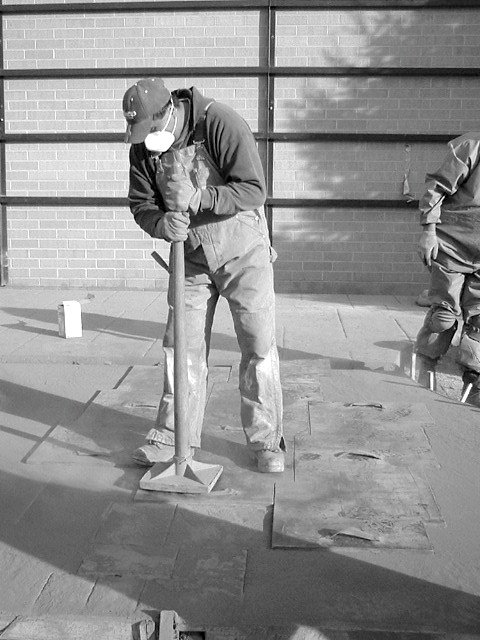
Stamping involves workers using their hands to work stamps and press borders, and there is no guarantee their hands will do a top-notch job in freezing cold weather, he says.
Rubber stamping mats also become too stiff to work in freezing temperatures. Even in 40-degree weather, when mats will perform OK, Griffis still recommends storing them with a space heater in the back of a truck. “It’s certainly a good idea to keep them warm the night before.”
Griffis prefers tenting to covering a pour with insulating blankets, because the latter will mottle the concrete.
And while he uses non-chloride accelerators, those pose challenges too, he says. “Accelerators are going to cook concrete from the inside out. The heat from hydration will be working its way out. So the inside is going to be hard, while the outside is going to be soft from the weather.”
A soft surface and harder inner core make it tough for stampers to push a stamp deep enough to make a proper impression, he says.
Questions from readers
Question
Are there any problems when stamping a concrete patio during the summer in a cold winter climate zone? Would winter temperatures damage the finished project?
Answer from Concrete Decor
The question of whether stamped concrete will hold up in winter weather is going to depend on the quality of the concrete work. Color hardened concrete improves the surface strength of the concrete, however moisture intrusion in a freeze/thaw climate can create problems.
I would recommend finishing the project with a couple coats of a good solvent-based acrylic penetrating sealer. This will allow for moisture to escape, but significantly reduce moisture intrusion.
Lastly, if you are considering stamped concrete on a driveway that is going to see occasional visits from a snowplow, I would entertain a radiant heating system, otherwise the plow will ultimately damage this kind of surface and along with it the sealant that was used to protect against moisture intrusion.