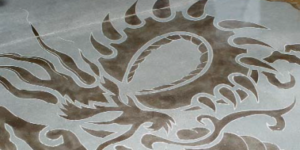


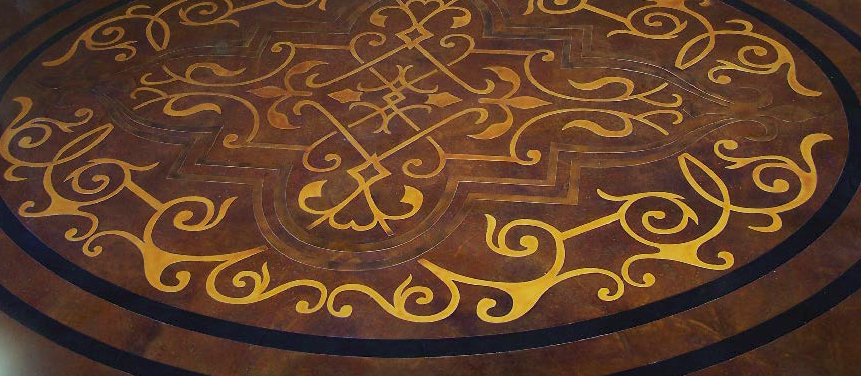
Several companies have developed polymer-modified concrete toppings formulated specifically for stenciling. Bob Harris of the Decorative Concrete Institute in Temple, Ga., says these products differ from general-purpose overlay materials in two ways — the polymers that are used and the gradations of the aggregate. “A lot of times with a traditional overlayment, maybe even a microtopping, it’s a much finer sand,” he says. “In some cases they even have ground sand, which is silica flour.” The special-purpose stencil toppings, on the other hand, generally use slightly coarser sand.
|
|
|
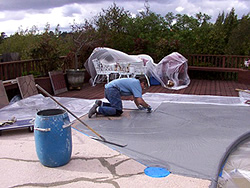
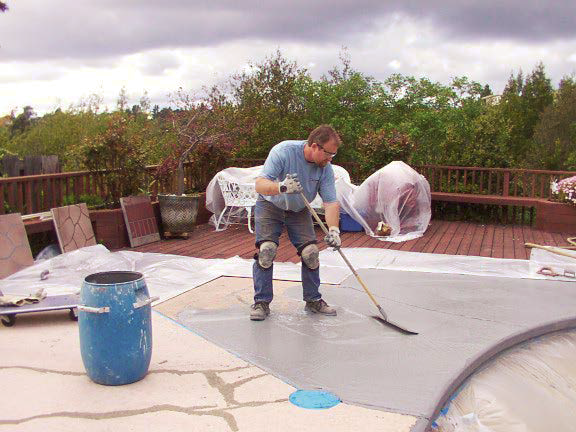
Many times, these types of products are air-applied with a hopper gun. However, some manufacturers suggest troweling as an alternative.
Application techniques and final properties of special-purpose stencil toppings differ from general-purpose overlays in several ways.
Thickness
One way stencil-grade toppings differ is thickness. “The specifically formulated ones are designed to go down very thin,” says Matt Shields of Ramcrete in Owasso, Okla. He often uses Colormaker’s Sgraffino, which is troweled on in ultra-thin coats that are less than
1/32-inch thick. More commonly, stencil-grade toppings are applied at thicknesses of 1/32 inch to 1/8 inch, compared with general-purpose overlays, which are applied at thicknesses of 1/4 inch to 3/4 inch. The stencil-grade products can be built up in layers if a thicker surface is desired.
“The thinner route is where I like to go,” says Kirk Berry of The Outdoor Living Co. in Denver, Colo. “You still have the look, but it’s not going to become an issue as far as grabbing too much dirt. It’s just more manageable to sweep or dust-mop it.” Besides, he says, “You’re saving product, meaning profit.”
Strength
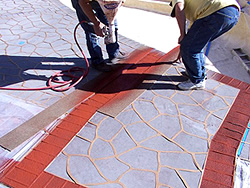 The stencil-grade toppings are formulated for strength despite the thinness of their application. “In a lot of ways, thinner is stronger,” Berry says, explaining that with a thicker buildup, there’s more chance to catch an edge with something and cause a topping to flake. Shields notes that these surfaces are also less likely to chip when they get hit.
Manufacturers claim various degrees of strength for their products. For example, literature from the L.M. Scofield Co. says that after 28 days, its Texturetop Stencil Grade has a compressive strength of 4,500 psi, which is 13 percent greater than the strength of the same company’s stamp-grade product. Literature from Specialty Concrete Products says its Stencil-Crete Overlay System develops a compressive strength of more than 6,000 psi after 28 days.
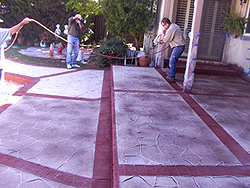 Stencil-grade products are also designed to form a strong bond with a properly prepared existing concrete surface. For instance, Stencil Systems Inc. reports that laboratory tests show its Cover-Tex overlay adheres to existing concrete with a strength exceeding 435 psi. In the tests, opposite-direction forces were applied to the tops and bottoms of three samples of Cover-Tex covered concrete. The concrete substrate failed in two instances; in the third sample, failure rates were 75 percent in the concrete and 25 percent at the bond. Stencil Systems is one of the manufacturers that recommend users prepare an existing surface with an acid wash followed by pressure-washing and a primer coat. Others recommend surface preparation by grinding or sandblasting. Cracks must also be repaired before applying the stencil toppings.
Abrasion resistance
 The polymer formulations and coarser sand of stencil-grade overlays increase their ability to resist abrasion, which can be important for areas of vehicular traffic or heavy pedestrian use.
Manufacturers of stencil-grade toppings generally tout their products as having great abrasion resistance qualities. Scofield’s technical data bulletins get specific, listing abrasion resistance test results for its Texturetop Stencil Grade. Samples of the topping and ordinary concrete, both aged 28 days, were each subjected to 1,000 cycles of mechanical abrasion by a 1,000-gram load. The stencil-grade topping lost 0.35 grams of material — 30 percent less than the concrete, which lost 0.50 grams of its surface. Although Scofield’s product can be applied as thin as 1/32 inch, the company recommends an application thickness of 1/8 inch in areas where abrasion might be a problem, in order to ensure an adequate wearing layer.
Stencil release
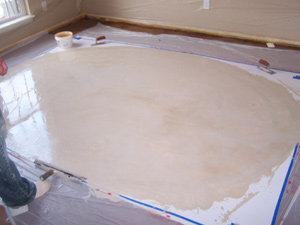
A specially formulated overlay is made to let the stencil be pulled out without tearing and catching, says Berry. “It’s just stronger, and it’s allowed to release easier.” Still, he says, skill level and timing are important to remove the stencil for the best effect. He suggests starting at a corner and peeling it off on a diagonal. “Take what it gives you at that particular time, instead of just picking it up and ripping it back,” he says. “It’s about taking care and taking your time, and that could be variant on how hard it is and what it happens to give you at that particular pour or coverage.”
Shields agrees that a good overlay material will help the stencil come up easier. The right tools are important too, he says. His favorite is a weeding tool supplied by Modello Designs. “It’s just a real sharp needle with a handle on it,” he says. “You can reach in and pluck the stencil out with it.”
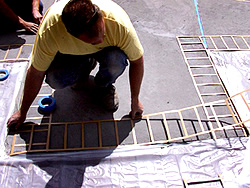
Shields uses mostly vinyl stencils, but other materials may be more appropriate for certain applications. For example, Harris explains that paper stencils may be more economical for large surfaces. “A lot of times, I’ll just make my own stencils, depending on the complexity,” he says. “I may use fabric tape, which is a tape that doesn’t break when you remove it once the material is sprayed over it. Or I cut simple shapes out of plywood or masonite and use them as templates.”
The general-purpose alternative
Installers who use special-purpose stencil toppings seem to appreciate their advantages. On the other hand, some stencilers are satisfied with general-purpose overlay materials. “I’ve not used anything that’s been specially formulated for stenciling,” says Jeremy Monroe, a technical advisor with Decorative Concrete Impressions, a manufacturer of adhesive poly stencils located in Webb City, Mo. “We’ve used general-purpose bag mixes and different polymers from a variety of manufacturers. There are some differences, but there are a lot of good quality general-purpose toppings out there.” He cautions, though, that they must be applied in a thinner layer than usual for stenciling. “The biggest consideration is to not bury your stencil so deeply under your topping that it is difficult to pull it out afterwards,” he says.
 Monroe adds that what matters most is that the installers know how to use each product and how to deal with ambient conditions such as temperature and humidity. “It’s absolutely critical that you always keep in mind the specific circumstances of where you’re working, because every day and every job is different,” he says. “And every topping is different too. How quickly they will cure and set up dictates when you will pull that stencil out. That’s the case with most of the concrete world — timing is the key.”