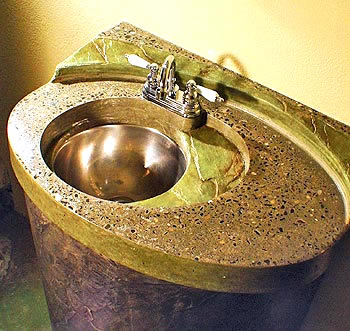
The sink’s designer, Toledo, Ore., artist Michael Dahl, took first prize in the contest, held in April and sponsored by TechFab LLC.
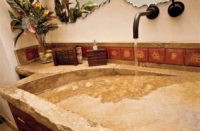
Dahl’s winning sink top has three concentric layers that suggest an egg sliced in half. The primary surface is gray exposed aggregate, while a lower level and most of a back ledge are colored and textured to resemble greenish jade slate. Embedded flecks of stainless steel and hand-blown funnels of glass give the piece a bit of flash.
The sink’s concentric ovals are a motif that appeals to Dahl. “I’m just really big into the ovals and symmetry,” he says.
 |
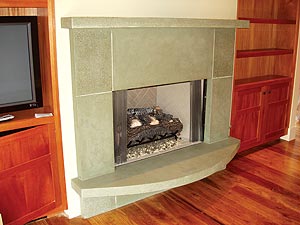 |
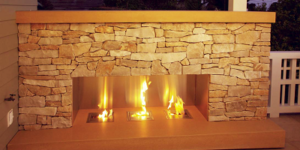
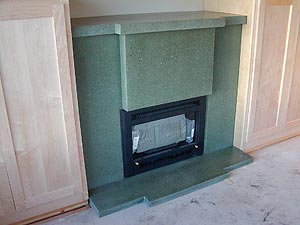
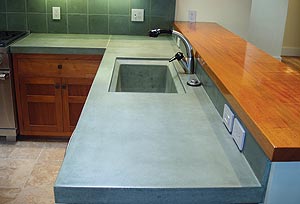
Concrete, based in Moss Landing, Calif., for work he performed at a home in Carmel, Calif. The project consisted of dark sage green kitchen countertops and two Craftsman-style fireplaces, one dark green and one with a variegated gray finish.
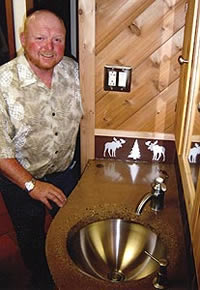
John Cox of Cox Decorative Concrete, a Clifton, Ill., company, came in third with an apricot-colored bathroom sink top that features a curved outer edge and tapered basin lip. The edge and basin lip were finished without a slurry mix, giving them a rougher look than the countertop. A commemorative NRA coin and a piece of polished stone accent two corners of the piece.
 |
 |
The winners were selected by a team of three judges: Bent Mikkelsen, publisher of Concrete Decor magazine; Michael Smith, founding partner of Equus Design Group; and Lauriel Leonard, Allied ASID, Dex Studios.
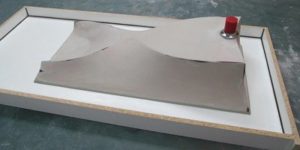
TechFab sponsored the design competition to showcase the best and brightest the decorative concrete industry has to offer. Contestants were told to create an original concrete countertop, vanity, tabletop or architectural décor product for a residential or commercial application using TechFab C-GRID materials. C-GRID is a high-strength carbon grid that controls cracks but is stronger and lighter than steel. C-GRID can be used in place of, or along with, steel mesh and light rebar. Unlike steel, carbon grid can be placed just below the finished surface and allows for thinner, lighter countertops.
Dahl, the award-winning artist, began working with small concrete slabs and foundations in 1994. He started designing, building and creating with concrete in earnest in 1999, incorporating ideas from the fields of graphic design, sign manufacturing, mold-making and concrete fabricating. In addition to his concrete work, he owns and operates a sign and screen-printing shop.
TechFab LLC is headquartered in Anderson, S.C., and manufactures structural grids, adhesive-bonded nonwoven scrims and scrim composites. Its products are used for cement and concrete reinforcement, roofing systems, high-performance sail cloth and infrastructure repair and rehabilitation products. More information about the company can be found at www.techfabllc.com.