Concrete Decor Archives
pg 2 of 2
stamped driveway


…continued from previous page

From Slump to Stamp: creating better impressions
How to get the best results from stamping concrete
by Denise Wendt

Tool selection, use can help reduce repeats
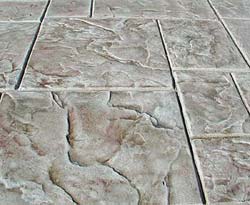
Some stamps, such as a European fan pattern, are designed to be used throughout an entire pour, repeating over and over again. But a visible repeat, in an ashlar slate for example, is undesirable. For such a project, use a 3-pattern stamp, with patterns labeled A, B and C or blue, gold and red. “The different colors dictate a different rock pattern to help you reduce the look of using a mold.” says Sacco. Interchange these three different patterns frequently throughout the slab.

Smith avoids unwanted lines by turning some patterns 45 degrees. “A pattern, such as ashlar slate, that isn’t intended to be a straight-line pattern becomes a straight-line pattern when you start stacking it,” says Smith. “The way to get around that is to turn it on a 45 degree angle and all of a sudden all those lines disappear.”

Bands and borders can also break up noticeable lines that develop on large areas. “Hide” control joints by incorporating them into the design with complementary bands and borders, suggests Leland. “Banding with a contrasting color or texture will help break up a large field,” says Riggs.
Borders can also help downplay slight color variations that can result from different pours.

stamped sample
Above: Ashlar slate with a visible repeat.
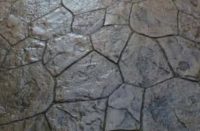
Below: Running the pattern at a 45-degree angle eliminates unwanted lines.
stamped sample

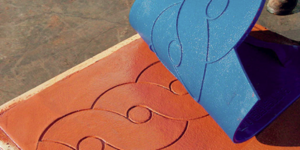
Sacco uses Creative Images tools to cover larger pieces of ground with fewer placements of the mat. The larger Creative Images stamps can break up noticeable lines that develop on large areas. Note that two men must lift these larger stamps simultaneously to avoid scrubbing the surface of the concrete.

Admixtures can also help
Admixtures do many different things and some can help minimize the problems that can occur when stamping concrete.

Calcium chloride and Polar Set accelerate set time and allow the bottom of the pour to dry at the same rate as the top, promoting a good stamp. Polar Set doesn’t have any adverse effects with rebar while some colors are adversely affected by the calcium chloride. So consider your job when choosing an admixture.

“Fritz-Pak makes good admixtures that you can add on the job site,” says Ralston. This is especially useful when the site is hotter or windier than where you started that morning. “Fritz-Pak step retardant can give you the extra time you need in those conditions,” he says.

Riggs uses admixtures to control set times and water cement ratios. But watch out for crusting and surface cracking with some high-range water reducers.

Riggs likes to use dry shake color hardeners, which offer a broad range of coloring options. “Installers need to apply the hardeners evenly to avoid clumps and wet and dry spots,” says Riggs.

“Some detailed stamps require a creamier cement,” says Smith, who adjusts for this by adding a little color over the top of the cement. “The extra color gives the concrete a slightly fattier surface or a creamy base,” says Smith.

Tamping tips
Tamping well requires practice and experience. Our pros had these tips on which tools to use and how to use them.

“We like to use the tamper because it allows us to use different amounts of force to address the areas of the slab that have not set up consistently,” says Riggs.

Leland uses a tamper to remove footprints.

Smith usually uses a square tamper, but some jobs require a different approach. “If we’re doing a driveway or pool deck that has a drain basin, even the standard 10x10-inch square tamper will leave an outside impression.” Then he turns to a thin, 8-inch round piece of plywood to tamp down the stamp. “When you get into different elevations or when the slab tends to roll up and down, you want to try a different method.”

Sacco uses 2x10 or 2x12-inch pieces of lumber to seat his mats. “When the concrete is very fresh, we’ll lay the mats out, keeping them as tight as possible. Then instead of stepping on the mats, we’ll lay a strip of lumber down and walk on that, distributing our weight more evenly.” He uses two pieces of lumber, putting one in front of the other, and leapfrogs from one to the next.

Training
All our professionals agree that training is crucial, whether you’re a veteran of the trade or just starting out.

“If you are not constantly learning in this business you are in big trouble,” says Riggs. “Since 1970 we have placed literally millions of square feet of stamped concrete and every day is a learning experience.”

“Training is extremely important,” agrees Ralston, who also teaches pattern stamping and acid-staining techniques around the country. “Any seminar you can send a person to is beneficial. You will always learn something and they can make good networking connections when attending seminars.”

Twenty-five-year concrete veteran Smith says you’re never too experienced to learn something new. “Wherever I can get my hands on a good training course, I still go. There are constantly new techniques, new chemicals coming out and new ways to apply color.”

 
This Issue
Concrete Decor, Vol. 2, No. 4
December/January 2003
 

Stay informed!
Enter your e-mail address
and subscribe to the
Concrete Decor Newsletter.


Related Readings
Basics of Stamping
Release Agents
Choosing the Right Aggregate
Polymer Modified Cements
Stamping Tools
Hot Weather Stamping
Surface Preparation
Coloring Stamped Concrete
Concrete Skins
Stamped Overlays
Fiber Reinforcement
Micro-Toppings
Embossed & Embedded Images
Color Hardeners
Concrete Sealers
Early-entry Cuts for Decor
Secrets for Better Stenciling
Using Admixtures
Aggregates
Recipe for Success
Black Pigments
Poolside Rehab
Brushed Finishes
Integral Color for Ready Mix
Slump Stump
Other articles in this issue
Concrete Stamp: From Slump to Stamp
Los Angeles Cathedral: Concrete Color
Concrete Coatings: Epoxies
Control Joints in Concrete
Decorative Walls & Caps
Communication with Questions
Contractor Profile: Airspeed Skateparks
Concrete Industry News
Project: Las Vegas Concention Ctr
Product Profiles
Product News
Decorative Concrete Tip